
Israel agrees to ease some restrictions
JERUSALEM – Pressed by visiting Secretary of State Condoleezza Rice to take steps on the ground to bolster peace negotiations, Israel announced plans on Sunday to ease some restrictions on Palestinian movement in the West Bank and allow the Palestinian Authority to post hundreds of additional police officers in the town of Jenin.
After a three-way meeting in Jerusalem among Rice, Israeli Defense Minister Ehud Barak, and Salam Fayyad, the prime minister of the Palestinian government in the West Bank, Barak’s office said that about 50 earth roadblocks hindering travel between some West Bank cities would be removed, and a checkpoint that restricts movement between Jericho and Ramallah would be opened.
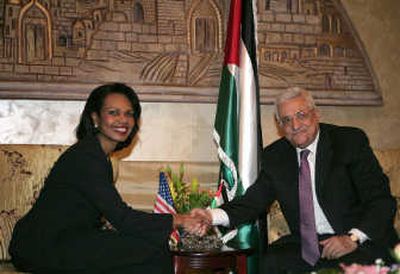
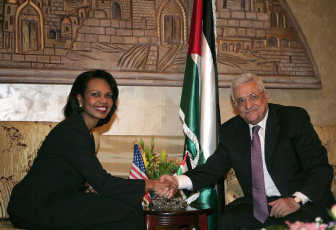
Similar pledges have been made in the past with limited results, and Rice, who shuttled between Israel and Jordan to hold talks there with Palestinian President Mahmoud Abbas and King Abdullah II, gave no indication of progress in negotiations on the core issues of a permanent peace agreement.
Rice is on a three-day visit to the region, her second this month, to boost peace efforts that have stalled since they were re-launched in November at a U.S.-hosted Middle East conference in Annapolis, Md.
She urged “meaningful” action to improve daily life and economic conditions for ordinary Palestinians in the West Bank and called the steps announced Sunday “a very good start” in meeting commitments under a U.S.-backed peace road map.
“There has not been enough momentum,” she said. “This is a start in terms of delivering on some of those obligations.” Rice said she expected the announced steps to be taken “very soon,” and that “we will be monitoring and verifying” that they indeed take place.
A State Department statement said that in addition to removing the 50 roadblocks, the Israelis would take “immediate steps to upgrade checkpoints to reduce waiting time without sacrificing security.”
According to the United Nations Office for the Coordination of Humanitarian Affairs, there were 580 Israeli obstacles, including checkpoints, earth or concrete roadblocks and gates, hindering Palestinian travel in the West Bank as of February, an increase over previous years.
Israel says the obstacles, restricting access to roads used by Jewish settlers in the West Bank, are a security measure meant to prevent attacks. Palestinians say the web of travel restrictions has crippled their economy and seriously hindered access to schools, jobs and medical care.
Samir Abdallah, the planning minister in the West Bank government, called the Israeli moves “small steps,” and said major checkpoints causing the most serious bottlenecks should also be removed. But Barak has balked at removing those checkpoints.
Barak’s office said that an additional 700 Palestinian police officers, trained in Jordan, would be allowed to deploy in the Jenin area “to enforce law and order,” but Israel would retain “supreme security responsibility.” The State Department said the Palestinian Authority would “work to prevent terror.”
A similar deployment in Nablus, a West Bank city that is a militant stronghold, has had mixed results, with Palestinian officials asserting that continued Israeli army raids there have disrupted security efforts and undermined the authority of their forces. Palestinian police patrol Nablus by day, but Israeli forces have occasionally raided the city at night, searching for militants and arms.
Mark Regev, a spokesman for Israeli Prime Minister Ehud Olmert, said that “improving the quality of life of the Palestinians on the West Bank is an integral part of a successful peace process,” but that there were still “real threats to the Israeli public from hard-core terrorist cells in the West Bank.” He cautioned that an upswing in attacks could undo the measures announced Sunday, which include the transfer of armored vehicles, cars and logistic equipment to the Palestinian forces.
Barak’s office also announced steps to help the Palestinian economy, including construction of a Turkish-funded industrial park near the West Bank’s border with Israel, new housing projects for Palestinians, an international investment conference in Bethlehem, and raising the quota of Palestinian construction workers and businessmen allowed into Israel.