
‘08 Dodge Challenger hits the streets
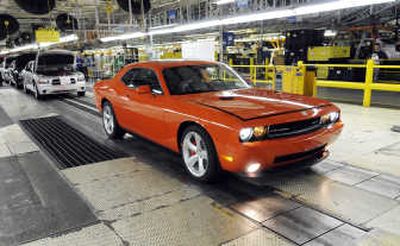
BRAMPTON, Ontario – The 2008 Dodge Challenger began rolling off the assembly line Thursday into an uncertain market that could embrace the nostalgic muscle car or reject it for its gas-guzzling excess.
Chrysler LLC celebrated the launch at its 2.95 million-square-foot Brampton Assembly Plant, where the Challenger shares the assembly line with the Chrysler 300 and Dodge Charger sedans.
Chrysler has already sold all 6,400 of the 2008 Challengers it plans to make for the U.S. market as well as several hundred for buyers in Mexico and Canada. Spokeswoman Kristin Tyll said Chrysler will begin taking orders for the 2009 Challenger in the next few weeks.
“From my perspective, it’s the ultimate halo vehicle,” said Reid Bigland, president and chief executive of Chrysler’s Canadian operations. “The attention this product gets is like nothing I’ve ever seen.”
But even Bigland says it’s hard to predict how long that demand will last. It’s a difficult time to be launching a $40,000 car with the fuel economy of a large sport utility vehicle. U.S. auto sales were down 8 percent in the first four months of the year as the weak U.S. economy took a toll on consumer confidence.
At the same time, gas prices nationally reached a record high of $3.62 per gallon last week and could climb to $4 per gallon in the coming weeks. The 2008 Challenger gets 13 miles per gallon in the city and 18 on the highway, the same as Chrysler’s largest SUV, the Dodge Durango.
Alexander Edwards, who heads the automotive division of the San Diego-based Strategic Vision consulting group, said most potential buyers want the Challenger for its performance and don’t consider it a commuter vehicle, so gas prices shouldn’t affect sales. But sales could be dampened because of the economy, as potential buyers juggle mortgage payments and the tougher credit environment.
The Challenger could also cement Chrysler’s reputation as one of the most gas-hungry automakers. Chrysler relies on trucks and SUVs for 70 percent of its U.S. sales, compared to 41 percent at Toyota Motor Corp. and 58 percent at General Motors Corp.
Sales of those larger vehicles have been plummeting this year and Chrysler’s fortunes with them; Chrysler’s U.S. sales were down 18 percent in the first four months of this year, a decline matched only by Mitsubishi Motors Corp.
Chrysler tried to temper that image this week by offering buyers a new incentive that caps the price of gas at $2.99 per gallon for three years. But the Challenger isn’t eligible for that program.
Chrysler hopes to replicate the success of another nostalgic muscle car, the Ford Mustang, which was a runaway hit after it was introduced in 2004. The Mustang racked up 166,530 sales at its peak in 2006, although sales have fallen significantly as the vehicle ages.
Rebecca Lindland, an auto analyst for the Waltham, Mass.-based consulting company Global Insight, said this could be one of the last gasps for V-8 powered muscle cars before tougher fuel economy standards take effect.
“Some people will be appalled by it. But there’s a portion of the market that’s appalled by the Prius too,” she said. “This is a fashion accessory. It’s not intended to be a practical appliance. This is the type of vehicle that the American marketplace really thrives on and was built on.”