
South Hill bungalow kitchen remodel

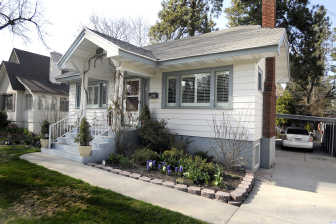
When Richard Imbler was looking at houses in Spokane, a little bungalow steps away from Manito Park caught his eye.
But the idea of a two-bedroom bungalow wasn’t what he and his wife, Susan, had in mind. With four grown children, they needed some space.
“We knew we wanted a home large enough for the grandkids to run around in,” he said.
So he kept looking. After driving by the house about 12 times, his real estate agent told him he should take a look at it.
That’s when Imbler remembered that you can’t judge a house’s square footage by its exterior.
Turns out that “two-bedroom bungalow” sported a full basement and a large, unfinished attic. Unfortunately, it contained one awkward and ugly kitchen.
The 1927 home had last been updated sometime in the 1950s. The whole house needed work, but it’s the kitchen that takes center stage.
Previously, the kitchen had been closed off from the dining room by a wall and a swinging door. There was a small mudroom to one side and a breakfast nook on the other. The actual kitchen space was L-shaped and had a drop ceiling held up with wires.
“We knew we wanted to take out the wall and make (the kitchen) part of the house,” Imbler said.
So they did that. And much more. The entire main floor – living and dining areas, kitchen and two bedrooms – was gutted. The kitchen was ripped out down to the studs. A total do-over.
In the place of that awkward kitchen now stands a light, bright and open space that flows into the dining area. The yellow, country-cottage kitchen absorbed the mud room and nook. A large center island offers work space, seating for three and storage. Above it is a combined pot rack and light fixture. Built-in shelves display cookbooks and knick-knacks. Two skylights and large windows flood the room with natural light. Beveled corners on the countertops help make the kitchen more child-friendly, with few sharp edges to bash little heads into.
As anyone who has remodeled their kitchen knows, getting from ugly and awkward to open and functional takes a lot of time and money.
The first things the Imblers did when they relocated from the Seattle area to Spokane four and a half years ago was move into the basement. The laundry room became a makeshift kitchen; the washer and dryer, her countertops.
“We lived in the basement for two years,” Sue Imbler said. “We had Thanksgiving dinner there. We had company come and stay.”
Her husband added, “It’s an amazing woman who can live through a kitchen remodel.”
Once they settled in the basement, the couple began work upstairs. But rather than concentrate on just one room, they took a whole-house approach to the remodel. They had to. Among other issues, the house still had the original wiring, which Richard Imbler called “burst-into-flame” wiring. Instead of tackling that project piecemeal, they rewired the whole place at once. An upstairs guest room was finished first.
But after a couple of years intermittently working on the kitchen themselves, Sue Imbler decided to move the project along. They hired a contractor.
“After two years, I said, ‘I can’t wait 10 years for a kitchen,’ ” she said.
When it came down to choosing the kitchen’s appearance, “Susan knew she wanted something that would fit the rest of the home,” her husband said. That meant the cottage look – wainscoting on the walls, a light buttercream yellow paint (called “Belgian waffle”), red accents, and a smattering of sheep, chickens and cows.
“I just love the cottage look,” she said.
They put a lot of thought into the details. There are deep drawers for pots, and narrow, pullout shelves for spices. Near the back door, there’s a built-in bench with a lift-up seat for storage. Grounded electrical outlets pop out from multiple spots on the wall.
“Can you tell our last kitchen didn’t have enough outlets?” Sue Imbler asked.
Now that they’ve lived and cooked in the kitchen for about 18 months, they know what they’d change.
“I wouldn’t do a thing differently,” Susan Imbler said. “I love it. We will never move out of here.”
All their work resulted in their ultimate goal – to make the kitchen part of the house.
“It’s where we are when we have the grandchildren over,” Richard Imbler said. “They do their homework at the island while we cook.”
“It is,” he added, “a happy place.”