
The view has truly changed
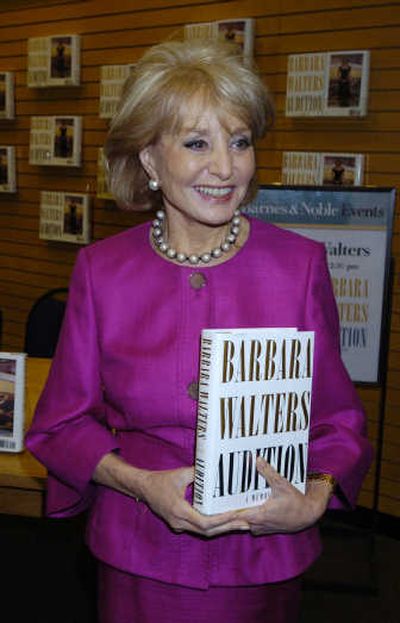
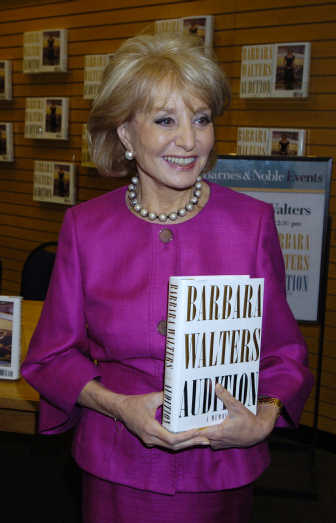
NEW YORK – It’s hard to imagine now, with a dozen photographers snapping away and hundreds of people lined up at a Broadway book signing, that Barbara Walters once considered herself a flat-out failure.
“I would sit in the makeup room and cry,” she says, recalling her unhappy stint as co-anchor of ABC’s evening newscast. “I thought they might ask me to resign.”
To her boyfriend at the time – the future Fed chairman, Alan Greenspan – “every night I would wail, ‘My career is over.’ … I must have been enormously boring, and he put up with it.”
But others were not so kind. For all her success as a woman breaking television barriers, Walters’ life, as recounted in her new memoir “Audition” (Knopf, 624 pages, $29.95) has been buffeted by a long line of men behaving badly.
There were the three husbands who became ex-husbands, the reporters who wouldn’t accept her as one of the gang, the anchors who openly balked at sharing the limelight.
When Frank McGee took over as host of the “Today” show in 1971, he told NBC executives that Walters could continue to sit at the anchor desk if her role was limited to conducting “girlie” interviews – and the management men agreed.
Walters’ protests led to a compromise: She could pipe up after McGee had asked important newsmakers three questions. If there was still time, that is.
“You’d think we were talking about the 1800s, when women were subjugated,” Walters says in a hideaway office at the huge Barnes & Noble, resplendent in a brightly colored dress, elegantly coiffed and made up, regal but approachable.
In her pungent voice – a dead giveaway when she’s trying to be anonymous on the weekends – Walters says just enough and no more, as if the cameras are on and a commercial break is approaching.
She whips out a gold credit card to buy 10 copies of the book, because some of her friends are perturbed at not having received a signed copy.
What emerges from “Audition” is a tenacious 78-year-old woman who, despite occasional mistakes, has managed to overcome every setback in achieving her exalted status as veteran journalist, celebrity interviewer and world-class yenta.
In true tell-all fashion, she details her strained relations with her father (a Broadway producer who once attempted suicide); her sister (who was developmentally disabled); and her daughter Jackie (who as a teenager was sent away to a boarding school to battle a drug problem).
In the most shocking confession, Walters admits to a 1970s affair with the married, African American Sen. Edward Brooke – a liaison that could have wrecked both their careers had word leaked out.
Walters wasn’t successful at marriage. Her first, to businessman Robert Katz in 1955, lasted three years. Her second, to theatrical producer Lee Guber in 1963, lasted 13 (they adopted Jackie after three miscarriages). The third, to Lorimar Television CEO Merv Adelson in 1986, lasted six years.
And there were the near-misses. Roy Cohn, the shady ally of Sen. Joe McCarthy, proposed, to her astonishment. In the ‘70s she dated investment banker Alan Greenberg – overlapping with her relationship with Brooke – and Greenspan. And then there was future senator John Warner, who went on to marry Elizabeth Taylor.
She and Brooke talked about getting married; he divorced his wife and, when Walters broke it off, wound up marrying someone else.
Although Brooke did not object when Walters wrote him that she planned to spill their secret, why did she go public now?
“I thought, in a way, it was history,” she says.
But her motivation also touches on Walters’ sense of her public image.
“I think there is this feeling that I am somewhat austere and I ask all the questions,” she says. “I thought, well, let people know I have a human side and had a few interesting romances.”
Walters, a Boston native who graduated from Sarah Lawrence College and started out in public relations, was hired as a “Today” writer and producer in 1961 and got a few on-air opportunities, including an assignment to follow Jackie Kennedy to India and Pakistan the following year.
But Don Hewitt, the future “60 Minutes” producer, told her she’d never make it on the air because she didn’t “have the right looks” or pronounce her r’s right.
Still, in 1964 she joined Hugh Downs – a former game-show guy who became a “Today” host (and was reunited with Walters on “20/20” decades later) – as a sidekick, for $750 a week.
Over time Walters began landing high-profile interviews, including a 1971 sit-down with Richard Nixon, and hosting a talk show she renamed “Not for Women Only.”
But she felt she had little leverage when McGee joined the show and made her life miserable.
“I couldn’t go in and demand anything,” Walters says. “I had to somehow make sure Frank didn’t get me fired, which he would have if he could have.”
When McGee died of cancer in 1974, Walters became the first woman to co-host a network morning show.
In 1976 she agonized over an offer to co-anchor the “ABC Evening News,” eventually succumbing to the notion that she would again make broadcast history.
The move was a disaster. Co-anchor Harry Reasoner made little effort to hide his hostility.
During a break toward the end of their debut newscast, Reasoner told her: “I’ve kept time on your stories and mine tonight. You owe me four minutes.”
It was no joke; his pals in the crew would use a stopwatch, and he would demand longer pieces to match hers.
Walters sometimes took herself too seriously – she initially hated Gilda Radner’s “Baba Wawa” impression on “Saturday Night Live,” though she came to appreciate it after meeting Radner – and could give her critics ammunition.
She ended a 1976 interview with the newly elected Jimmy Carter by beseeching him, “Be wise with us, Governor. Be good to us.” She admits she deserved the mockery that followed.
Perhaps her greatest triumph, in 1977, was landing an extraordinary joint interview with Anwar Sadat and Menachem Begin before the Egyptian and Israeli leaders made peace.
Her biggest blunder, in 1986, was briefing Ronald Reagan on information involving American hostages she had gotten from Iranian businessman Manucher Ghorbanifar, without telling her bosses. She was stung, she writes, when ABC News publicly reprimanded her after the news came out.
Walters, primarily known these days for her all-women gabfest “The View,” has interviewed everyone from Fidel Castro to Saddam Hussein to Monica Lewinsky to Martha Stewart (“Martha, why do so many people hate you?”). Last year she considered a sit-down with O.J. Simpson before deciding she didn’t want to help him sell books.
By the end of her own book it’s clear that Walters is friends with just about everyone. She pals around with Michael Douglas, whom she has interviewed several times, and his wife Catherine Zeta-Jones. She takes vacations with Oscar de la Renta and parties with Queen Noor.
Has that undermined her on-air role?
Chatting up stars is different than interviewing politicians, Walters says. With celebrities, she says, “You’re doing them a favor, but they’re doing you a favor. You want them to be comfortable and open up.
“My way of doing that is never to attack. I often start by asking about their childhood, and that’s when they cry.”