
Online tutoring is growing, but not right for every student

With the end of the school year and term papers and final exams looming, online tutoring can sound like a parent’s dream – a private tutor in the comfort of their home (or their child’s dorm room), available 24-7.
No one knows how many students use online tutoring services, but enough are achieving – or trying to achieve – better grades with help from an online tutor to make it a $3 billion-$5 billion industry.
But educators caution that online tutoring is only as good as the effort students put into it. Some students respond favorably to the online method of learning; others aren’t going to learn without a face-to-face conversation.
“All kids learn differently, and online may not be the best learning style to meet their needs,” said Doug Pratt, communications director for the Michigan Education Association, the state’s largest teachers union.
“Experiencing an online class or tutoring can be very valuable, especially as these students prepare for 21st-century jobs, but we have to be careful that – first and foremost – we’re meeting their academic needs.”
There is no independent measure of the growth of the online tutoring industry, but TutorVista.com President John Stuppy said demand for services has more than doubled in the past 18 months.
The growth in online tutoring is fueled in part by the No Child Left Behind law, which emphasized on standardized testing in schools. It’s also fueled by today’s students being more comfortable online than their predecessors.
But the biggest reason is probably that it is convenient, said Ian Wissman, senior vice president of consumer marketing for Tutor.com, one of the oldest and largest tutoring sites.
“People are used to doing a whole lot of their activities online,” Wissman said.
Manjula Kavadi’s two children, first-grader Monica Kandela, 6, and fifth-grader Gauthem Kandela, 10, were going to an in-person tutor. A friend told Kavadi about online tutoring. She signed her children up for math, English, science and geography with TutorVista.
She said she’s happy with the online tutoring and appreciates not having to drive her kids around. “I don’t have to go anywhere. I can watch the kids doing the class and listen to it on the speaker.”
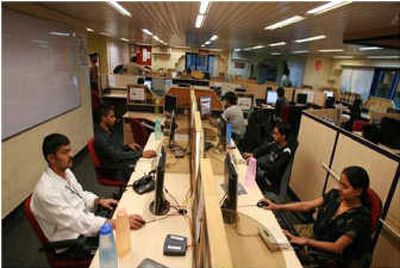
TutorVista is typical in that most of its tutors are overseas. That can give some parents pause, Stuppy acknowledged. But the real issue to consider, he said, is time and money.
Stuppy said his tutors are fluent in English and extensively trained. He added that he attracts a highly educated work force because in India online tutors can earn twice as much as classroom teachers. But they cost far less than American tutors. And using tutors worldwide makes it easier to offer classes 24 hours a day.
Wissman said his company relies on tutors from India for chemistry and physics because he can’t find enough qualified instructors for those subjects in the United States.
Pricing varies by company. Tutor.com, for example, charges by the minute – 50 minutes for about $30; TutorVista charges about $100 a month for unlimited tutoring.
Online tutoring may not be right for every student, however. Some students need to hear their lessons, rather than read them, said Sonja Marquis, owner of Club Z In Home Tutoring. Teachers who can’t see students “can’t pick up on nonverbal cues,” Marquis said. “If you have an interaction where you’re going back and forth for questions and answer, then are they pausing because they’re typing slowly or are there questions that haven’t been answered?”
Cheating also is a concern. Online tutoring companies say they guard very carefully against it. “Our tutors just won’t give you an answer,” Wissman said. “We ask probing questions; we ask familiarity with formulas, so we help them get to the answer themselves.”