
John Blanchette: Memorial Cup stirs Cox’s memories
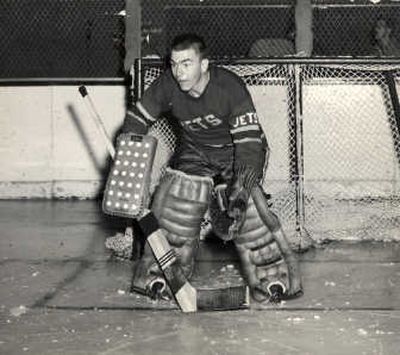
This much Dave Cox knows: If it were his Kitchener Rangers that the Spokane Chiefs were to play on Sunday afternoon, the engravers could start lettering the Memorial Cup right now for shipping back to Spokane.
“We were,” he said with a laugh, “absolutely terrible.”
But the memories, even 45 years later, are still good – revived as they are by the television images being beamed back this week from Kitchener, where the Chiefs are a victory away from the biggest prize in junior hockey. Dave Cox has been at home watching, wearing a red Chiefs sweater and a Rangers hat.
OK, a New York Rangers hat. Close enough.
He was, once upon a time, under contract to them, and it was the Rangers who – after his year in Kitchener – gave him the choice at the age of 20 of being shipped out to play for the Long Island Ducks or the Spokane Jets.
“I didn’t want to go to New York,” Cox said, “so I’ve been here ever since.”
That included 10 seasons in goal and two Allan Cups for the old senior amateur Jets and a real-life career as a plumber, from which he retired three years ago. But he still makes the hockey highlights on the local news almost every night – he’s a goal judge at Chiefs games, proprietor of the red light he used to hate to see flash over his shoulder.
And in Kitchener, Cox saw it a lot.
“Other teams averaged 50 shots a game,” he recalled. “Our record was something like 9-41-6 – and I was the co-MVP.”
He’s lucky he wasn’t DOA. This was the 1963-64 season, before goaltenders wore facemasks.
“In those days, goalies were men,” he said. “Or we were just too dumb to know any better.”
Cox grew up in Selkirk, Manitoba, on the Red River, along with future Jets teammate Don Scherza. After playing for a Winnipeg team in the Manitoba Junior Hockey League, he became one of the early “inter-branch transfers” when he was assigned to Kitchener in what was then the Ontario Hockey Association.
“It all sounded very exciting,” Cox said.
So is facing a firing squad, in its own way. The Rangers – they were, in essence, owned by the NHL club until such arrangements were outlawed in 1967 – were in the process of being transferred themselves, having very nearly gone under a few kilometers away in Guelph. But the Kitchener enthusiasts staged a strong season ticket drive and spirits were high when the Rangers beat St. Catharines 4-3 in the season opener.
“And I can’t remember when we won another game,” Cox said.
He does remember one – a 2-1 victory over the Montreal Junior Canadiens who, yes, played in the Ontario league in those days. Cox stopped future Hall of Famer Yvan Cournoyer on three breakaways.
“I played against a lot of good hockey players,” he said. “Bobby Orr was in the league. Dennis Hull. Peter Mahovlich, Freddy Stanfield. I put a lot of guys in the Hall of Fame that year.”
And one he wasn’t going to knock out – Jacques Plante.
The great Canadiens goaltender had just been traded to New York for the 1963-64 season, but was fighting regular asthma attacks – and came down with one just before the Rangers were to play in Toronto. Cox was summoned from Kitchener as an emergency fill-in.
“So they fly me to Toronto and I’m scared out of my wits,” said Cox. “There’s Plante getting dressed so I walk over and put my stuff next to him and say, ‘I hear I’m supposed to play goal tonight.’ He glares at me and says, ‘(Bleep) off, kid, you’re not taking my job.’
“I didn’t have a comeback for that.”
Cox continued to go to training camp with the New York team after moving to Spokane, but already he was aware that his prospects were limited.
The Rangers wanted a minor-league backup to Gilles Villemure, who was enduring a long grooming himself for NHL stardom.
“But I was making more money in Spokane than what I would have been getting in the old Western Hockey League,” he said. “So after that they canned me. It was hard to make NHL teams in those days – there weren’t many of them. Of course, there was a reason we were in Spokane, too – we weren’t good enough.”
Yet they were good enough that the Jets finished first in the old Western International Hockey League eight of the 10 years Cox was either the regular goalie or split time. He was 32 when he finally retired.
“After a while, you weren’t making that much money and the puck started hurting,” Cox said. “Our equipment was not that good. The masks we wore, all they did was stop you from getting cut. I had one of those flush facemasks and took a shot one time and vomited inside it.
“That’s when I thought to myself, ‘I think this is my last year.’ “
Of course, there were times during those 50-shot assaults in Kitchener when he must have thought the same thing.