
36 days in 2000 election
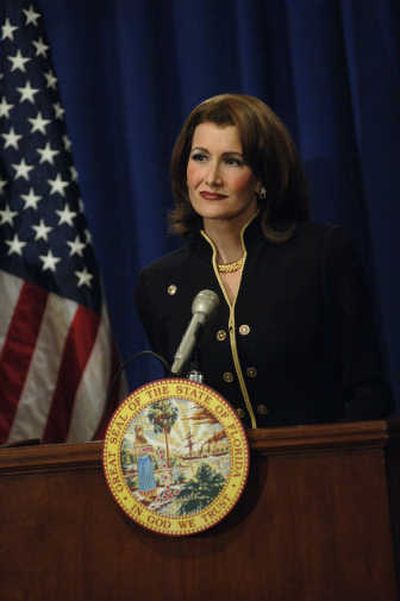
Laura Dern recalls the night of Nov. 7, 2000, as a sleepless one.
“I thought I was going to bed that night, that infamous night, and stayed up all night, as most of us did, and by the morning I had the flu,” she recalled in a recent phone interview.
“I was completely paralyzed with the flu, with a 103 fever. My whole system shut down, I was just so overwrought.”
For many people, the opportunity to revisit the 36 uneasy days between that Election Day and Al Gore’s concession to George W. Bush may be about as welcome as Dern’s flu.
But while HBO’s “Recount,” which premieres tonight, is bound to bring back memories of the frustration that engulfed Americans of every political stripe in the late fall of 2000, it’s not all butterfly ballots and hanging chads.
There’s Dern, for instance, who as Florida Secretary of State Katherine Harris got to channel one of the most colorful political figures of the decade.
“It’s got to be illegal, that I had that much fun,” she says.
Though most of the actors in “Recount” were charged with playing real people, Dern’s particular challenge with Harris was to avoid caricature.
“She was already a comedy skit on (‘Saturday Night Live’). She was, you know, the favorite joke of David Letterman and even Jay Leno, all the nighttime talk-show hosts,” Dern says.
“We’d all talked about her makeup and hair and her deer-in-the-headlight facial expressions through the course of that month – so where do you go from there? … Even playing it honest is over the top, because she is that person.
“All her gestures were extreme. Her tics, her mannerisms are extreme. It’s such an odd thing, so you feel you’re overdoing something that you’re just trying to stay true to.”
For Kevin Spacey, who plays Ron Klain, the former Gore chief of staff who found himself leading the campaign’s challenge in Florida, “Recount” is more of a suspense film.
Rather than playing like “some kind of boring polemic political history lesson,” he says, it’s “a very entertaining thriller.”
“It sort of reminded me of when I saw ‘All the President’s Men’ for the first time,” Spacey says. “You know, not like we don’t know the end of that story.
“But it’s about the detail, and about the humanizing of characters and showing how not one thing occurred, many things occurred, confluence of events, different personalities, some with agendas, some who were just quite frankly unqualified for their positions. Our electoral process is just not equipped to handle margins of victory so small or margins of error so big.”
Political films generally face a tough test with conservative viewers who, not without reason, consider Hollywood a liberal stronghold.
So it was with some purpose that Spacey (who’s been active in Democratic politics), Dern and “Recount” screenwriter Danny Strong all mentioned, in separate interviews, that former Secretary of State (and Bush strategist) James Baker was planning to co-host a screening of the film with former President Jimmy Carter.
“And you know why? Because they are both on committees to try to change election laws, because even some of the laws that were to (Baker’s) advantage in 2000 he thinks should be changed,” Spacey says.
It probably didn’t hurt, either, that Baker is played by Tom Wilkinson – the British actor most recently seen as Benjamin Franklin in HBO’s “John Adams” – and comes off as considerably more forceful than his Gore team counterpart, former Secretary of State Warren Christopher (John Hurt).
Strong, an actor for whom “Recount” is his first produced script, was still a recurring player on “Buffy the Vampire Slayer” (as the nerdy Jonathan) in 2000.
He recalls not following the outcome of the election very closely, “because I was pretty disgusted by the whole thing very quickly. I didn’t understand why there wasn’t a statewide recount. … It seemed to me like the only thing that was fair.”
In telling the story, Strong says, he strove for fairness, rather than merely balance.
“I wanted it to be accurate, I wanted the process to be open,” he says. “We sent James Baker the script, to get his notes, we showed him an early cut of the film to get his input. Some of his notes we took, some we didn’t.
“Same with the Democrats. We included some of them in the process, sent them the script, showed them an early cut, included them in the process. We also hired all of the journalists that had written the (four) books I had used as my primary sources on this.”
In the end, he says, “There’s good and bad on both sides. But the movie isn’t ultimately about the parties. The movie’s not about Bush, the movie’s not about Gore, or who was supposed to win.
“The movie’s about the process. And we the filmmakers think this process was flawed.”