
Damage control starts with McClellan as target
WASHINGTON – The Bush White House, long accused by outside critics of misrepresenting the facts to make the case for war in Iraq and other matters, has launched a personal counterattack against harsh accusations of “deception” from a longtime insider who worked closely with the president.
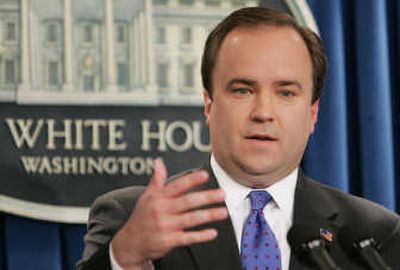
White House aides past and present are strongly dismissing the words of Scott McClellan, who served as President Bush’s press secretary and has now written a book accusing Bush of misleading the public about the war and more.
With the discipline of a White House team that is nothing if not decidedly on-message during crisis, Bush aides have stepped forward to say this isn’t the Scott McClellan they recall.
In their full-bore, personal attack on the author, whom Bush once embraced as a valued friend, they are confronting potentially damaging new pages in another chapter of the president’s legacy.
As Bush’s party fights to retain control of the White House, the Bush administration also faces the challenge of refuting embarrassing new inside accounts about an administration that was intent on waging a war that the presumptive Republican nominee, Sen. John McCain, supports and will have to defend in the November election.
“It is sad,” said current White House press secretary Dana Perino, dismissing McClellan on Wednesday as “disgruntled about his experience at the White House. … This is not the Scott we knew.”
The president was “surprised” by the book’s claims, Perino said.
“He is puzzled,” Perino said of Bush, “and he doesn’t recognize this as the Scott McClellan that he hired and confided in and worked with for so many years.”
“For him to do this now strikes me as self-serving, disingenuous and unprofessional,” Fran Townsend, former head of the White House-based counterterrorism office, told CNN.
Dan Bartlett, former counselor to the president, said in an interview on CNN: “There is an enormous amount of disappointment among those who are closest to Scott. This is not the Scott we knew.”
McClellan followed Bush from Texas, having worked in the governor’s office from 1999, and served as traveling spokesman in two presidential campaigns and as White House press secretary from 2003 to 2006.
McClellan and others were quietly eased out during a second term house-cleaning that ultimately removed all of the highest profile Texans from the Bush administration – from Karl Rove, Harriet Miers and Dan Bartlett at the White House to Attorney General Alberto Gonzales.
But McClellan maintains that he wrote the book – “What Happened: Inside the Bush White House and Washington’s Culture of Deception” – “not to settle scores or enhance my own role.” Rather, McClellan wrote, events at the White House, principally the leaking of a CIA operative’s identity and misleading information that the administration promoted as the rationale for the U.S.-led invasion of Iraq in 2003, prompted him to write the tell-all.
“I was caught up in the deception that followed,” he wrote of the White House’s denials about having any hand in the leaking of CIA operative Valerie Plame’s identity after her husband, Ambassador Joseph Wilson, criticized the administration for allegedly manipulating pre-war intelligence.
“It was the defining moment in my time working for the president,” McClellan wrote, “and one of the most painful experiences of my life.”
McClellan also contends that Rove, the former chief political adviser in the White House, and Lewis “Scooter” Libby, the former assistant to the president and Vice President Dick Cheney’s chief of staff who was convicted of obstruction of justice in the CIA leak probe, had meetings in which it appeared they were coordinating their stories about the events regarding Plame and Wilson.
Rove adamantly denied this Tuesday night, in an interview with FOX News’ Alan Colmes.
“Scooter and I visited all the time,” Rove said. “I don’t know what the particular meeting in question was about. I know what it wasn’t about – it was not about Plame and Wilson.”
A Democratic congressman, calling McClellan’s claim “earth-shattering,” said he should be compelled to testify before the House Judiciary Committee.
Rep. Robert Wexler, D-Fla., said: “The allegations … that Rove and Libby deliberately coordinated their stories in order to obstruct justice in the Plame case, that the president deliberately disregarded contradictory evidence related to Iraq, should outrage every American” and Congress should respond with an “aggressive” investigation.
McClellan also portrayed the president as an “instinctive leader more than an intellectual leader” who believed that the invasion of Iraq would lead to a broader peace in the Middle East, but could not sell it that way to the American public. So, McClellan said, Bush turned to intelligence about Saddam Hussein that supported his case and disregarded or discarded any intelligence that disputed the later-refuted contention that Hussein possessed weapons of mass destruction.
Ari Fleischer, who served as Bush’s first press secretary, echoed the White House’s suggestion that this is not the Scott McClellan he remembers. Yet, in an interview with FOX News, Fleischer also voiced some sympathy for the task that McClellan faced.
“He got dealt a deck of cards that were very tough,” Fleischer said. “He was the press secretary at a time when the war in Iraq started to go very badly, he had issues inside with staffers who deceived him. There are some legit issues that Scott raises, but the point he makes about the president and the war in Iraq, that’s just the part I don’t understand.”
Perino said that Bush would have no public comment about the book.
The book “has been described to the president,” she said. “I do not expect a comment from him on it – he has more pressing matters than to spend time commenting on books by former staffers.”