
Escapes from stark reality
Tough times may be reason for increase of sales in romance novels

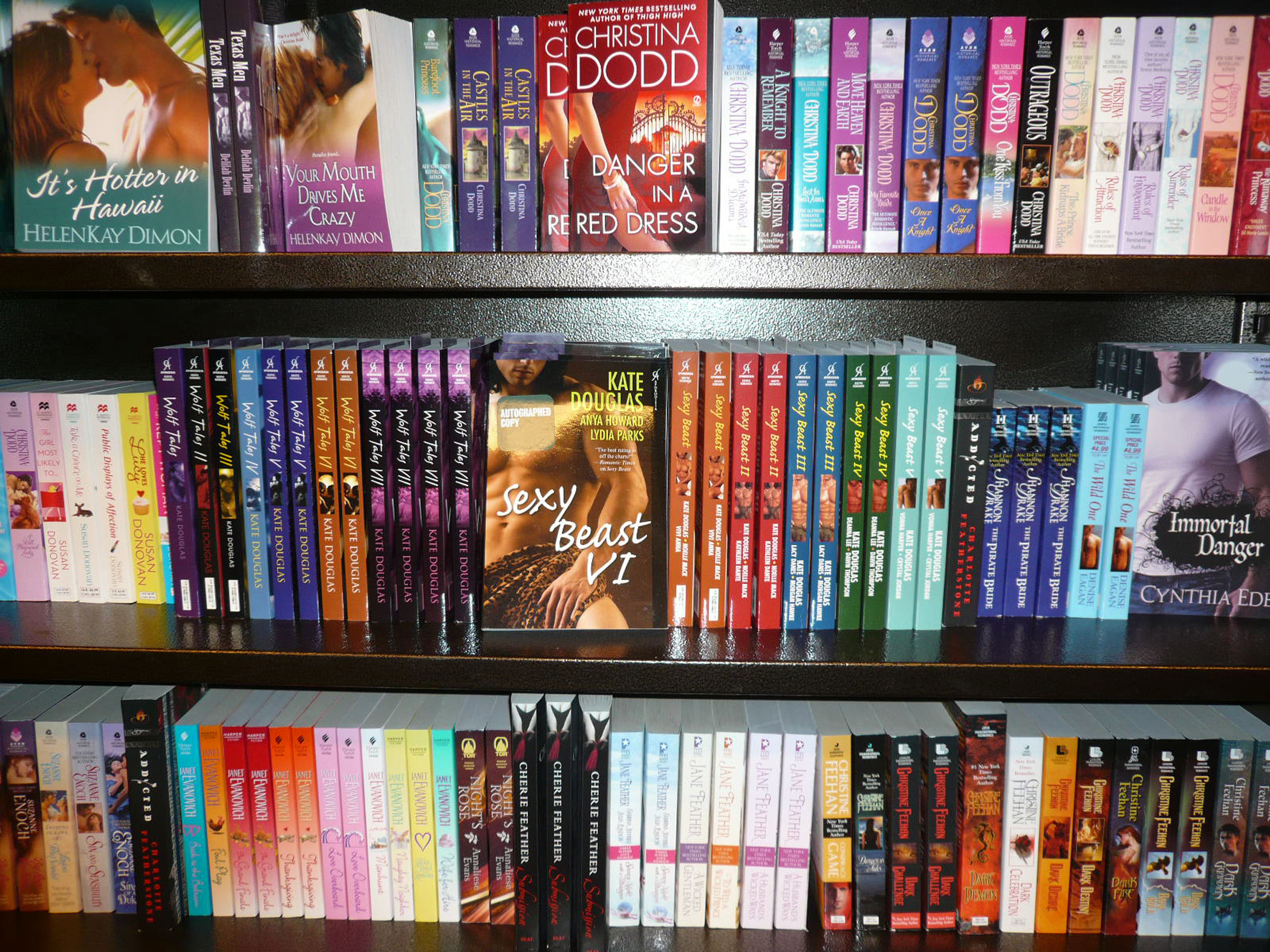
With an out-of-work husband and two children to support, Christine Mead needs a cheap – and uplifting – break from life.
So lately she’s been escaping into sweet and heartening stories of love and passion, in which heroines overcome insurmountable obstacles to find their happiness.
“I am left with a satisfied feeling at the end of a good book, a feeling of hope that all can, and will, be OK,” says Mead, who lives in the small town of Festus, Mo., and suffers from fibromyalgia and osteoarthritis.
Mead, 41, rarely goes anywhere because of the price of gas, and the family has been relying on a food pantry.
Romance novels, she says, are “a distraction from not knowing what’s going to happen next.”
Love may not conquer all in real life, but its power in relatively inexpensive books is quite a comfort in this economy. Publishers are seeing strong sales in the romance genre as other categories decline and consumers cut back on spending.
Harlequin Enterprises Ltd., a global giant in women’s fiction, reported fourth-quarter earnings up 32 percent over the same period a year earlier, with U.S. retail sales up 9 percent in 2008.
For the week of May 10, romance book sales overall were up nearly 2.4 percent compared with the same week last year, according to Nielsen BookScan, which covers 75 percent of retail sales.
Travel book sales were down 16 percent, while detective/mystery and self-help were each down 17 percent. Adult fiction, of which romance is a subgenre, was up 1 percent overall.
Jennifer Enderlin, associate publisher for St. Martin’s Press, says romance is doing so well, the publisher is releasing 32 titles this year, compared to 26 last year – and more could be added.
Enderlin and other publishers say they’re not surprised by the genre’s success.
“Especially when business is bad or business is down, people want to escape a little bit,” says Laurie Parkin, vice president and publisher of Kensington Publishing Corp., which has seen a 5 percent sales increase for mass market paperback romances. “I think romance offers that in a wonderful, wonderful way.”
“It’s a healthy and positive coping mechanism,” adds Judith Orloff, a medical doctor and author of “Emotional Freedom: Liberate Yourself From Negative Emotions and Transform Your Life” (Harmony, $24.95).
Romance stories help people find an oasis of calm, she says.
Christine Dionne, 38, of Cloverdale, Ore., says romance was the soothing balm after one of her two sons died playing an asphyxiation game in 2004 at age 10.
Now, she’s reaching for more lighthearted fun romances as a distraction from financial and family troubles. Her husband, a truck driver, has had his hours cut and the farm where she works has taken a hit.
Dionne says the books make her feel like she’s something bigger than her tiny town and the small house that she rarely leaves. With little money to go out (she doesn’t drive), she shops at Goodwill. Ramen has become a staple in the house.
“It’s my connection to the world and I can visit other places and be somebody else – for just a little while,” says Dionne, whose surviving son is 12.
Katherine Petersen, 43, of Menlo Park, Calif., says she feels more energized to resume her job search after she finishes a good romance.
Petersen, who is blind, has been looking for work for about a year.
Before, reading was a hobby. Now, it’s her saving grace. She says it’s something she can do in braille or by listening, without the company of others and without spending a lot of money.
“When I’m reading, I’m thinking about something else,” says Petersen, whose background is in public relations. “I’m certainly not worrying about that job letter I just sent out or who I have to call or how I am going to pay the electric bill. It’s kind of a freedom from that.”
But escapism is only part of the attraction, says best-selling author Janet Evanovich, who started out writing romance and then morphed into mystery.
She likes romance because the characters are quirky, vibrant women who take charge, are tenacious and are able to overcome crises in their lives – characters women can identify with.
While the endings may be predictable, says St. Martin’s Enderlin, there’s solace in knowing that things are going to turn out like they should.
For Diane Pershing, president of Romance Writers of America, the recession-proof romance is a no-brainer.
Romance novels offer “rich, complex stories about good people overcoming obstacles to achieve intimacy and an eventual joining of their lives,” she says.
“Along the way, they have great sex,” she adds. “What’s not to like?”