
These kids are far from idle
Super Seven fifth-graders taking pollution solution to Denmark
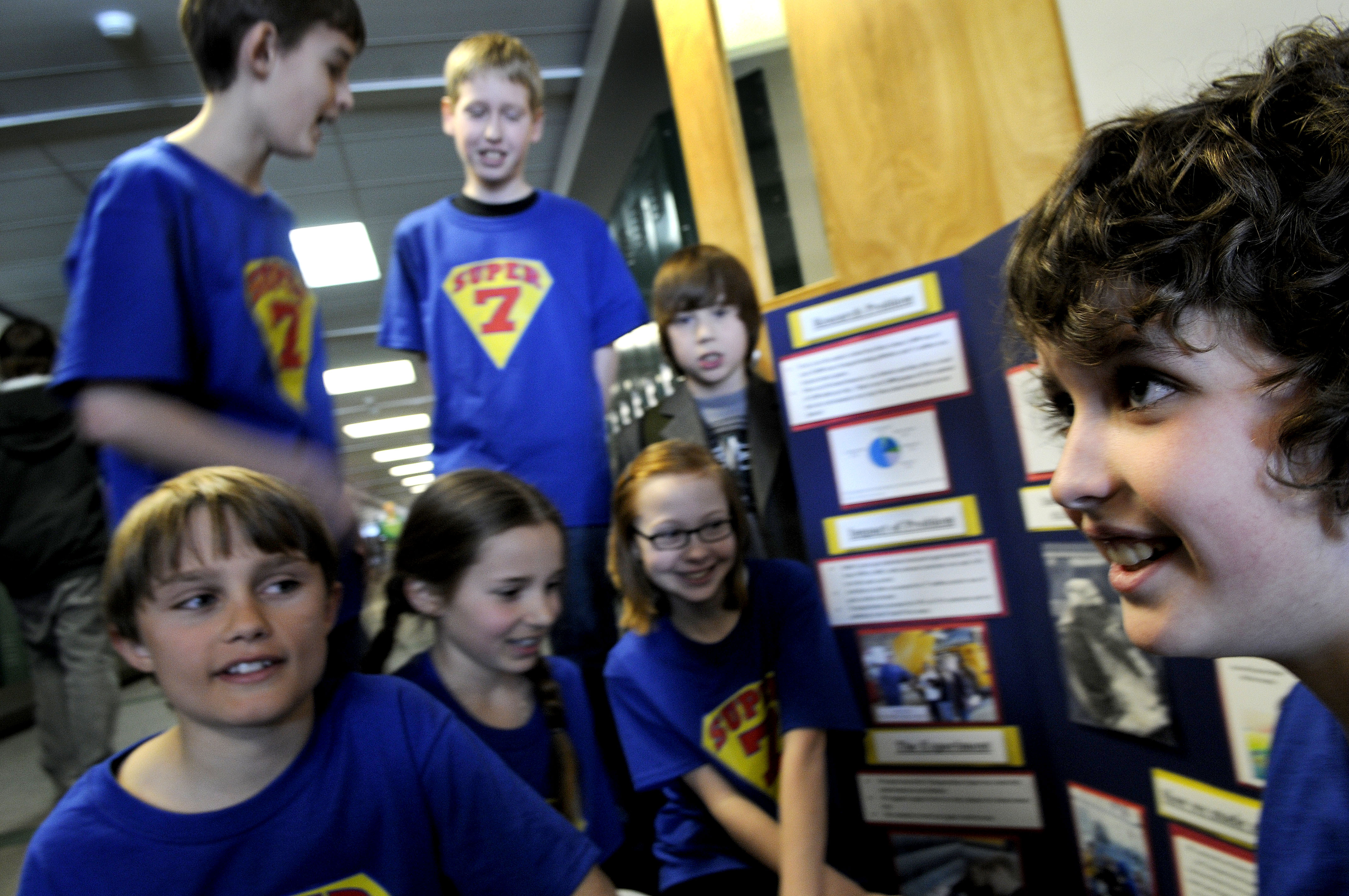
The 40 school buses in the Lakeland School District drive a total of 3,300 miles a day. The buses warm up for about 15 minutes, putting carbon dioxide into the atmosphere.
A group of district fifth-graders put their minds to the question: How can we reduce the carbon emissions from district buses? Their solution earned them a trip to Denmark in May to present their idea at the European Children’s Climate Call.
The students, dubbed the Super Seven, are enrolled in Lakeland’s talented and gifted program, called STRIVE, which meets weekly at Lakeland Junior High School. They also are members of Lakeland’s First LEGO League, a global program to interest kids in science and technology.
LEGO League competitions are twofold. First, each team uses LEGO building blocks, motors, sensors and other tools to create a robot. The second part includes researching a specific topic related to an overall theme. This year’s theme, Climate Connections, sparked the interest in carbon dioxide emissions and school buses.
“We come to STRIVE every Tuesday on a bus,” said Tyler Siegford, 11, a student at Betty Kiefer Elementary. “We noticed our buses were idling a lot, so we decided to see if we could make them stop idling.”
The Super Seven won in the research and presentation category at both the regional and state FIRST LEGO League contests. That enabled them to apply directly to the global competition, to be held May 1 through 3 in Copenhagen. They will be one of six teams from around the world to present their “climate action” idea at the Climate Call, along with teams from Illinois, California, Germany, Australia and Mexico.
A panel of engineers will serve as the judges, and the winning team will have its idea designed and implemented for real-world use, said Beth Brubaker, Lakeland’s STRIVE teacher.
“This is an amazing group of students,” she said. “I think this is a life-changing event for these kids.”
A few of the kids have been to Canada. Most have never been outside the United States. All of them are excited to visit Europe.
“I think it’s going to be cool to meet teams who are doing the same work,” said team member Cameron March, 10, who attends Garwood Elementary.
Ross Jenkins, 12, a student at Twin Lakes Elementary, is excited about the possibilities.
“If we do good with this, it could be implemented throughout the U.S.,” he said.
The students’ winning idea is to hook up tanks to the idling buses to collect carbon dioxide emissions. Then the collected vapors would be pumped into a man-made pond, where they would feed blue-green algae. Blue-green algae, which double in size every day, then could be harvested for a number of uses, including biofuel, fertilizer and even nutritional supplements. Also, the students would surround the pond with cattails, which are good natural carbon scrubbers.
The team’s solution was the result of brainstorming and research.
“We all brought different ideas,” said Hayden Zeimantz, 11, who attends Twin Lakes Elementary School. “Then we voted on which would be the best for our project.”
The team has been at work on their five-minute presentation since October. Their Tuesday STRIVE sessions have been dedicated to it, and all have worked on it at home. Along the way, they’ve learned a lot about buses, exhaust and greenhouse gases.
“When (a bus) idles for 15 minutes, it puts out 5,000 grams of CO2,” said Rohnin Randles, 10, from John Brown Elementary.
To get an idea of what that might look like, a couple of the students held paper towels near the exhaust pipe of a bus for five minutes to collect the emissions. The deeply blackened pieces of paper have become a key prop in their presentation board. They also tested a bus outfitted with a catalytic converter, which is designed to reduce emissions. That paper towel came out much cleaner.
“But the converters are like $5,000,” said team member Shelby Cass, 10, from Garwood. “They’re really expensive.”
It was an eye-opening experiment for many of the kids.
“I didn’t know one bus could produce so much CO2,” said team member Magen Daniels, 11, a student at Garwood.
Their work is not done. As part of the selection process, the judges in Denmark critiqued the Super Seven’s proposal and provided some feedback. The big question for the team: How to collect carbon dioxide from moving buses. So now the team is researching carbon-scrubbing filters and other systems that may do the trick.
Brubaker, who hand-picked the team, is confident they’ll find a solution.
“They work so well together. They listen to each other’s ideas,” she said. “You can’t give them information fast enough.”