
‘We didn’t compromise’
Leader reflects on GU basketball, mission
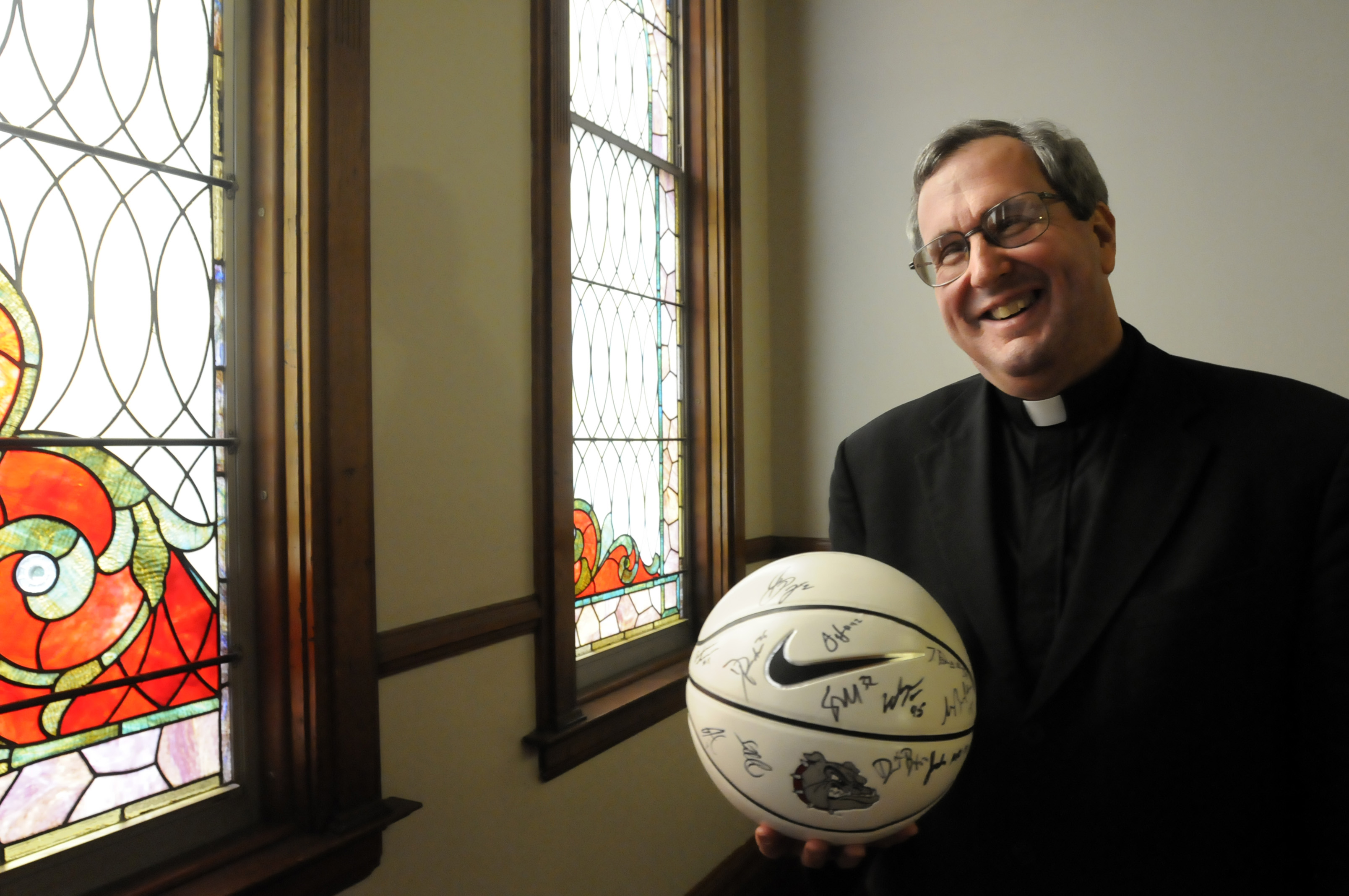
Whenever this Gonzaga basketball season ends – first round or Final Four – the Bulldogs will graduate five seniors and one immense off-the-court influence. The Rev. Robert Spitzer, the school’s president since the Zags’ NCAA tournament run began in 1999, will leave the school in July.
If coach Mark Few has been the architect of the basketball program’s phenomenal development, it couldn’t have happened without the vision, endorsement and support from the school’s leadership. Spitzer has used basketball as a lever for spurring enrollment and campus growth to unprecedented levels – earning him both accolades and some criticism within the Gonzaga community, and beyond.
On the eve of GU’s 11th consecutive NCAA tournament appearance, Spitzer sat down for an hour-long Q-and-A. The highlights:
S-R: What were your impressions of the West Coast Conference tournament’s first neutral-site venture in Las Vegas?
Spitzer: Are you kidding? It was Zags everywhere. I did the Mass on Sunday – 440 people, all Zags. The University of Portland was next door with 16. So we sent 40 Zags to UP’s Mass because they were literally out in the hallway. We took the place by storm. I think we had 4,000 guests that Gonzaga alone brought down there. Then on top of it, the spirit was so great. We really want to play back down there again. I had a chat with the commissioner while we were there and I think he’s going to get that solidified.
S-R: You’ve said your presidency has been “charmed” by this basketball team. Do you get razzed by other college presidents?
Spitzer:
Honestly, there are generally three reactions from other presidents. One is to completely ignore it, like nothing is going on. Then you have the “You can’t stay on this crest forever” comment: “Your time shall end and I’ll be here to witness it.” And then there’s the teaser: “Aw, Spitzer, you’re so lucky – what the heck?” I get all three of them pretty regularly.
S-R: It’s one thing to succeed. Can you explain the strategy to capitalize on that success? Was there a grand design to the enormous commitment you made to athletics?
Spitzer: After the first season (1999), I recognized immediately what this would do for us. Of course, Dan Monson coming in and telling me he was going to take the offer from the University of Minnesota – I was crestfallen. But I didn’t blame him at all – the offer was so good, he did the right thing for himself and for his family. And there were a couple of different guys that had so much confidence in Mark Few and told me, “Don’t worry.” Which has turned out to be absolutely warranted. He’s our Knute Rockne, let’s face facts. He really is.
Three things kind of happened then. We had two bylines: We’re going to leverage this for all it’s worth, and no opportunity will be left unseized. A series of things came out of it. The first was to try and build up the athletic endowment right away. So I asked Mark if he would come down with me to Salt Lake City to see the McCarthey boys. Phil was in my class at Gonzaga; Tommy was a little ahead of us.
I asked Mark to meet with me in this coffee shop and we could strategize before we go over to their home. So I tell him, “We want to get this funding for our athletic endowment.” Mark goes, “Well, the athletic endowment is important but I think the arena is more important.” I said, “The arena? Where are you going with this?” And Mark laid it on the line: an investment in a new Kennel is going to help us with our recruiting, with our marketing and on down the line – all these things instinctively one would know.
But when Mark put it out there it was very, very clear. I knew right away for Mark that this was going to be essential for him as a coach. So I changed my pitch right away – I’ve told the McCartheys this story – and it became all about the arena. We didn’t have a design, we didn’t have an amount, we didn’t have anything, but we were pitching the arena.
At the time, I wanted to go on the cheap – is there some way we could expand the old Martin Centre, bust out the walls or something? And John Stone came up to me and he put his arms on my shoulder and said: “Can I be really honest with you? That’s a lousy plan. You’ve got to get something that’s worthy of this team.” And I realized that was right. You just get kind of scared when people start throwing out numbers like $26 million. Which now, if you tried to build it, it would be $43 million.
S-R: What about beyond basketball?
Spitzer: We wanted to make sure we were going to take advantage of this for admissions possibilities, and we have. Obviously this helps us with recruitment of men’s students. At a time when a lot of other private schools are 65-35 in favor of women, we’ve been looking for a real balance.
What basketball does is generate leads and interest. You have to do three other things to seal the deal.
The first is to get your financial aid strategy in order. It doesn’t matter how much a student wants to come – if they can’t afford it, it’s a deal breaker. Then you have to make certain that you have very good publicity for your academic programs. We have great rankings – great Princeton rankings, great U.S. News and World Report rankings, great rankings in the independent surveys. So the thing is to get the word out about those rankings and our programs so people can say, “This isn’t just a basketball school.”
The third area is the campus visit. One of the difficulties of being in Spokane is what’s called initial name recognition. Actually, people know Gonzaga more than they know Spokane when they’re applying. But that gets reversed when we bring them to campus. Then we have about a 70 percent chance when a senior or junior visits here of actually sealing the deal. Then Spokane becomes a huge advantage.
S-R: You were at Georgetown when the basketball program there first reached its heights in the 1980s. Is there something in that model that influenced you here?
Spitzer: I was almost oblivious to the infrastructure and marketing going on behind the scenes at Georgetown, but who could miss Patrick Ewing and later Alonzo Mourning and Dikembe (Mutumbo)? These were great players – who are like our players, in that they’ve come back to support Georgetown the way our former players support us. Georgetown didn’t need a lot of name recognition. In Spokane, we probably need the team a little bit more just to get the visits going so that people recognize Spokane for all the virtues that is has.
S-R: With the enormous expectation that’s grown here, have you ever been concerned what might happen if the program were to slip competitively?
Spitzer: No one is going to turn their back on this team. We ain’t no ingrates. We know what this team has done for us. Your kid has a bad semester, you don’t reject him. Whatever Gonzaga is, we are a grateful community first and foremost. It pervades. The key thing is, at Gonzaga, if we have a disappointing loss, I don’t get calls from anybody telling me, this has to change, players, coaches, whatever. I don’t get a lot of yadda-yadda. I know other presidents get it.
And if we had a slippage, it wouldn’t just be tolerance. We’d be figuring out whatever we could to help, not to hang somebody at midnight. We have such forward-looking coaches and athletic staff that even if we had two bad seasons or whatever, I know this much: We would be systematically rebuilding.
I’ve always said to our coaches: I’m your athletically challenged president. So I trust you. That trust has never been unjustified. And I’m going to back them, and I know the next guy will, too.
S-R: Are you aware of the term “the Gonzaga syndrome”? Not just within your league, but schools of your ilk where pressure has increased to try to duplicate what you’ve achieved. It has been suggested at some of those places that Gonzaga has sold its soul for basketball success. Your response?
Spitzer: That’s just about the silliest allegation I’ve ever heard. Our Jesuit mission has not been compromised by basketball. If anything, basketball has helped to get us resources to strengthen that mission. Our academic mission has not been compromised. The whole atmosphere of our community is not only built on the development of the whole person and all the Jesuit ideals that we try to cultivate, but it’s also built on fun and spirit. That’s part of the deal even in a Jesuit atmosphere.
Selling your soul – I haven’t compromised anything in faith, in Jesuit mission, in academics, in student life, in culture for basketball. Basketball has never asked me to do that. Our student athletes are out there, working with grade schools … did you hear Josh Heytvelt’s speech at the final game? This is hurting my mission? And Mark has done us a huge favor. The Coaches vs. Cancer (events) – are you kidding me? Mark and Marci out there bringing the whole community together? This is Jesuit with a capital J. It galvanizes the spirit of our campus in a healthy way.
We certainly didn’t sell our souls. And we didn’t compromise in any way our Jesuit ideals or commitment to academics.
S-R: You’ve brought up Josh’s name. Mark has said that he was poised to remove Josh from the program two years ago after his arrest on drug possession charges – and that it was you who urged that Josh be given a second chance. Why was that your counsel?
Spitzer: Mark sometimes doesn’t give himself enough credit. Mark very much wanted to be a believer in Josh, too. But the key element was that I was assured when I was talking with people that Josh was having a deep reconsideration of what had gone on his life. Being a Jesuit, I’m a believer in forgiveness. And I’m a believer that people can change. We all wanted to be believers. I would always would say, if there is a real purpose of amendment and you think that’s genuine, it’s worth it to take a chance on somebody. And Josh just proved it to me that it was worth it to me to take a chance. He proved it for the next person I’ll have to trust.
S-R: How would you characterize your relationship with Mark, and what qualities make him a good fit for Gonzaga?
Spitzer: I have a genuine friendship and affection for Mark Few. Mark knows I’m athletically challenged. Obviously, he’s a tremendous basketball strategist. He’s methodical, which is a personality that appeals to me. I love methodical people. But he can also be decisive and that’s a gift.
If you have someone who is careful and methodical, but can also be decisive, that’s a great combination for leadership. Mark is quieter than I am and with all the accolades that are given to him, quite frankly he is humbler than I am. And humility is a great gift of a leader, and Mark does have it. Sometimes he brings that out in almost Jimmy Stewart-esque fashion. He also has a great sense of dignity and pride in himself, the program and the students which he continually points to.
Is that a great fit for Gonzaga? Oh, yeah.