
Let’s talk turkey
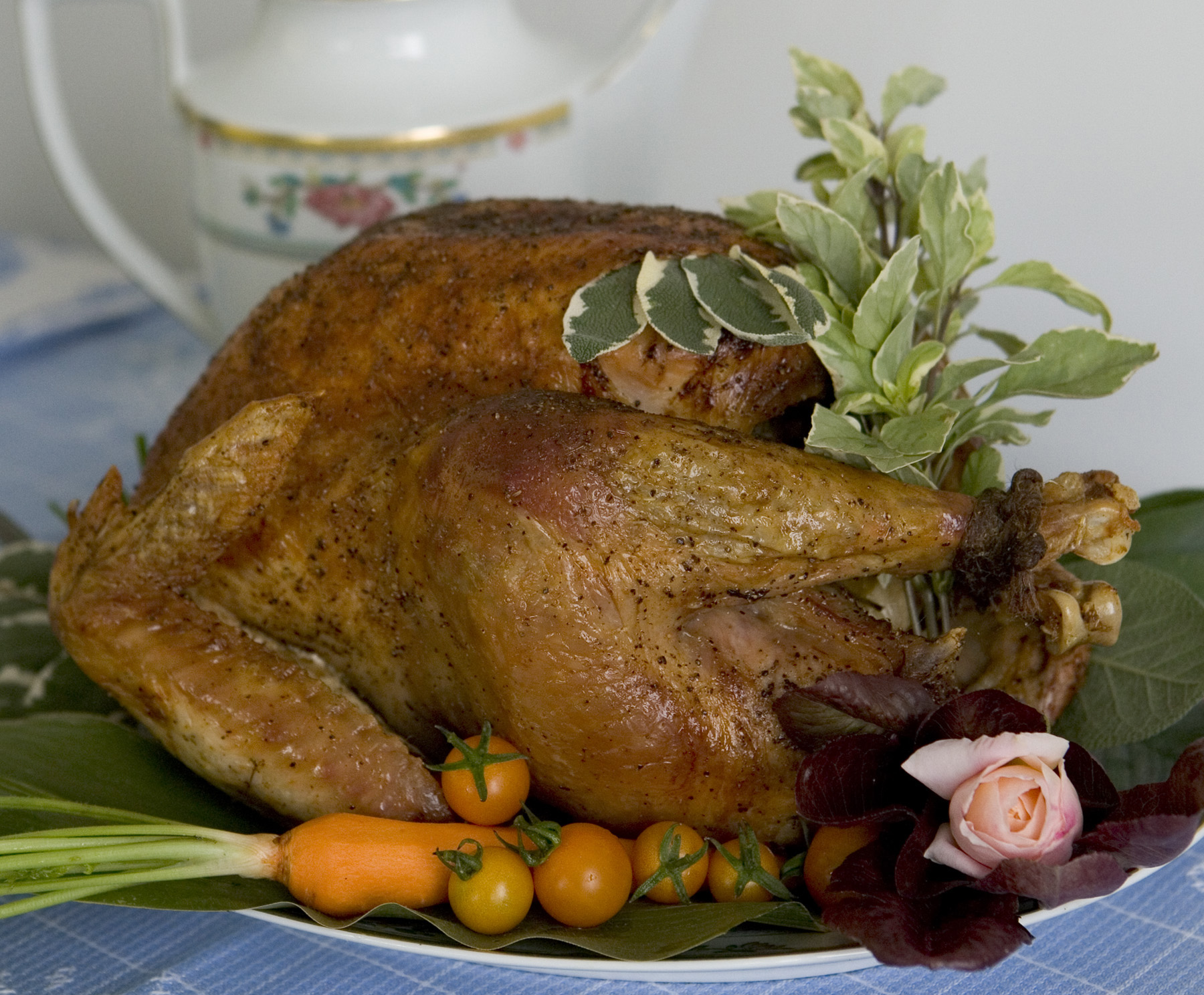
Each year, about this time, the buzz on my Web site chat room turns to turkeys. Who can help it? The urge is almost instinctual. As soon as the first frost hits, the tummies of Thanksgiving traditionalists start to rumble. These days, though, there is also a yearning to reclaim traditions that hail from an age older than the supermarket-meal mentality. No boxed potato flakes, no canned cranberry gel and no mega-farm meat. We hunger to reconnect with our food in a way that simply isn’t satisfied by brand-name birds bought with a blind eye to the conditions in which they were raised.
Factory-farmed turkeys of the broad-breasted white variety are nothing like the beautiful backyard birds raised just a few generations ago in rural America. These unfortunate products of commercial breeding are designed to grow quickly and gain inordinately large amounts of breast meat. They are so “top heavy” that they can’t fly, run or even breed without human intervention. For the duration of their relatively brief lives, these turkeys are destined to sit tight, literally, among a massive crowd of their kin. Packed together in poultry houses, they know nothing of green grass and fresh air.
So the question that arises more and more frequently is how to buy a better turkey; one that will nourish us with rich and flavorful meat grown on grass, bugs and sunshine; one that is not pumped full of antibiotics and dubious “solutions” before being packaged in its plastic wrapper. But buying better is not as easy as it sounds. In my chat room, Katy from Alabama writes: “I am trying to decide on a turkey for Thanksgiving, but I’m confused and need some help. I want to go ‘healthy,’ and I plan to buy a free-range or organic turkey. What are the benefits of free-range? And what are the benefits of organic over free-range?”
Double Up: 100 percent Pasture Fed AND Organic is Best!
Labels lead us in the right direction, but the devil is in the details that aren’t always readily apparent. Here’s the lowdown:
— Organic turkeys are fed organic food, but, there is no guarantee that they are allowed access to any kind of pasture for foraging.
— Free-range turkeys are allowed access to the outside. Mind you, “access” can mean a small door in a poultry house packed with thousands of turkeys, and that door may lead to an outdoor area with a concrete floor, not grass. Unless they are also labeled “organic,” they may be fed nonorganic and GMO feed.
— Pastured turkeys, as the name implies, are allowed access to pasture. They may roam freely, or they may be confined to pens or fenced areas that are moved frequently onto fresh pastures. Either way, they are guaranteed a diet of bugs and greens, which makes them and their meat healthier.
Again, unless they are also labeled “organic” or 100 percent pasture fed, they may also be fed nonorganic and GMO feed. If possible, buy a pastured bird locally. That way you can talk with the farmer, tour your turkey’s stomping grounds and assess the quality of the operation firsthand. Even if it isn’t technically organic, the benefits of a small-scale pastured farm certainly surpasses the value of a factory farm’s USDA certification.
How About Heritage?
“Heritage” is a term used to define a new trend in old-breed turkeys. Gorgeous varieties like Standard Bronze, Bourbon Red, Chocolate, Slate and Narragansett once graced the tables of our great grandparents with their flavorful and nutritious meat. Today, lucky locavores are finding these breeds cropping up in their own neighborhoods. Most heritage turkeys are raised by conscientious farmers who are dedicated to producing happy, healthy poultry — and the proof of the pampering is in the delicious meat.
Liz Young of Nature’s Harmony Farm describes her first experience eating heritage turkey on her Web site, www.naturesharmonyfarm.com: “I expected it to be tough. I mean, I see how much these turkeys run around, and I figured this would be reflected in the firmness of the meat, but it wasn’t! This was actually the tenderest turkey I have ever had. The meat fell off the bone and broke apart with a fork. And the taste … well I can’t even explain it. This turkey had flavor! It was wonderfully full of turkiness!”
You can track down a heritage turkey by visiting Local Harvest (www.localharvest.org) or Eat Wild (www.eatwild.com). Local Harvest offers tips on cooking a heritage turkey, which is actually simpler and faster than cooking a commercial bird.
Recipe Ideas:
Cider-Basted Turkey
12-pound whole turkey
2 Granny Smith apples, cut up
1 cup seedless grapes, halved
2 cups apple cider
1. Preheat oven to 325 F. Remove giblets from turkey and set aside. Pat turkey dry with paper towels.
2. Stuff body and neck cavities of turkey with apples and grapes. Arrange turkey breast side up in shallow roasting pan. Pour cider over turkey.
3. Roast turkey at 325 F for 3-1/2 to 4 hours until thermometer inserted in thickest part of thigh registers 180 F, basting every 30 minutes with pan juices. When turkey is as brown as desired, tent turkey with foil to prevent overbrowning.
4. In the meantime, and add giblets to 2 quarts water in a large saucepan along with apple. Bring to a boil, partially cover, and simmer until giblets are very tender, about 1-1/2 hours. Use broth for gravy.
5. Remove turkey to warm platter, reserving pan juices. With foil tent on turkey, let stand 15 minutes before carving.
Apple Wine Gravy
1 Granny Smith apple, quartered
cooked giblets
turkey/apple broth
1/2 cup all-purpose flour
1/4 cup white wine (I like Frey Vineyards organic wine, FreyWine.com)
salt, pepper, sage and thyme, to taste
1. While turkey is standing, strain pan drippings. Skim off fat. Add enough broth to drippings to measure 2-1/4 cups. Pour back into roasting pan. Chop giblets and neck meat and add to pan.
2. Whisk or blend together flour and 1 cup broth until smooth. Slowly whisk into simmering pan drippings.
3. Whisk in wine. Season to taste with salt, pepper, sage and thyme. Set roasting pan over 2 burners. Cook gravy over medium-high heat, stirring constantly, until thickened and boiling. Strain into serving dish.
4. Carve turkey and serve with gravy.