
Sharing sustainability world-wide
Spokane eco-architect Kelly Lerner brings straw bale tips to China
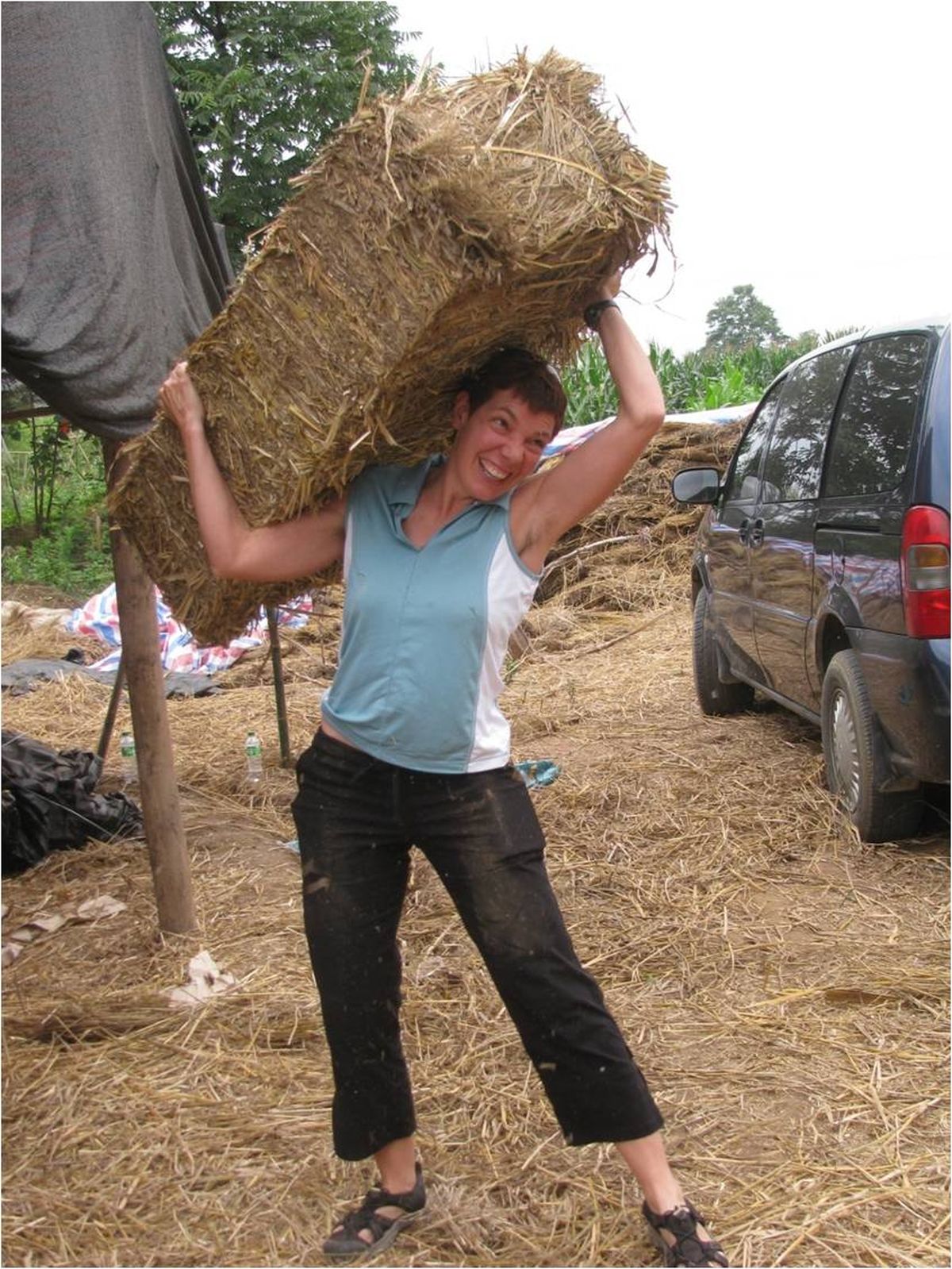
Kelly Lerner didn’t always want to be an architect. Originally, she wanted to build, and maintains she was “raised with a hammer in one hand and a measuring tape in the other.”
Today, Lerner definitely has found her niche – she designs homes that are not only good for the environment but for the people living in them. She owns One World Design Architecture, located in the Perry district of the South Hill, and has becoming known as an ‘eco-architect’ not just in the Northwest but other parts of the world, including Asia and South America.
“My best memories are always of planning projects and building: patching the roof, laying and grouting tile, driving a new well by hand — my Dad’s great idea) — building a trailer, then a storage barn and finally, the summer I was 17, a whole house,” she wrote on her company’s Web site, www.one-world-design.com.
She was raised in a small, rural town in the Midwest, where she acquired elements of the Mennonite approach which places high value on the principles of community, of everyone pitching in to care for “common” land.
All of these things gave Lerner a love for building and growing things, and an appreciation of American folk architecture, with its simple, hand-crafted designs from natural materials. This interest eventually took her to the University of Oregon, where she earned a master’s degree in architecture.
In this program, she focused on passive solar design and passive cooling, processes that rely on no-cost natural energy provided by the sun and wind, plus other ways to efficiently heat or cool a structure, such as the placement of windows and doors.
After graduation, Lerner traveled to China, Mongolia, and Argentina to build homes and public structures using sustainable materials from the natural environment, such as rice straw waste that is recycled into straw bale wall insulation. This insulation style keeps heat costs low and also uses natural materials close at hand.
She brought these ideas with her plus other natural building designs when she moved to Spokane in 2003 and set up One World Design Architecture.
Lerner doesn’t limit her expertise to Inland Northwest clients.
She recently traveled to China where she was hired by the Adventist Development Relief Agency to conduct a feasibility study on the usefulness of strawbale construction to rebuild homes in the Sichuan Province of China after a 7.9 magnitude earthquake made millions of people homeless.
“With the warmer climate of the Sichuan Province, the utilization of this technology was not so much about energy efficiency but rather about the seismic stability of strawbale walls and utilizing a locally-available waste product,” said Lerner.
About 10 years ago, the same organization hired Lerner to work in a colder region of China. Straw bale was also the recommended method here as well due to the better energy efficiency and low cost.
These homes not only took advantage of a readily available resource — rice straw waste — but eliminated reliance on high sulfur-content coal to heat the home, a resource which is damaging to air quality. The technology was inexpensive, insulated well, and was earthquake resistant.
It was Lerner’s work helping the community rebuild about 600 homes with strawbale construction that earned her the United Nations World Habitat Award in 2005.
Today, her work is said to be “eco-friendly,” sustainable,” and “green,” but Lerner simply calls it, “naturally perfect building.”
She sees insulatio like straw bales in the walls of homes, thermal mass incorporation (using dense material that can absorb and store radiant heat), natural finishes (non-toxic and natural plasters and paints), and other techniques to all be examples of good, environmentally friendly, healthy design.
While solar panels and intricate, geo-thermal heating systems are viable options in making a home better for the environment, these features are often out of many individuals’ price ranges.
“My approach is to make a building as passive as possible,” saidLerner. “A lot of deep greenness of a home might be invisible. If you design the passive systems well, then you don’t need as much of the expensive, high-tech heating systems.”
If you insulate your home as tight as possible, you not only save money on your electric bill, you’re lessening your impact on the environment.
She has other tips she can pass along to individuals wanting to make greener design choices in their homes.
First, Lerner says you don’t need to replace all your windows to prevent heat from leaving your home. You can use caulking or weather-stripping on existing windows or install storm windows. In addition, you can prevent drafts by blocking them around the doors, outlets, the attic hatch, and the fireplace.
Second, you truly can afford making your house more environmentally sound. You can choose more natural materials from your local area, you can be discerning about where you put windows in the home (if you are remodeling or designing from scratch), and you can be more mindful of landscaping outside the home, ie., where to put the trees for better shading or windblocks.
“Good passive design doesn’t cost any more,” explained Lerner. “You just have to think about it and plan to take advantage of nature’s gifts.”
Finally, Lerner cautions buyers from purchasing building material with toxic glues (specifically urea formaldehyde), as well as toxic paints and finishes. She says the cheapest is not always the best, especially when buying furniture or cabinets made of particleboard. When going to a building supply store, you can ask staff to look at the material safety data sheets (MSDS) of what you are going to purchase to make better-informed decisions.
This and other advice can be found in Natural Remodeling for the Not-So-Green House, a book Lerner co-wrote with Carol Venolia.
Lerner continues to be available as a consultant or an architect anywhere on the planet the client is.
“That’s why I named my company, One World Design,” says Lerner. “Because we’re all in this together.”