
Desert Jewels business blooming
Upriver Drive location owners happy to help choose native plants
Diane Stutzman’s passion for plants started at a very early age, and didn’t even begin that happily.
When her father gave her some seeds to plant, she eagerly watched for the blooms as she tended her little patch, anticipating a riot of colorful blossoms. When at last the plants started growing, Stutzman was sorely disappointed.
“I thought they were flower seeds,” she recalls. “They were lettuce seeds.”
But she still was very interested in what could grow, and how you can encourage plants to grow better, an interest “the daughter of gardeners and the mother of gardeners” retains today as owner of Desert Jewels Nursery in Spokane.
The Upriver Drive location offers more than the latest plants. Stutzman uses her extensive knowledge of gardening techniques and rare flora to offer shoppers the best choices for this area.
You won’t find exotic, hothouse species at Desert Jewels, but you will find plants that thrive throughout the Northwest, especially those that are native and drought-tolerant.
Native plants are easier to maintain because they’re natural to the landscape. But there’s additional benefits.
“What’s really wonderful about planting native (species) is that it provides for wildlife,” says Stutzman.
Her gardens are alive with activity. Hummingbirds and other birds flit in and out of the shrubs, or pause to take a dust bath.
“We spend an embarrassing amount of time watching pollinators,” she says, gesturing to a flurry of buzzing bees. “We take pictures of them on the flowers.”
Stutzman doesn’t use pesticides or fertilizers in her gardens and is always getting new items in, sometimes weekly.
“My sale yard changes throughout the weeks,” she says, pointing to tables full of starters. While many nurseries receive a big shipment in the spring, at Desert Jewels, “we get new stuff all season. We propagate seed, and we’re a primary producer for many things.”
Next year she plans to add more trees and shrubs to her burgeoning stock.
“Our mix is different from anyone else’s in the area,” she said.
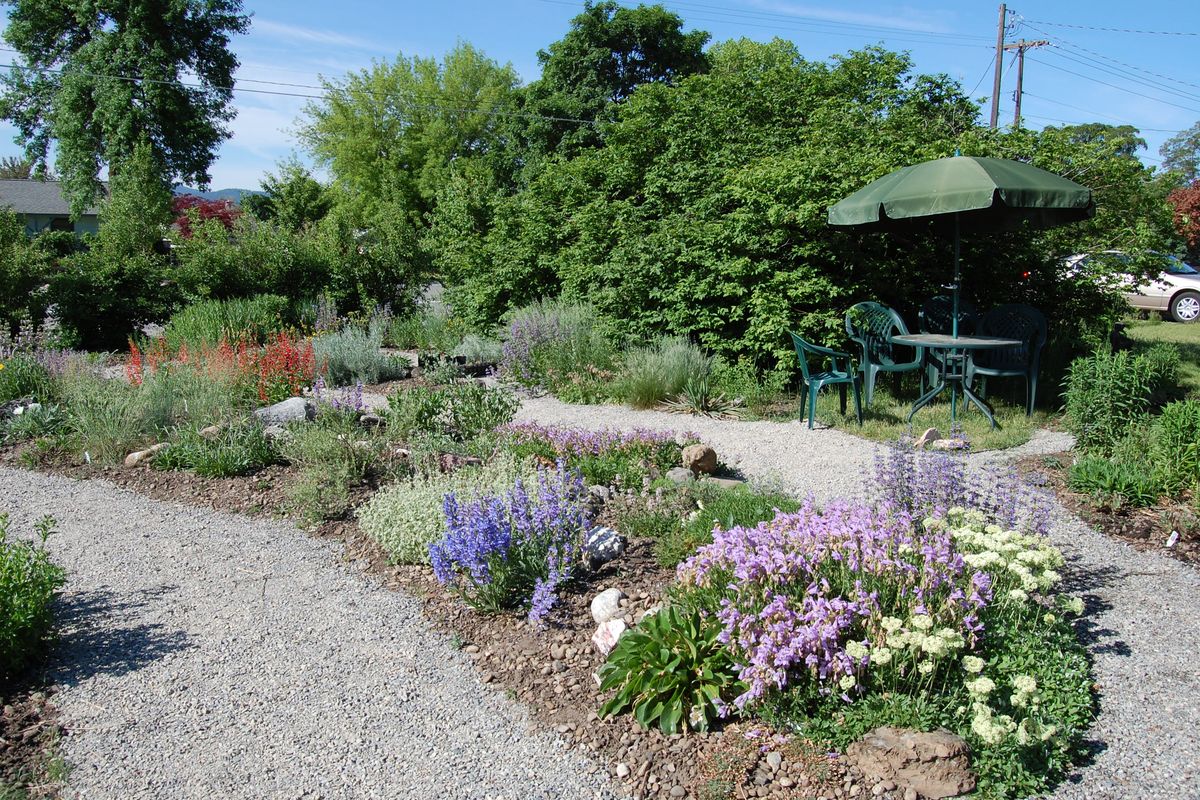
Visitor to this lush 1-1/3 acre setting will find plenty of plants from several growing zones.
From a prairie garden to a woodland edge plantings to a dry garden, color abounds.
Stutzman says she created these multiple garden zones for two reasons.
First, to see how plants behave in this environment, and secondly, so people can see what the plants look like. Her customers don’t have to study a packet of seeds and hope for the best.
Bees buzz among purple shrubby Penstemon, while nearby brilliant red Firecracker Penstemon shoot up like sparkling flares in the rock garden. While it’s correct to label these hardy flowers “Penstemons,” Stutzman calls them jewels. In fact she named her plant nursery “Desert Jewels” after the flowers she fell in love with.
“There’s 270 different species of Penstemon and countless hybrids,” she says. These adaptable plants can grow on rocky cliffs and in harsh, dry conditions. The shrubby Penstemon is evergreen, with a reddish-maroon cast in the winter and delivers lots of large flowers in the spring.
In the prairie garden, tall Indian grasses and wild buckwheat bend in the breeze. “American prairie plants are good if you want a landscape you only water twice a month,” Stutzman says.
Nearby, a hummingbird hovers above a Mojave sage plant in the desert garden. Stutzman says colorful plants can blossom in the driest of areas, and savvy gardeners can cultivate beauty with minimal resources.
The concept is called xeriscaping and refers to gardening and landscaping in ways that reduce or eliminate the need for supplemental irrigation.
However, Stutzman stresses, “It’s xeriscaping — NOT zero-scaping. All plants require water to get established.”
Xeriscaping is used in drier climates like Utah, but is becoming more popular elsewhere, as gardeners focus on being good stewards of the land and its resources.
Another specialty of the nursery is plants that thrive on rooftop gardens.
“We did the green roof for the Catholic Family Charities family services building,” Stutzman says.
Desert Jewels is currently open most Saturdays May through October, or by appointment – during the week, Stutzman works as a botanist for the Bureau of Land Management in Spokane, another aspect of the lifetime of interest in plants.
Stutzman grew up in Melbourne Village, Fla. The community was conceived in 1946 by three women in response to the hardships they’d endured during the Depression. Created as a self-sustaining organic gardening community, Melbourne Village flourished as residents built their own homes, started businesses and above all cared for the land they inhabited.
She earned a biology degree from Florida State University and later received a degree in botany as well. She later worked for the U.S. Forest Service, where, “I discovered I had a knack for finding rare plants.”
This talent took her across the country, including a stint with the Nature Conservancy in the Black Hills of South Dakota.
Several years ago, she and her husband spotted the Upriver Drive property and saw the potential of turning a weedy, overgrown lot into a garden oasis.
Now, even at the edge of the road, where weeds and refuse once were the only things to be seen, visitors can spy Desert Yellow Daisy, Blue Mist Penstemon and Shining Oregon Grape. She calls this area her “hell strip garden.”
Desert Jewels Nursery is her second job, but her first love. “I hope to do this full-time when I retire,” she says. She points to soft purple lavender, the flourishing asters and the fragrant sage. “What’s not to like?” she replies. “Plants are the basis for everything— our food systems— our breath.”
Desert Jewels Nursery is at 9809 E. Upriver Drive in Spokane. It can be reached at desertjewelsnursery.com/index.html or by calling (509) 893-3771.