
Unwelcome commodity
Though glass is considered organic, recycling it becomes cost prohibitive
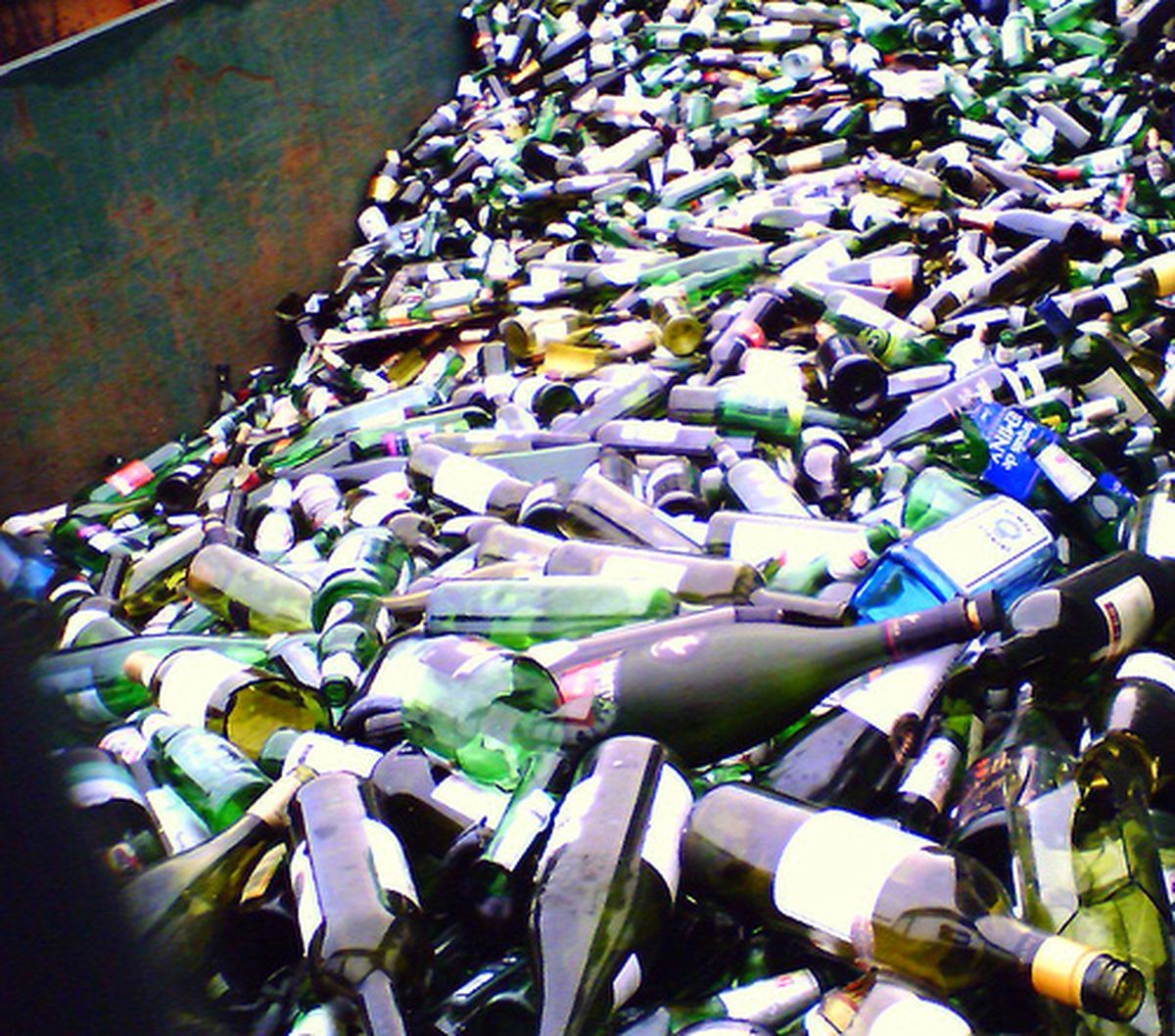
Driving over broken glass might not sound like the best idea, especially if done deliberately. But if your route takes you to the newly reconstructed Market Street in Hillyard, that’s exactly what you’ll be doing.
Luckily for your tires, you’re not going to find jagged chunks of sharp glass sticking out of the roadway. But approximately 1,400 tons of crushed glass combined with crushed rock was used to create the bed for the asphalt in the 1.25-mile roadway reconstruction. It’s a pilot project for the City of Spokane, which, for the past year, has been plagued with the question of what to do with post-consumer glass.
“Right now, no glass is moving out of Spokane; it’s just too cost-prohibitive,” said Ann Murphy, education coordinator for Spokane Regional Solid Waste Systems. “However, we are continuing to collect it and look at different ways in which we can use it, such as more road base use or as aggregate in construction projects.”
What to do with glass – our bottles, jars and more – has always been an issue in the Spokane area, says Murphy. When glass recycling started in 1990, it was subsidized by SRSWS in order to keep it out of the Waste to Energy process and send it to viable markets.
Glass that was initially collected was usually sent to a Canadian facility which remanufactured it into fiberglass. However, about eight years ago, this process slowed as the facility would intermittently reject loads because of more stringent glass contamination guidelines or equipment maintenance issues, which caused the plant to shut down completely.
Because of this, much of our area’s glass was stockpiled at an SRSWS site in Colbert.
This past year’s economic downturn made the situation even more acute.
“With the economy hurting the construction industry, the demand for fiberglass really diminished, thus creating a lesser demand for our glass,” said Kevin Holcomb, assistant manager at Pacific Steel and Recycling. Plus, an unfavorable weight-to-value ratio makes long-haul transportation uneconomical, ruling out driving our glass to the next closest glass recycling plant, in Portland, Ore.
Due to these variables, communities located far from glass recycling centers have abandoned curbside glass recycling all-together. Kootenai and Bonner counties in Idaho both began sending glass to a landfill in 2008.
Roger Saterfiel, Kootenai County’s Solid Waste director, hasn’t given up trying to find viable places to take glass.
“Just because we don’t take it doesn’t mean we’ve stopped looking for a market or a solution,” Saterfiel said.
The City of Sandpoint still recycles glass even though surrounding Bonner County doesn’t. Currently Waste Management takes Sandpoint’s glass to Graham Road Recycling Disposal in Medical Lake, Wash., where it is crushed and used for road base. However, when the contract with WM ends in May 2011, city officials are unsure if it will be renewed.
A local grassroots environmental group — The Sandpoint Transition Initiative — has researched other options including shipping glass to tile manufacturers in Oregon or to Lewiston, Idaho, to be used as fill in city projects. But transportation costs weigh heavily.
“It’s frustrating that something we have so much of and that’s so reusable has no market,” said Jen Del Carlo, chairman of the STI working group researching waste issues.
First and foremost to the group’s mission, Del Carlo says, is to reduce material that goes to landfills.
According to the Earthworks Group, a recognized leader in environmental planning, about 28 billion bottles and jars are thrown away every year, even though demand for quality cullet (crushed glass) outweighs supply. That’s enough to fill a space the size of New York’s former World Trade Center every two weeks.
Without the factor of transporting, recycling glass is very cost-efficient, as well as environmentally friendly, using much less energy than manufacturing from raw materials. When glass is made from scratch, high temperatures are needed to melt and combine the ingredients. Cullet melts at a lower temperature, so the more added to a batch of raw materials, the less energy needed to melt it, therefore reducing air pollution by 20 percent and related water pollution by 50 percent.
Reuse of glass containers benefits the environment even more so. Refillable bottles are used extensively in many European countries, such as Denmark where 98 percent of bottles are refillable and primarily returned by consumers. A similarly high number is reported for beer bottles in Canada.
These systems are typically supported by container deposit laws like the U.S. Bottle Bill. These types of bills require a refundable deposit be charged per bottle purchased. When the consumer returns the empty bottle to the store, the deposit is refunded. The retailer then recoups the deposit from the distributor.
However, the many unclaimed deposits each year remain the property of the distributors and bottlers in most states, amounting to millions of dollars a year. In Michigan and Massachusetts, the courts have ruled that these unclaimed deposits belong to the state, and are now used to fund their environmental programs.
Despite these statistics and although support for deposit laws is widespread, members of the beverage and retail industries consistently spend large sums of money to prevent bottle bills from being passed, insisting they result in increased costs to them, increased cost to the consumer and the elimination of jobs in the container manufacturing industry.
For this reason in large part, only 11 states currently have the Bill in place, with 13 states (not including Idaho and Washington) currently running “Bottle Bill” campaigns. Just recently Washington House Bill 2644 was defeated.
“I think at this point we need to try and deal with the issue of glass recycling as best we can on a local level,” said Jamie Davis, a Sandpoint City Council member, and member of an informal committee of Sandpoint residents discussing the feasibility of opening a glass re-use facility in the area.
The idea here is that the glass would be tumbled, and then used for mostly artistic means. The committee is looking to possibly enlist graduate students in the coming months to conduct a market analysis for the project.
As far as Spokane’s continued glass recycling, it has yet to be determined if money saved from transporting the county’s 5,300 tons of collected glass annually across our borders for recycling will even cover the increased cost of using glass in the mix to repave our streets. Using glass in the Market Street pilot project added an estimated $30,000 to the cost.
However, regardless of the numbers, city officials are looking to use recycled glass in future projects, confident that working with it will become cheaper as the city and contractors gain experience.
“We are committed to keeping glass a priority in Spokane…to finding additional and preferably local markets,” said Murphy.