
Gabriel Brown: Educating through art
Tries to stimulate but not anger minds with his artwork

On a misty morning in late July, I’m sitting with artist/activist Gabriel Brown on the patio of the super sustainable Saranac building.
Brown is describing something that clearly invigorates him—our city’s potential to become a transition culture where localized food, sustainable energy sources, a resilient local economy and a strong community are the norm.
I’m thinking that five years ago this little vignette could easily have played out on the other side of the Cascades. Here it would only have been a scene in an imaginary play titled “Dreams of Being a Real City.”
But the view of our local sustainable landscape has blossomed in recent years, thanks to people like Brown who see Spokane as “the big little city that could” and aren’t willing to just sit back and wait.
For a guy who was raised amidst all the conveniences of American consumerist culture, Brown’s days spent lounging in his parents’ backyard pool could very well have steeped him in the notion that he was entitled to a future of luxuries.
His innate awareness of just how fortunate he was coupled with his out-of-the-box, organic way of thinking instead became the launch pad from which his works of art and art performances soar.
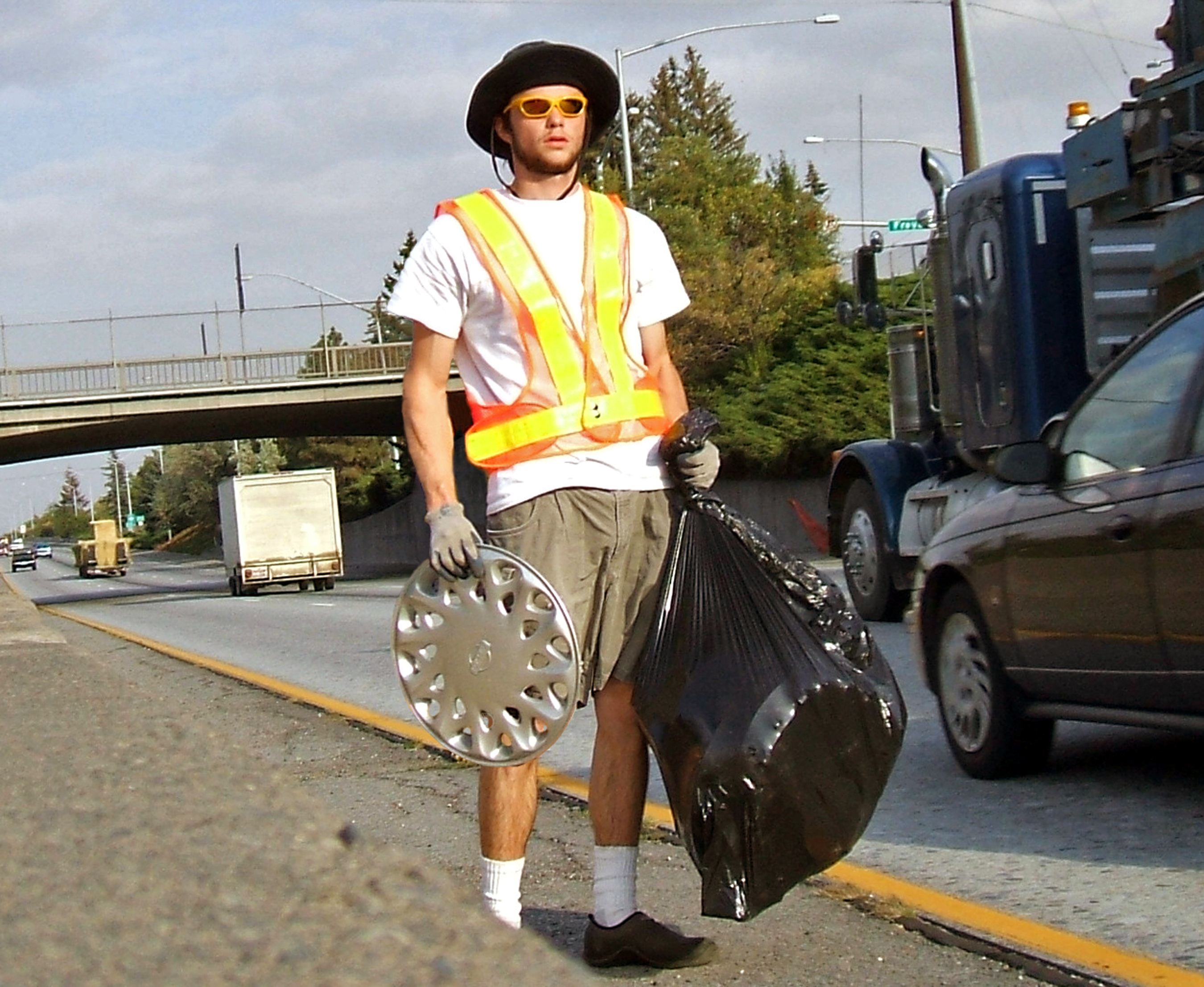
When not at his day job at Community Minded Television via AmeriCorps VISTA program, Brown is a self-proclaimed ‘garbologist,’ collecting art fodder from Dumpster diving and general rummaging of any garbage bin, bag or can he comes into contact with.
He’s even created a performance piece around this hobby, in which he, while dressed in a suit and talking on his cell phone, pushes the “Hummer of shopping carts” around downtown, while lifting recyclables from the litter.
Although his performances, including one of his most popular—standing on a street corner in a business suit, holding a sign saying “My Lexus Needs a Tune-up” or “Will Work for Starbucks” — may seem tongue-in-cheek; and while his MAC exhibit last year, “Great Tasting Goodness” consisted of cookie-cutter houses made from consumer packaging in a cul-de-sac design was colorful and pleasing to look at, this is exactly what’s so brilliant about Brown’s work: he doesn’t take himself seriously, but at the same time sends a not-so-subtle, gritty message about what he believes is fundamentally skewed about the “American way of life.”
How does your approach affect people?
I really try to make all my exhibits or my performance pieces positive, approachable; I think people are willing to listen and talk to me because I don’t accuse. I really am trying to bridge that gap of understanding for people—so that they can relate to my message, and even enjoy it…without being offended. When you start to [tick] people off, that’s when they shut down and you don’t get anywhere.
Are you often surprised by people’s reactions to your work?
I’m usually pleasantly surprised, really. I’ve found that people love garbage art. I think most people are able to admit there’s a definite excess to their lives…With my ‘beggar in a suit’ bit, it seems I really hit on something. The word spread like crazy…news stations, journalists were contacting me…people would recognize me. The irony was that it ended up being a really strong, clever idea. The question is, are they sinking their teeth into the idea, are they willing to get their hands dirty?
How else do you live your life sustainably?
Well I don’t own a car, so I ride the bus or take my bike everywhere. I’ve cut back on the amount of meat I buy as the whole meat industry greatly contributes to the excess of CO2 that’s in our atmosphere. I create almost 0 garbage—I try to buy food and items in as little packaging as possible and what I do end up with, I typically use in my art. I own some chickens, I compost, I have worm bins.
What has been your favorite show and why?
I think it has to be “Chicken Sh@#! Exploring Urban Eco-systems” [at the Saranac, New Year’s Eve 2009, with fellow artist Rimas Simaitis]. It was the most interactive and community-involved show I’ve ever had. It was inspirational, gritty, fun. There were art installations made from garbage—of course. There were chickens, who are the most economical animal…There was compost, all the ingredients for starting your own seedlings…The idea was to convey how from these ingredients, we can create our own ecosystem—we can grow more food to eat, give the waste back to the chickens to “recycle it.” It’s an immediate understanding of economics… how to turn waste into something of value.
What would you like to see happen in regards to sustainability, in Spokane in the next five to 10 years?
I’d like to see a lot of awareness raising and connecting the dots. I think the transportation issue is huge right now and hopefully will move to a more sustainable model. The lack of current interest depresses me.
People don’t realize how this lack of interest is directly affecting STA’s funding. I’d like to see Spokane become more of a “transition network”—which really takes into account the bigger picture—how transportation, education, the elderly population, how our neighborhoods are constructed, all works together. It’s a very humble, old fashioned, practical-yet-charming, yet serious approach to the way in which we live and interact together.
For more details about Gabriel Brown visit www.gabrielbrown.net.