
There’s no place like Hoh
Heavy rain? At Olympic National Park rain forest, it’s usually an understatement
HOH RAIN FOREST, Olympic National Park – Diamond drips of moisture cling to the tips of branches, and a soft drizzle eases from a thick quilt of clouds overhead.
“This is girlie rain!” scoffs Jon Preston, as he heads deeper into the rain forest.
He ought to know. Lead rain-forest interpreter for Olympic National Park, Preston knows wet when he sees it, in a place that can get 12 feet of rain a year.
Preston poured more than 24 inches of rain out of his rain gauge at the Hoh in January – more than 4 inches above average.
He wasn’t the only one who got a good soaking. Other areas on the Olympic Peninsula got socked with 170 to 200 percent of average rainfall in January.
Here in the Hoh, all that moisture is sopped into mosses and other epiphytes – plants growing on top of other plants – that pad the big-leaf maples.
In the winter rainy season, Preston likes to knock on the trunk of a Sitka spruce to hear its fat, resonant voice.
“Sounds like a ripe melon, it’s so full of water,” he says, rapping a giant spruce looming by the trail.
Facing west, and with no mountains between this low-elevation forest and the Pacific, westerlies barrel across a vast fetch of the sea, bringing storm after storm.
“The atmosphere is a wild ballet,” Preston says. “We get it all: Pineapple express. Frontal system after frontal system, lined up on the Pacific like a platoon of soldiers. Mid-latitude cyclones.”
Trees can grow to epic heights, towering more than 200 feet and living more than 500 years. Rain begets more rain: Moss moves water by osmosis, cell by cell, until its green tips glisten with drops with nowhere else to go, and fall to the ground. Moss rain.
Cloaked and draped in green, and glazed with moisture, every surface is wet and alive with something – or decaying to make way for the next generation of life.
“I like the intricacy of all the lives of various kinds, the hidden realms and wheels within wheels,” says Ruth Kirk, 85, of Lacey, Wash., co-author of “The Olympic Rain Forest, An Ecological Web,” the classic text on the forest’s ecology.
Kirk is the one who made the plaster casts of animal tracks on display in the Hoh Rain Forest visitor center. She carried a sack of plaster into the rain forest while staying in remote cabins by herself to work on the book, going out to cast footprints nightly after dinner.
In a too-busy world, she finds the stately pace of the rain forest a welcome reset button. Time on a grand scale is on display here, in trees standing sentinel for centuries, and the cycle of decay and renewal relentlessly under way in the rain forest’s mild climate.
The trunks of fallen trees act as nurse logs for the next generation. Seedlings root in the nutrients and moisture of the decaying wood, above the hurly-burly competition of the forest floor.
“It’s the changing of the guard. Each organism there has a finite amount of time, but the flow of life is unending,” Kirk says.
“It is healing to us in these tumultuous times, it’s peaceful to us. You surround your own self-importance in that great web of life, and you are not so dang self-important anymore.”
This, Jerry King knows from long experience.
He’s a lifelong resident of Forks, Wash., which proclaims itself the rainiest city in the Lower Forty-eight (annual average rainfall: 117 inches).
His family has kept a volunteer observation station for the National Weather Service in his back yard for three generations – and his rain gauge has been getting a workout lately.
Forks saw 5.3 inches of rain on Jan. 11, the wettest day that month. King’s daily weather report for the trailer park he owns with his wife, Margaret, is a dismal diary, starting with “Damaging wind, heavy rain,” on New Year’s Day.
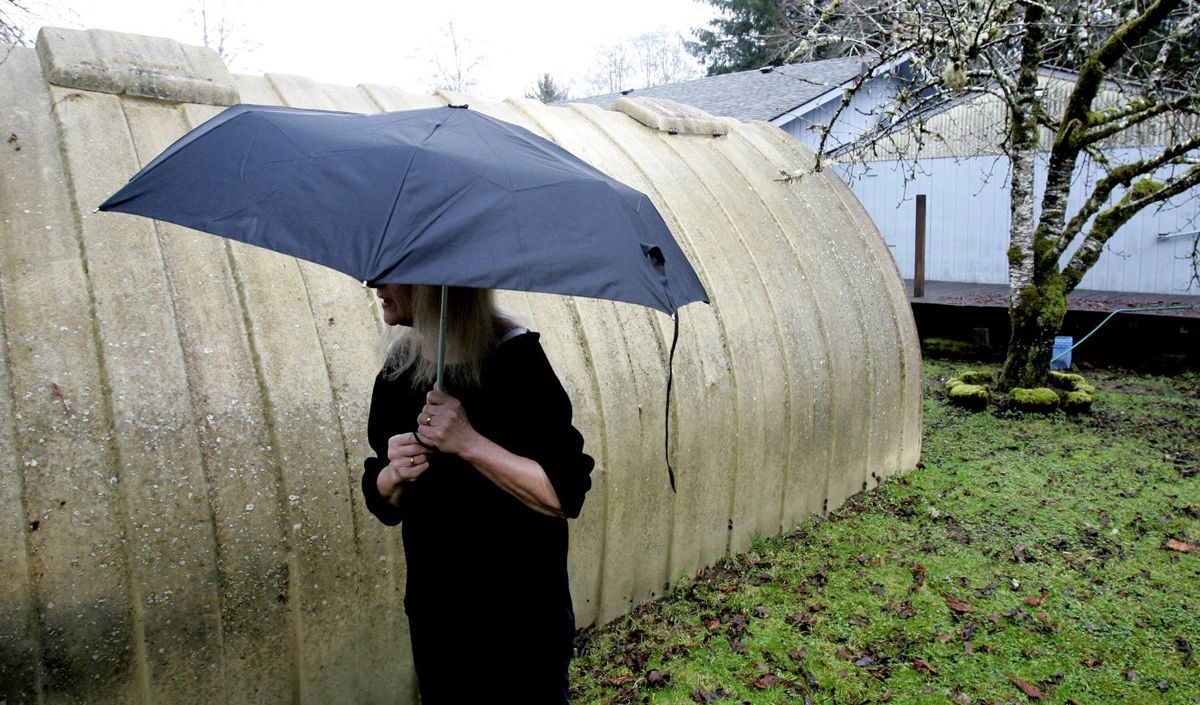
Margaret King, a native of Scotland, raises an umbrella overhead in their yard as she takes out their dogs on a recent afternoon – actually a dry day for Forks, with less than an inch of rain.
“She’s a sissy,” King says, teasing as she raises her bumbershoot. “She’s from the British Isles.”