
Organization helps educate community about the value of trees
Community Canopy hopes to continue outreach

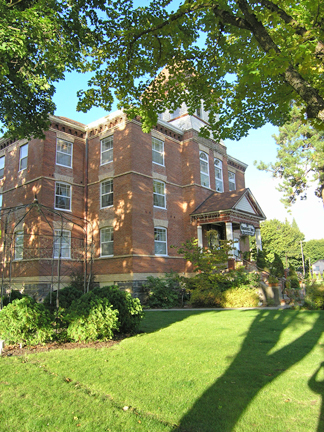
Trees add beauty to our dwellings – they enhance landscapes and neighborhoods while also potentially increasing property values in the area.
But even more important than aesthetics, a healthy urban forest also provides environmental, social and economic benefits to an entire community; they affect the quality of people’s lives.
However, many tree owners take these living things for granted. They plant them too deep, or give them too little or too much water. They “top” trees and improperly prune them. They also damage younger ones by banging them with weed wackers and lawnmowers, which cut through their thin bark, which destroys their natural armor and nutrient transport system.
About seven years ago, these common mistakes caught the attention of urban foresters and others in North Idaho. People from Coeur d’Alene, Hayden and Post Falls started meeting over coffee to discuss what they were witnessing in their communities and what it would take to educate others about healthy, sustainable urban forests.
“Trees do a lot of work in our community,” said Karen Haskew, Coeur d’Alene’s urban forester for the last 21 years. “Our goal is to have healthy trees that are growing to maturity.”
The forestry professionals created focus groups and invited people to join their conversations. Their collaboration eventually earned a grant from the Idaho Department of Lands in 2005.
Before long, their efforts became known as Community Canopy – a tree care education partnership of the three north Idaho communities along with the Spokane County Conservation District. They also receive assistance from the University of Idaho Extension and Washington State University Extension.
In order to spread the word about proper tree care and the benefits of a “community canopy,” she and others involved help organize exhibits, workshops and in-the-field training for people who work in the landscape industry.
While its overall goal is to protect the urban forest in the region and promote sustainable tree care practices, Community Canopy has been focused on protecting the future canopy.
Young trees need to be planted in the right place and provided with adequate water and care for establishment. Tree owners often don’t water them enough or drown them, Haskew said.
People also make the common mistake of letting grass grow right up to the base of trees, which make them vulnerable to lawnmowers and weedwackers. Nutrients are transported through the layers in the bark, Haskew explained, “and if you bang the trees with mowers and cut through the bark, you cut through the support system,” she said.
When Community Canopy first came into being, members concentrated efforts on trees in public places. So they contacted businesses, professional offices and retail spaces to learn from owners and managers about their tree and landscape care.
Community Canopy then started reaching out to people in the field of landscape maintenance. In recent years, the organization has begun collaborating with a tree care educator and the Extension Master Gardeners in order to offer educational opportunities to churches, schools, homeowners’ associations, retail stores and other organizations.
The partnership – which involves about eight to 10 core members and dozens of volunteers – also developed a video about the environmental, social and economic benefits of planting and maintaining trees that has been broadcasted on local-access channels in Coeur d’Alene and Post Falls.
Trees improve air quality by removing pollutants in the atmosphere, Haskew said. “Those airborne pollutants are buffered by trees that take those carbons away and turn them into oxygen,” she said.
According to American Forests, the nation’s oldest non-profit citizens’ conservation organization, trees in Portland, Ore., remove an average of about 2 million pounds of pollutants each year. In Atlanta, the urban canopy is responsible for reducing as much as 19 million pounds of pollutants annually.
Urban forests also provide shade and reduce air-conditioning and other energy costs, said Haskew.
Trees that are properly positioned to mitigate sun and wind can save up to 25 percent of a household’s energy use for heating and cooling, according to the U.S. Department of Energy. Shading your home from the summer sun can reduce indoor temperatures by as much as 20 degrees, according to the DOE, therefore reducing the need for air-conditioning, which lessens the impact on the environment.
In addition to providing shade, trees help cool the air through a process called “evapotranspiration” – by absorbing water through their roots and releasing it into the atmosphere through leaf pores.
Evapotranspiration alone can result in peak summer temperature reductions of 2 to 9 degrees Fahrenheit, according to the U.S. Environmental Protection Agency.
Some studies also show trees can reduce stress and promote health. Areas surrounded by trees encourage people to go for walks, exercise and spend time outdoors. This can potentially build community since more people are out and about in neighborhoods.
In order to maintain a healthy urban forest, communities must always consider diversity – in size, age and species, said Haskew. You have to be constantly planting and looking out for the older ones, she said.
Some bigger trees – oaks, maples and others that are 50 feet or taller – can live for 100 years or more. Cherry trees and other flowering varieties that are smaller than 25 feet usually survive for about three or four decades.
Stressful growing conditions can sometimes result in unhealthy trees and those in urban areas are especially at risk since they are exposed to pollution, traffic, pavement, restricted root-growth area and sometimes vandalism.
Nationwide, the average community tree has a lifespan of about 15 years, said Haskew. Many of the trees that are part of the community canopy of Coeur d’Alene, Hayden and Post Falls have already surpassed the national average.
Along Sherman Avenue in downtown Coeur d’Alene, the honey locusts, flowering pears, lindens and other varieties have been around for about 20 years, she said.
“Our communities do much better than the average,” Haskew pointed out.
Last year, Coeur d’Alene, Hayden, Moscow, Post Falls, Sandpoint, and Kellogg were all recognized with Tree City USA Growth Awards. Sponsored by the National Arbor Day Foundation in cooperation with the USDA Forest Service and the National Association of State Foresters, the awards recognizes communities that have viable tree management plans and programs that promote action, education, a positive public image and citizen pride.
Tree City USA communities also receive preference when grant money for trees and forestry programs are available.
Spokane, Liberty Lake, Walla Walla and Fairchild Air Force Base were among 17 communities in Washington state that received a Tree City USA Growth Award, and the only four in Eastern Washington.
Members of Community Canopy are now coordinating with public agencies and other groups in hopes of becoming a non-profit organization. Community Canopy also has a web site and publishes several newsletters a year. Each summer, the group recognizes “landscapes of excellence” to showcase homeowners, businesses and other organizations that have made the effort to ensure the health of their trees.
“Just a little bit of education and a little bit of know-how can make a difference,” Haskew said. “This is not a rocket science. We can make a difference and care for our community canopy.”
For more information about Community Canopy, check out: www.plrcd.org/community_canopy/index.html