
For some celebrities, the camera doesn’t lie
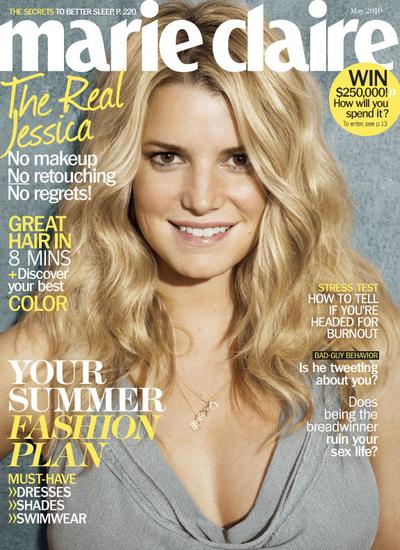
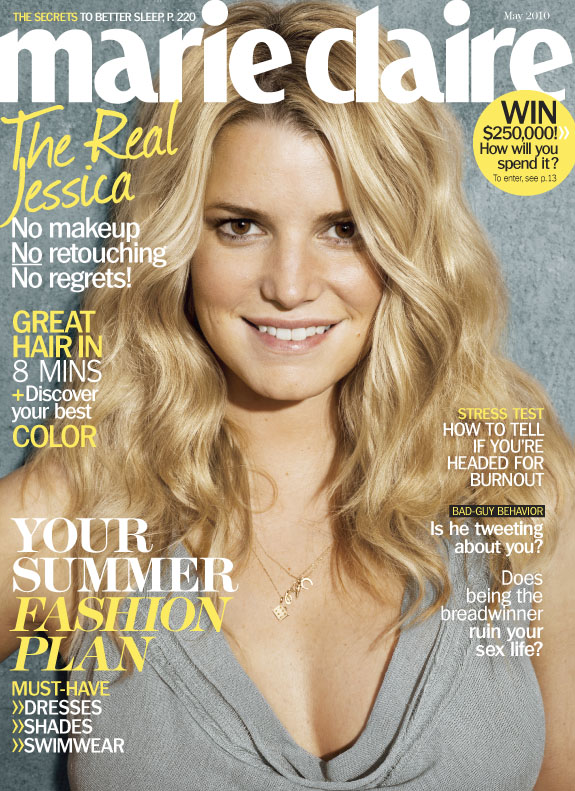
Jessica Simpson is her usual pretty blond self on the May cover of Marie Claire magazine. But where’s the makeup?
Simpson looks like a natural all-American beauty in unretouched photos that include her sitting in a grassy field running her hand through her air-dried locks and looking into the distance, the sun shining on her face.
The spread makes her the latest brave celebrity (there aren’t many) who have been willing to be seen by a mass audience without the prerequisite beautification process.
“I think she was at a place in her life where she felt comfortable doing it,” said the magazine’s editor-in-chief, Joanna Coles.
While few are willing to go where Simpson has, more are popping up.
Kim Kardashian, Joy Bryant and Amanda de Cadenet all posed unretouched – and naked – for a story on body image in the May Harper’s Bazaar. Kardashian also went unretouched in a bikini on the cover of Life & Style last year.
Claudia Schiffer posed for unmanipulated photos in the September 2009 issue of Tank, a British magazine.
Unretouched shots of Britney Spears from a Candie’s ad surfaced recently on the Internet next to more buff images the company actually used.
Marie Claire has asked many celebrities to go bare-faced, but none agreed, according to Coles.
Simpson was motivated by her VH1 series, “The Price of Beauty,” Coles said. The show had her traveling the globe with two friends to examine standards of beauty around the world.
“I think it changed the way she thought about things. I think making that show was really quite a profound experience for her,” said Coles. “There was something very liberating for her about doing this.”
Simpson, who became a household name through the MTV reality show “Newlyweds: Nick and Jessica” with then-husband Nick Lachey, faced criticism over her weight last year after she wore a pair of high-waisted “mom jeans” that cut her in all the wrong places.
“I just think she’s an interesting person to do it with because she is usually so packaged,” said Coles.
So few have gone unretouched that those who do earn notice, both positive and negative. In the original photos of Spears, she looks a little heavier, with cellulite – a point not lost on some commenters at a blog of New York magazine.
“I don’t think Britney should be hired or used for sex appeal anymore. You can sell her face alone, just do that,” said one signed MOBABY.
In 2002, More magazine ran photos of Jamie Lee Curtis, flaws and all, in undergarments.
“It’s a gimmick,” said Lesley Jane Seymour, More’s editor-in-chief. “Aside from a gimmick, you are not going to see many celebrities bare-faced. They can’t even go to get the mail bare-faced.”
European publications first photographed women without makeup and no retouching last year, then it crossed the Atlantic.
Often, it’s the celebs and their publicists who demand more retouching, Seymour said. Her magazine, aimed at women over 40, likes to keep in signs of aging.
In Simpson’s case, what’s the risk? She’s beautiful with or without makeup, Seymour said.
“It’s not me crawling out of the shower … with my husband’s iPhone photo,” she said. “It’s all very carefully orchestrated gimmicks, but clever.”
Dove has accurately depicted women’s shape, size, skin color and age in photos in their print ads since 2004 as part the Campaign for Real Beauty. The company also uses real women instead of professional models in ads.
A study conducted for Dove made executives realize they should encourage women and girls to build a positive relationship to beauty, said Kathy O’Brien, the vice president for personal care of parent company Unilever.
Only 2 percent of women around the world described themselves as beautiful in the study.
“I think it’s really encouraging that we are seeing more and more individuals or organizations embrace this idea of real beauty,” O’Brien said.
Lisa Wade, an Occidental College teacher whose areas of expertise include sexuality as power and the media and feminism, said Simpson and others are going unretouched voluntarily and have control over the images, as opposed to paparazzi photos that emerge without their permission.
“We actually do have lots and lots of celebrities when their makeup isn’t perfect. What is amazing and what we find so intriguing is that they choose to be seen that way,” she said.
Looking at less-than-perfect pics of celebs makes their status “not that unattainable” to those who view them, Wade said.
“We internalize the idea that beautiful people are better in every way,” she said, “and then we are told by society that we don’t measure up.”