
One World Cafe continues to serve community
E. Sprague location includes fresh ingredients, no prices
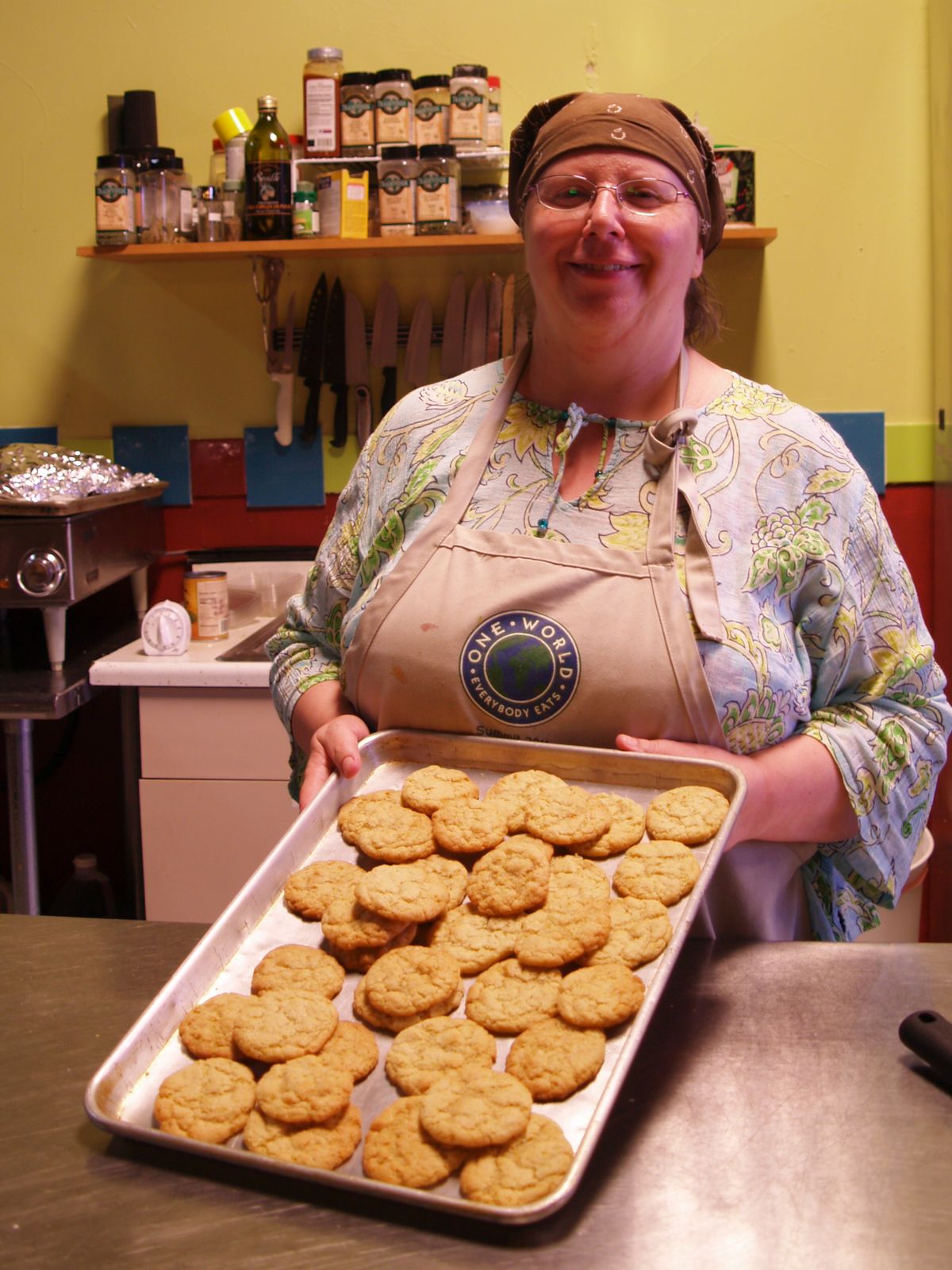
One World Café, where you choose your portions and pay as you’re able, re-opened this spring after a 2-month hiatus for reorganization and renovation.
Janice Raschko, founder of the community kitchen, spent her winter days mixing paints into vibrant tones of purple, yellow and orange, which she then rolled over walls of beige. She also wrote the café’s mission statement boldly on the front chalkboard so it wouldn’t be forgotten, and stripped dark paint off the front windows to welcome in natural light and a view of the neighborhood she loves and calls home.
Previously “just” board president, Raschko now cooks and oversees the day-to-day operations of the café and backyard garden (a 50-hour work-week) completely as a volunteer.
The business model is unconventional, but has proven to be sustainable. One World Spokane, which opened in October 2008, is run entirely by volunteers. Ninety percent of the produce served in the summertime is donated from local gardens or grown behind the cafe, food is prepared in small batches to prevent waste, and patrons choose their portions and pay what they feel is a fair price.
The cafe would not be here without Raschko and her husband, who moved to the apartment that now sits above the restaurant six years ago. A longtime business-person, Janice read about the original One World cafés in Salt Lake and Denver and immediately set to work opening the third of 13 that now operate across the United States.
“I thought it would be a really good thing for the neighborhood - I thought it would kickstart a revitalization of the community here,” she said.
Rashcko often finds herself defending its location, which sits on the 1800 block of E. Sprague, a section of town often associated with prostitution and crime.
“I just tell people, we need to be where it’s affordable and where everyone can reach us, that’s part of our mission. So, we’re on the best bus route in town.”
Besides, she says, she’s never had an “issue,” even in the backyard garden, which is extremely vulnerable to vandalism. Instead, she’s seeing new families move in, old houses being fixed up, and kids that would rather help in the garden than destroy it.
“The community really watches out for us – they feel like the garden’s their own – so they’ll treat it that way.”
In addition to justifying the location, Raschko says she continually must reinforce what One World is, and is not:
“We touch on so many different things - whether it’s feeding everyone, teaching skills, eating local, protecting the environment - but people want to put us in a box. They want to say, you’re a soup kitchen,” she said. “But we’re so not a soup kitchen – a soup kitchen relies on donations and government subsidies – we want to be more independent than that.”
Raschko believes that by eliminating extra expenses (such as paid staff), by adding suggested prices, and by keeping food waste low, the café can survive on the steady income stream coming from customers, and occasional fundraisers. Currently, the café is selling a cookbook with stories and recipes from all 13 One World’s, and is collecting used cell phones and computer cartridges to be sent in for cash.
According to Raschko, the average restaurant sees 40 percent of its food go to waste. “We are probably less than 5 percent, if that.”
Besides, financial independence, One World differs from a soup kitchen in that there are no “hand outs.” If someone cannot pay for their meal, they are asked to help. And there is plenty to do.
Volunteers range from people wanting a meal, fulfilling community service requirements, members of organizations such as the AARP, individuals who cannot find work and need to acquire marketable skills, and those who simply want to give back.
David Hart, from Career Path Services, has been volunteering since the re-opening,
“It’s a great place to be,” he says as he gets the day’s selections ready to serve. “I love it here.”
Every day, the café offers a complimentary vegan, vegetarian soup. From there, customers can create custom pizzas with fresh ingredients from the garden or can choose from a rotating selection of garden and deli salads, all topped with homemade dressings. Suggested prices range from $3 to $10 depending on size, and take-out containers are available for all items.
“We only make what either we’ve grown or what’s been donated, and what’s in season, so our menu is never the same,” Raschko says, who learned to cook from her mother. “I keep it very basic and never use fillers,” she promises.
Currently, the café is open 11-2 Monday through Friday, and every second Saturday. Doors are also every third Friday for the International District Art Walk and Raschko plans related activities, such as live music, art exhibitions, and fun for kids. .
“Who knows,” she laughs, “we might have a whole circus out here.”
“And oh,” she adds, “all those street musicians getting hassled downtown, come out here, you can do whatever you want. All we ask is that you have fun.”