
Main Market marks first anniversary
Spokane co-op wants to continue to hear suggestions
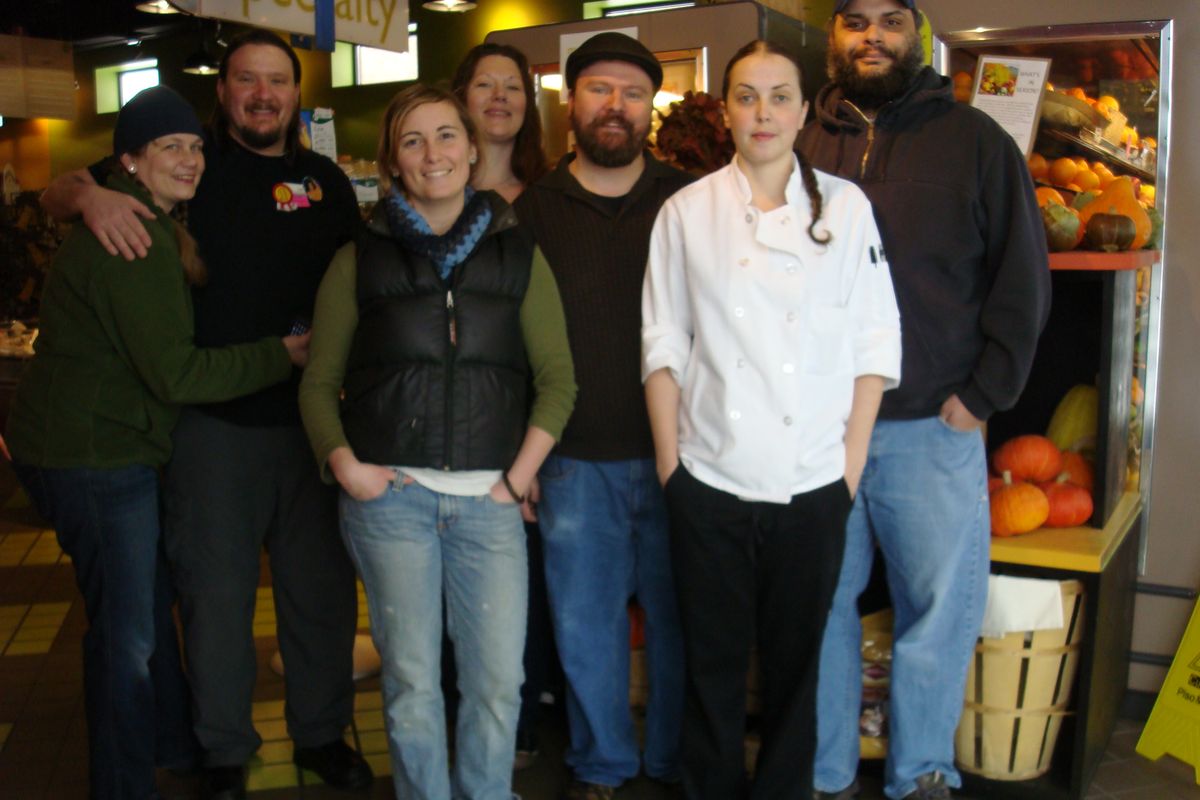
On Jan. 21, 2011, Main Market Food Co-op graduated from its first year of Spokane schooling, and the lessons this community taught the fledging grocer were similar to those many of us learned in kindergarten:
Listen. Practice basics. Meat and potatoes make things better. Share.
Lesson 1 came as no surprise to General Manager Jeanette Hamilton, who ardently subscribes to the principle that “co-ops are defined by their communities.”
She relies on customers to tell her how to, or how not to, run the store.
“If folks aren’t telling us what they want, then we can’t fix it. That’s the whole purpose of this co-op - to meet the needs of this specific community,” she said.
The Spokane community has never been shy to educate Main Market.
“We started off trying to do things differently,” Hamilton recalls, “But we quickly learned that people wanted what they had seen in more established co-ops. Our customers didn’t want us to reinvent the wheel.”
So, she said Main Market adopted a “back-to-basics” approach, mirroring what was seen in time-tested stores. On matters like product selection, this was fairly easy. On prices, “not possible,” says Hamilton, “yet.”
Hamilton said complaints about high prices were common when the market first opened, but insists that they were “absolutely not an attempt to make a bunch of money fast.”
Rather, higher prices are part of being a young co-op.
“When you’re brand new, you’re just not going to get deals, but once you develop history with suppliers and show that you’re going to pay your bills on time, then you start to get price breaks,” she said.
Plus, Hamilton explains that being small can also weigh against getting great deals.
“A big warehouse that buys things by the pallet is going to get a better price than when you’re like us and you buy things by the case,” she said.
Main Market plans to join the National Cooperative Growers Association, a collaboration of co-ops that pool their buying power to get better deals from suppliers.
To be accepted into this select club, a co-op must be at least 18 months old and meet certain growth and financial criteria. Hamilton plans to apply soon, and if accepted, expects Main Market to be able to lower prices on non-locally sourced products.
Even with current prices, however, the deli staff has sold plenty meatballs, shepherd’s pie, beef stew, and other animal-based entrees.
Enter Lesson 3: Meat and potatoes make everything better.
Unlike other co-ops where Hamilton has worked, meat remains a top seller in the Spokane deli – all year round.
Hamilton believes this preference is undeniably unique to Spokane and not a bad attribute at all.
“We don’t have to be vegetarians to eat responsibly and I think people in Spokane get that,” she said. “There are definitely other co-ops where the mindset is more – we should be eating tofu and brown rice – and that’s just not a hit around here.”
Main Market is also trying to “share with others,” a lesson impressed upon it by the Moscow Food Co-operative, which put the co-op principle of “cooperation” into practice by loaning a sign for Main Market’s February campaign.
“They very generously said, ‘you can use this - there’s no fee, and we don’t have a trademark or a copyright on it,” she said.
The borrowed sign is part of a campaign launched in mid-February to inform customers how many miles a product traveled to get to the store. Main Market has defined “local” as any place within a day’s drive of Spokane, but Hamilton understands that “just saying local isn’t nearly enough information for a lot of people.”
She believes that placing “mileage” signs next to products is the most effective way to let people decide “what’s local enough for me?”
This right to self-determination is fundamental to the member-owned structure of food co-operatives and basic for Hamilton.