
‘Drive’ time
Actor Ryan Gosling, director Nicolas Winding Refn share the wheel in new thriller
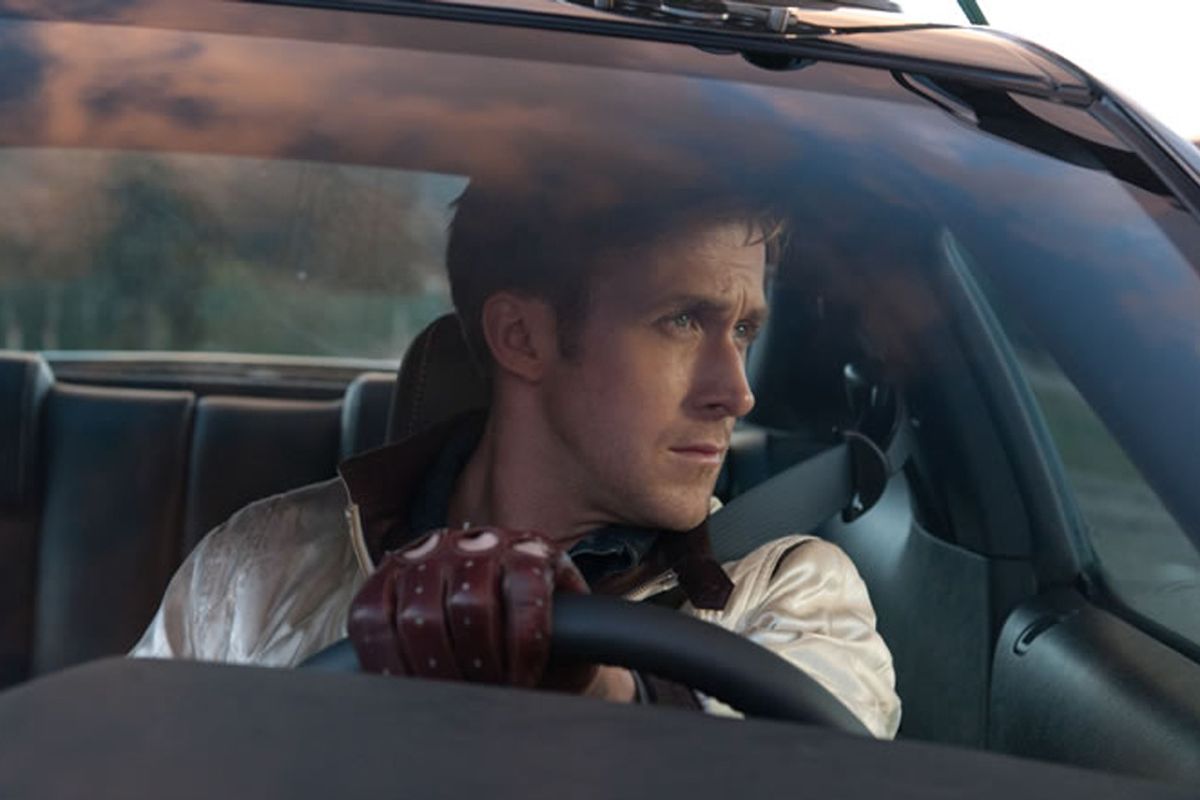
But when Ryan Gosling and director Nicolas Winding Refn would wrap 12 hours of shooting on “Drive,” their new thriller about a man who cruises around Los Angeles, they’d do the last thing you might expect: They’d get in a car and cruise around Los Angeles.
“We would just drive for hours, talking and listening to music,” recalls Gosling, who always took the wheel. “And I would say, ‘This is what we want to capture in the movie, this feeling of being in a trance in a car with pop music playing.’ ”
A stylish and often dreamlike mood piece with flashes of a 1980s aesthetic, “Drive,” opening today, romanticizes and occasionally criminalizes the activity many of us dread most about living in L.A.
Inside their vehicles, characters seek peace, make escapes, find romance and commit murder.
But to say “Drive” is about automobiles would be like saying “Rocky” is about boxing rings. Over its ethereal electro-pop score, the film probes themes of loyalty, loneliness and the dark impulses that rise up even when we try our hardest to suppress them.
Gosling’s taciturn character – known only as Driver – has a stable, if isolated, life. He’s stuntman by day and a getaway-car driver by night, and when he’s not engaging in one of those two gigs, he logs hours in the garage of a loser-ish mechanic (Bryan Cranston) or tinkers with engines and other auto parts at home.
Driver’s routine is shaken up when he meets Irene (Carey Mulligan), a young mother who lives in his apartment building. The two begin a tentative but tender relationship; Driver also establishes a rapport with Irene’s young son.
The idyll, inevitably, doesn’t last. When Irene’s semi-estranged husband is released from jail and set upon by thugs, Driver, out of a mixture of love and loyalty to Irene, agrees to help him with a robbery that will get the thugs off his back.
Soon Driver is caught up in a dangerous scheme involving a pair of ruthless gangsters (Ronald Perlman and Albert Brooks, the latter in what may be a career-reinventing performance). They’re the sort of characters who exact revenge by shoving forks in the eyes of those who wronged them, prompting Driver to think on his feet and often with his fists.
“I wanted to play with the classic notion of a fairy tale,” Refn says. “Driver protects purity, and yet he can slay evil in the most vicious ways possible.”
The film, adapted loosely from James Sallis’ lean noir novel, is characterized by moments of shocking violence. Its edginess won it plaudits at this year’s Cannes Film Festival, where it was one of the more gory titles ever to play the prestigious competition section.
Among its jaw-dropping scenes is a brutal beating in an elevator that makes Irene see Driver in a new light – and might do the same for how audiences view Gosling.
Also upending previous perceptions of the Oscar nominee (“Half Nelson”) is how rarely Gosling, normally known for verbally dexterous parts, actually speaks in the film.
Like a vintage Steve McQueen character, Driver can go without words for minutes and never utters more than a short sentence or two at a time – an approach that Gosling says he improvised at the start of production.
“After ‘Blue Valentine’ and all the press and all the talking for that movie and in that movie, I was tired of talking,” he says, referring to his role in the 2010 romantic drama.
“We also wanted to create an atmosphere of being in the car and the spell it puts you under, and talking pulls you out of that spell.”
He adds: “Plus Nic was listening to his iPod on set, even during takes, so the idea of talking didn’t seem important anyway.”
Although only 40 and with just one Hollywood movie under his belt (this one), Refn has already developed a reputation for the sort of unconventional on-set behavior that would make David O. Russell blush. His dynamic with his actors veers between taskmaster and Zen master.
He prodded Brooks to attack an actor in a minor role so hard that by the end of one take Brooks had the man by the neck, against a wall, causing him to collapse in a heap.
“I really thought, ‘This is it. I killed him,’ ” Brooks says. “I was relieved to find out he was still alive. Then Nic told me, ‘Go again.’ ”
At the same time, Refn would often hug Gosling before a take for a minute or longer until his leading man submitted to it. He then communicated his approval by saying, “Go with God,” and walking away.
Refn, who works mainly out of Europe and New York, decided to direct “Drive” because, he says, a tarot-card reader in Paris told him he would have a good experience making a film in Hollywood. So he went all in, renting a home in the Hollywood Hills and turning it into a kind of filmic Animal House.
Writers lived on a top floor, editors set up a suite in the living room, and Refn’s family, including his wife, two children and mother, bunked there.
Even Mulligan, recently broken up from Shia LaBeouf and gripped by a sense of domestic displacement, moved in. She quickly became a kind of den mother for the cast and crew, baking them carrot cake and other desserts.
Refn and Gosling set to collaborate on as many as three more movies together, including a remake of the 1976 cult hit “Logan’s Run.”
When they first met to discuss how to bring Sallis’ novel to the screen in “Drive,” things came into focus when the actor was driving the director back to his hotel.
REO Speedwagon’s “Can’t Fight This Feeling” came on the radio and the two began belting out verses. They decided to depart significantly from the book, which has few actual driving sequences in it, instead creating a music-oriented movie about a man who drives around Los Angeles.
Ironically, Refn notes, he doesn’t drive himself and doesn’t even have a license. But true to his persona, there’s a rich and geeky explanation for that: “Like (J.G.) Ballard in ‘Crash,’ I find driving so sexual and exciting, and I’m very much aroused by speed. So I will never control a machine.”
Gosling, looking increasingly disturbed as Refn offers this thought, is asked if he likes when his collaborator gets esoteric.
“Not,” he says, “after that.”