
NW activists encourage Gates Foundation to cut ties to Monsanto
Chemical company part of nonprofit’s portfolio
It’s huge – asymmetrical, shaped like two fat boomerangs meeting in midair. Benefactors call it a campus.
NBBJ architects had to design a colossal office complex of 900,000 square feet to accommodate the 1,200 employees of the Bill and Melinda Gates Foundation. It cost around $500 million to build.
It’s a prime piece of property in downtown Seattle’s Westlake area. The non-profit got the 12 acres for a relative song – $53 million after the land was appraised at $72 million.
Then the City of Seattle “gave” another $28 off the price, so this land ended up costing Bill and Melinda Gates – via their foundation – $25 million.
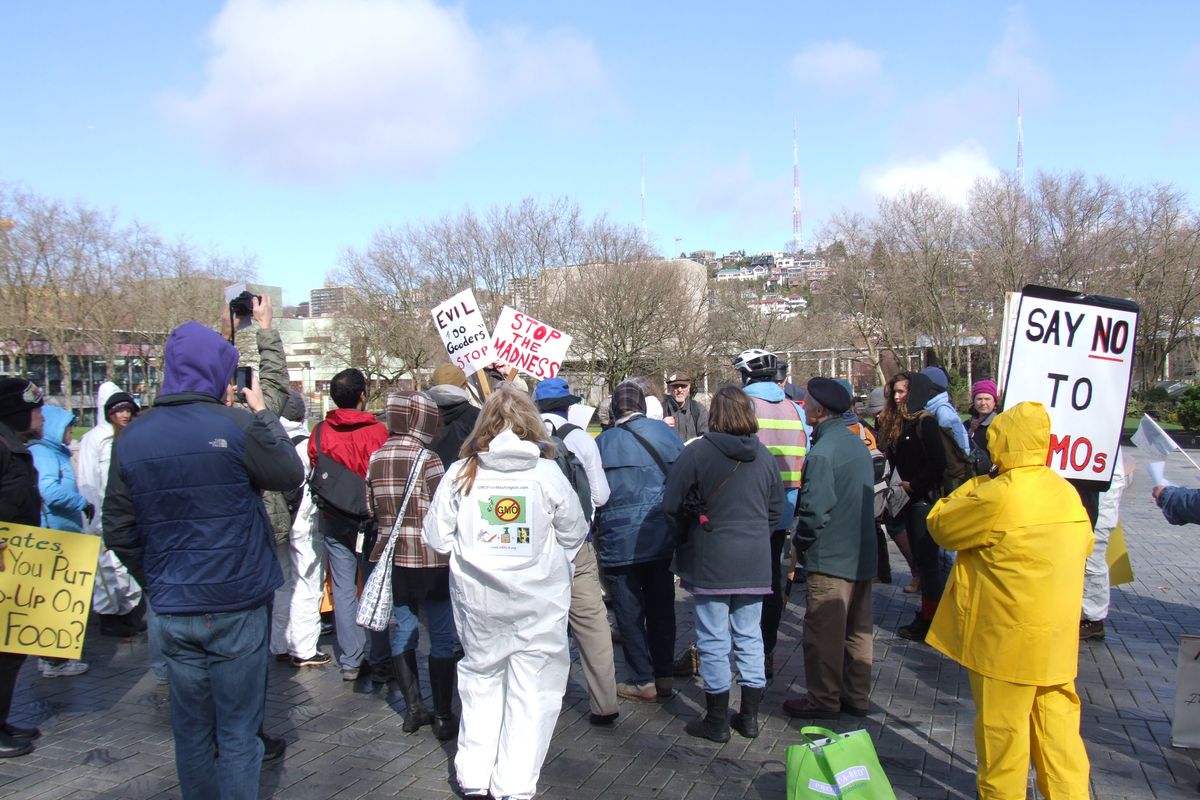
On March 16, more than 40 people, as part of a global day of action against Monsanto, marched to and around the Bill & Melinda Gates Foundation “campus” to deliver a letter asking the foundation to divest from Monsanto (the foundation has more than $23 million in Monsanto stock as part of a very odd mix of companies in their portfolio).
Trying to eradicate developing countries’ diseases, forcing genetically modified farming into Africa, and weighing in on and lobbying for privatizing public education are just a few of the Gates Foundation’s larger goals, largely financed by $11.9 billion, with the following five top stock holdings:
Berkshire Hathaway Inc. - 73,997,400 shares, 49.75% of the total portfolio.
McDonald’s Corp. - 9,372,500 shares, 5.21% of the total portfolio.
Caterpillar Inc. - 9,590,400 shares, 4.86% of the total portfolio.
The CocaCola Company - 10,182,000 shares, 4.31% of the total portfolio.
Waste Management Inc. - 15,716,367 shares, 4.15% of the total portfolio.
They’ve got 500,000 shares of Goldman Sachs, 7.1 million shares of Exxon Mobile and those half a million shares of Monsanto.
What’s all the protesting about? According to Dena Hoff, a diversified family farmer in Glendive, Montana, and North American coordinator of La Via Campesina, “The Bill & Melinda Gates Foundation Trust’s purchase of Monsanto shares indicates that the Gates Foundation’s interest in promoting the company’s seed is less about philanthropy than about profit-making. The Foundation is helping to open new markets for Monsanto, which is already the largest seed company in the world.”
These aren’t sour grapes about one of the richest people on earth capitalizing on stock trading. Monsanto, who created the dioxin-leeching defoliant Agents Orange and Blue, is one of the main drivers of genetically modified foods.
Heather Day, director of Seattle-based Community Alliance for Global Justice, and one of Friday’s organizers, summed up the recent news on GE crops and foods: “Reports are coming out weekly about impending crop failures of GE corn in Africa, pesticide resistance for GE corn grown for ethanol in the US, and about indications that Bt toxins, the primary GE pesticides, especially when in the presence with Roundup, have potential impacts on human kidney cells and mammalian testis.”
Another one of the protestors-letter signatories was Les Berensen, a medical doctor who is also with GMO Free Washington. His concern is tied to Monsanto’s Roundup, which has the main ingredient of 2,4-Dichlorophenoxyacetic acid. Berensen mentioned how salmon and other fish species are being affected by the huge runoffs from fields of corn, beets, soy, cotton and potatoes that are genetically modified to take up to four or five dousings of Roundup.
He likened this day and age of Monsanto as a Frankenstein era for both species in the wild and the human species.
The event, like many around the world, was attended by a diverse group of people, including in Seattle: Dan Trocolli, Seattle Educators Association and Social Equality Educators; Kristen Beifus, Washington Fair Trade Coalition; and William Aal, Washington Biotechnology Action Council.
One fellow holding a corn sign and getting signatures was Travis English, University of Washington graduate student in planning and with CAGJ and AGRA Watch. He is seeing more and more destruction of departments at UW through consolidation and outright disbanding. He’s working on food policies for several cities as part of his graduate work.
“There are already many movements around healthy local food economies. There are proven projects and farms in Africa that are both sustainable and organic,” he said. “Getting people hooked on Monsanto’s seeds and pesticides with micro-loaning that they can’t pay back will result in more farms being lost and more people moving to the cities. This is not a successful formula, and the Gates Foundation should really lead by getting rid of its Monsanto stocks, as a first step.”
Many of the protesters were in haz-mat suits, and many carried signs belying the fear of this giant genetically modified experiment taking place in mankind. Ellie Rose is working on Transition Seattle and buttressing “a culture of engagement through a group called We the People Power.”
One attendee, Karen Studders, had come from Occupy Wall Street, Zuccotti Park, where for two months she lived in a tent. Studders, in her mid-60s, once worked in big business, for government organizations, and with United Nations agencies, plying her legal and science degrees from the University of Minnesota.
“We have to act quickly. The abuse of these corporations, which is so blatant now, has got to stop. I have a lot of hope after being part of the Occupy movement, especially after we were illegally evicted.”
She not only went from tent to tent to listen to the ideas and rebellion of the youth, but she went into a self-made retreat after the police crackdown, traveling to various cities to see the Transition Town movement up close and personal.
The security at the foundation would not accept the signed letter [full disclosure: I signed it] asking the Gates Foundation to divest from Monsanto. I talked with several Foundation employees – researchers with higher degrees. They said that Foundation’s employee policy is to “not let us engage in any dialogue on any issues of controversy.” Which means, nothing but the weather can be discussed? (Whoops, climate change seems to affect disease and crops). Additionally, any nice, well-crafted and footnoted handouts on Monsanto and Roundup pesticides they might be handed “will have to be handed over to security once we enter the building.”
Those three monkeys – see, hear, and speak no evil – seem anachronistic in the 21st century for a think tank like the Gates Foundation.
Fortunately, less than a week after Seattle’s event, dozens of protesters monkey-wrenched Monsanto’s California office in Davis, an area close to the Capitol, through vocal activism. Unlike Seattle’s event, the California activists made demands to shut down the biotech giant which has its talons in the United States government, including the Supreme Court.
“If a small group can take down their office for a day from some mild protests, a few hundred thousand can take down the entire company — permanently,” wrote journalist Anthony Gucciardi from Natural Society.