
Birthday reflections show a growing betrayal of our will to make change
Have traditional activist methods lost their effectiveness?
My recent birthday –- Feb. 6, a day I share with Ronald Reagan — was an occasion to ponder what 2012 means to me, and a moment to read items that I consider reflective of my interest in “the environment.”
I started with Michael Klare’s “Hormuz-Mania: Why closure of the Straits of Hormuz
could ignite a war and a global depression.” We’re talking 17 million barrels of oil a day through
the straits controlled by Iran, 1/5 of the world’s oil at this geographic hot point.
Will $100 a barrel of crude jump $50 or $100 if that closure happens? Would the Carter Doctrine propel us into another war? Will $8 or $10 a gallon at the pump sink the USA experiment?
Scouring headlines on one’s 55th birthday means taking historical gulps and long pauses. Maybe I wanted turnaround in the collective thinking about energy and climate change. What I got was Terry Tempest Williams interviewing Tim DeChristopher in the Jan/Feb issue of “Orion.”
DeChristopher shared this: “I think that’s why we’re bad activists. That’s why the climate movement is weaker here than the rest of the world. We have more stuff, higher levels of consumption, and that’s how people are oppressed, through comfort, by consumerism, by believing we have so much to lose. I think our current power structures have power over us because of what they can take away from us. If we have a lot we’re afraid of losing, or that we’re not willing to lose, they have a lot of power over us.”
DeChristopher’s prominence to stop the power inherent in power structures started at a Bureau of Land Management auction in 2008, when he tried to out-auction the oil and gas industry to acquire dirt-cheap leases on Utah’s public lands. On March 2, 2011, DeChristopher was found guilty of violating the Federal Onshore Oil and Gas Leasing Reform Act and making false statements.
He wouldn’t take a plea bargain, nor abide by the judge’s admonitions to apologize and promise to refrain from activism and writing (Judge Dee Benson later said he would have sentenced Tim to 45 days if he had done so). On July 26, 2011, Tim received two years in a federal prison with a $10,000 fine plus three years of supervised probation.
Williams, a past guest of Spokane Community College and Get Lit!, interviewed Tim at Herlong Federal Correctional Institution.
“When I asked Tim about prison, he responded, ‘All these people are worrying about how to keep me out, but I feel like the goal should be to get other people in prison. How do we get more people to join me?’”
I’m wondering how effective it is to be part of an environmental and sustainability movement so immersed in placation and false regulatory thinking (zero tolerance for wars on terror and drugs, but when it comes to stopping pollution and environmental and cultural injustices, we must accept “allowable levels of toxins and injustice to win the day in Washington, D.C., and every state House of Representatives”). Gas, oil, coal, nuclear are too big to fail.
This following item wasn’t news to some of us:
“TIME has learned that from 2007 to 2010 the Sierra Club accepted over $25 million from the gas industry, mostly Aubrey McClendon, CEO of Chesapeake Energy – one of the biggest gas drilling companies in the U.S. and one heavily involved in fracking – to help fund the Beyond Coal Campaign.”
The Nation magazine described “The Wrong Kind of Green” by journalist Johann Hari: “As we confront the biggest ecological crisis in human history, many green organizations meant to be leading the fight are busy taking cash from the world’s worst polluters — and burying science-based environmentalism in return…In the middle of a swirl of bogus climate scandals trumped up by deniers, here’s the real Climategate.”
Christine MacDonald’s book, “Green, Inc.: An Environmental Insider Reveals How a Good Cause Has Gone Bad,” is based on not just research but her ties to Conservation International.
“About a week or two after I started, I went to a planning meeting of all the media teams, and they started talking about this supposedly great new project with BP. I had read the day before that the EPA had condemned BP for running the most polluting plant in the whole country…. Nobody in that meeting, or anywhere else in the organization, wanted to talk about it. You weren’t supposed to ask if BP was really green. They were ‘helping’ us, and that was it.”
Another recent headline described how Gasland’s Josh Fox and his documentary crew discreetly attended a Congressional hearing on hydraulic fracturing, but were expelled, and Fox charged with unlawful entry.
The hearing was the House Subcommittee on Energy and Environment discussing the EPA’s draft report on links between fracking and water contamination in Wyoming, and Fox was jailed as a legitimate member of the working press.
Does anyone get it? Working within the constraints of the legal and political systems produces less than satisfactory results.
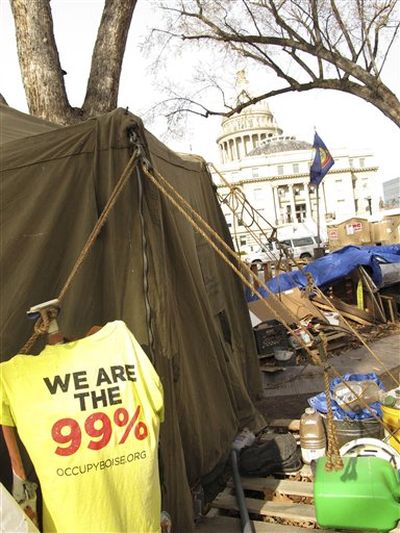
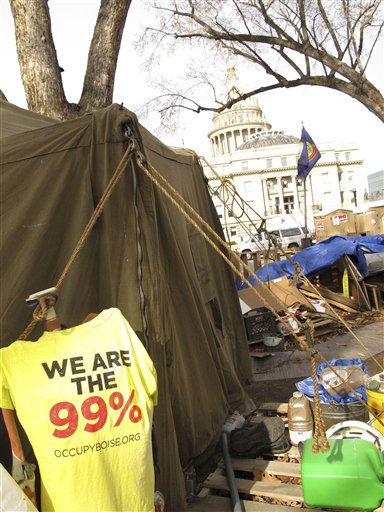
DeChristopher’s message resonates with me especially with the Occupy protests. Organizations like Wells Fargo are running scared, as our protest in Seattle a few weeks ago bore out. Well-dressed, non-abusive activists from Working Washington were not only expelled from the bank’s lobby, but security locked doors when they saw the political theater outside.
It was a compelling moment – faculty, Occupy Seattle, airport and dock workers originally from Somalia and Nigeria, and union workers including SEIU, doing our duty as citizens in a citizen-led democracy, witnessing Wells Fargo lock up like scaredy cats. Not that any of us feel that Bank of America, JP Morgan Chase and Goldman Sachs are any better than Wells Fargo.
We were protesting that 350,169 Wells Fargo homeowners were eligible for the Home Affordable Modification Program as of May 2010. As of February 2011, only 77,402 received permanent loan modifications. Wells Fargo canceled 118,697 trial loan modifications and denied 175,336 eligible homeowners access to HAMP since 2009.
This is part 1 of an analysis of the state of activism in the environmental/social justice communities.