
Military buries airmen missing since ’65 crash
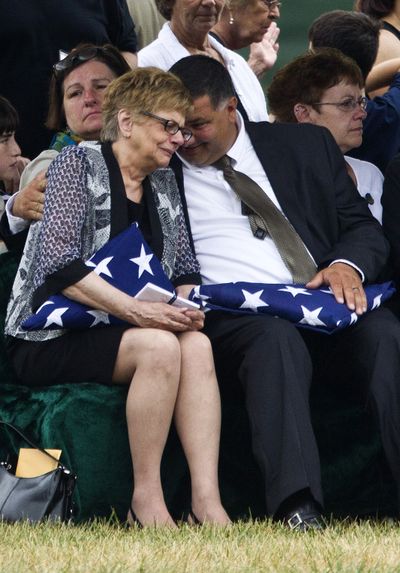
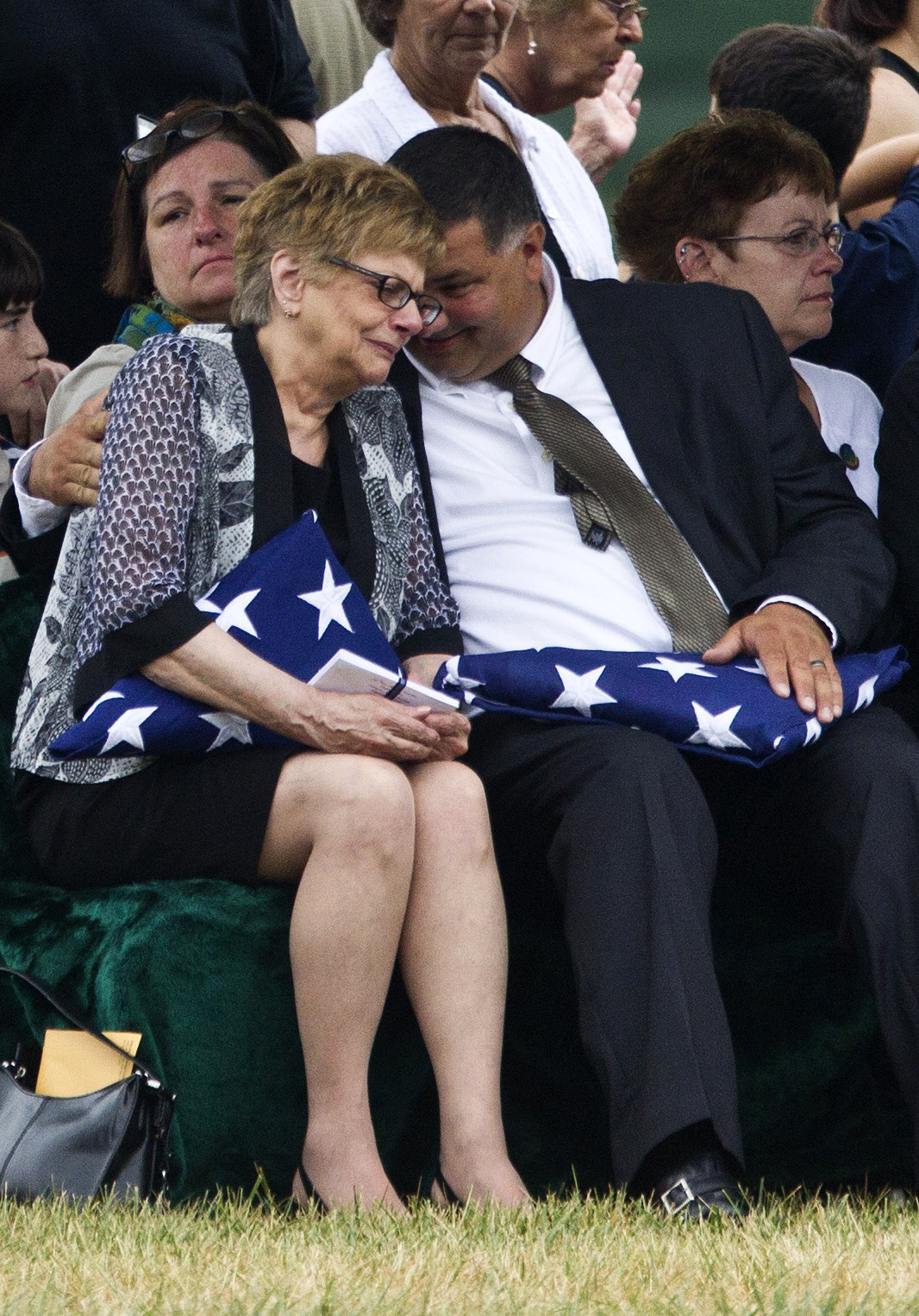
ARLINGTON, Va. – Ever since Sherrie Hassenger’s husband went missing with five other U.S. airmen over Laos in 1965, her purpose has been to wish and to hope he would come home. When those men’s remains were buried in a single casket Monday at Arlington National Cemetery, she said, some of that purpose was taken away.
“All I listen to is ’50s, ’60s music,” she said. “When I saw those Air Force men in those dress blues, just like back then, I just wanted to go up and hug them and kiss them. It felt like maybe I could find a piece of my husband in them.”
The charred remains of the six airmen – identified not through DNA matches but through dental records, personal items and other circumstantial evidence – were buried in a single casket with full military honors, as is common in situations where remains can’t be conclusively linked to a specific individual. The remains are representative of six Air Force servicemen: Col. Joseph Christiano, of Rochester, N.Y.; Col. Derrell B. Jeffords, of Florence, S.C.; Lt. Col. Dennis L. Eilers, of Cedar Rapids, Iowa; Chief Master Sgt. William K. Colwell, of Glen Cove, N.Y.; Chief Master Sgt. Arden K. Hassenger, of Lebanon, Ore.; and Chief Master Sgt. Larry C. Thornton, of Idaho Falls.
The Air Force gave all six posthumous promotions, a military spokeswoman said.
It was Christmas Eve 1965 when their Air Force plane, nicknamed “Spooky,” took off from Vietnam for a combat mission. The crew sent out a mayday signal while flying over Laos, and after that, all contact was lost. Two days of searches turned up empty.
For nearly half a century, the airmen’s families endured an emotional kaleidoscope that they say is difficult to describe to those who never had to face it. The men were listed for years as missing, and family members held out hope at first that their loved ones had survived. For most, that hope faded over time, despite an occasional unconfirmed report that crew members were seen alive. The crash site has been excavated several times over the past decade, but it was not until 2010 and 2011 that human remains were recovered.
Even though Sherrie Hassenger’s husband perhaps had the most conclusive identification of all six crew members – a tooth of Hassenger’s was recovered and matched through dental records – she and her son Keith Hassenger said they still have nagging doubts about what happened. Both said they appreciated Monday’s service, but they said they have had a difficult time getting answers over the years. The tooth, in their mind, raises more questions than answers: If a single tooth was found, they wonder, wouldn’t it make sense that other teeth or perhaps his skull could be found also?
For Jeanne Jeffords, 86, of Temecula, Calif., the hardest part of Monday’s service was seeing how emotional it was for her children, who were teenagers when their father died.
“I’ve lived with it for so long, I’m all teared out,” said Jeffords, who appreciated the opportunity to meet the families of her husband’s fellow airmen. “For all these years we just had a list of names.”
The first joint U.S.-Laotian team didn’t visit the crash site until 1995 in the southern province of Savannakhet. A villager recalled seeing a two-propeller aircraft crash near the village. A second villager had found wreckage of it and took the team to the crash site.
Follow-up teams revisited the site four times between 1999 and 2001 and recovered military equipment but no human remains, and excavation was suspended.
Excavations resumed in 2010 and 2011, when human remains and personal items were found.