
Conviction of Putin foe sparks protest in Moscow
Fraud case widely viewed as vendetta by the Kremlin
MOSCOW – President Vladimir Putin’s chief political foe was convicted along with his brother on Tuesday in a fraud case widely seen as a vendetta by the Kremlin, triggering one of Russia’s boldest anti-government demonstrations in years.
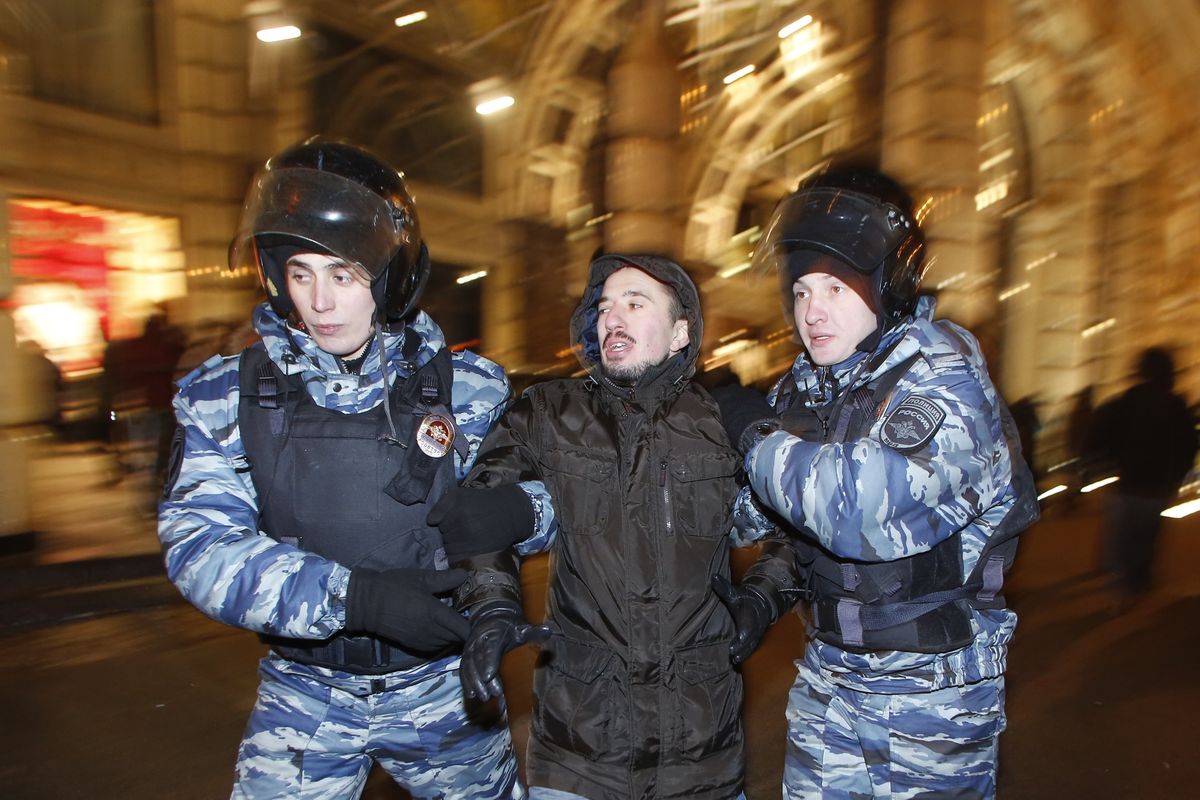
Police allowed a few thousand protesters to gather just outside Red Square for about two hours – a show of relative restraint for Russian authorities, who have little tolerance for dissent – before moving in to break up the unsanctioned rally by pushing the demonstrators toward subway entrances.
The rally came hours after anti-corruption campaigner Alexei Navalny was found guilty of what activists said were trumped-up charges and given a suspended sentence of 31/2 years. His younger brother was sent to prison, a move that drew comparisons to the Stalin-era practice of punishing family members of enemies of the state.
The 38-year old Navalny, a lawyer and popular blogger, rose to prominence with his investigations of official corruption and played a leading role in organizing anti-Putin demonstrations in Moscow in 2011 and 2012 that drew hundreds of thousands.
Navalny, who has been under house arrest since February, violated its terms to attend the rally and was rounded up by police as he approached the site. He later tweeted that police drove him home and blocked him from leaving his apartment.
The protesters, who gathered on the Manezh Square outside the Kremlin, chanted: “We are the power!” and “Russia without Putin!” Some shouted slogans of support for Ukraine, which saw its Crimean Peninsula annexed by Russia in March and has faced a pro-Russia insurgency in the east.
Scuffles erupted between the protesters and pro-Putin activists shouting, “Those who don’t like Russia should go to the United States!” – the chants reflecting the Kremlin’s depiction of opposition supporters as Western stooges.
The Russian authorities usually move quickly to break up opposition protests, and the unusual delay this time may reflect Kremlin concerns about fueling public anger amid the country’s economic woes. The ruble has lost about half its value this year, and the economy is heading into recession under the combined weight of Western sanctions and slumping oil prices.
Police said they detained about 100 protesters, while activists claimed up to 250 were rounded up. Russian law requires demonstrators to get official clearance for rallies. Violators can face prison sentences and heavy fines.
Tuesday’s verdict was not scheduled to come down until next month, but the court session was abruptly moved up to the day before New Year’s Eve, the main holiday in Russia, in what was widely seen as an attempt to head off protests. Russia’s main state-controlled TV stations all but avoided the story.
In Washington, State Department spokesman Jeff Rathke said the U.S. government was troubled by the verdict, which “appears to be another example of the Russian government’s growing crackdown on independent voices.”
Navalny and his brother Oleg were convicted of cheating a French cosmetics company and given the same 31/2-year sentence, but Navalny’s was suspended. The court also fined each man 500,000 rubles (about $8,800) and ordered them to pay a total of about 4 million rubles ($77,000) in damages.
Oleg Navalny, the father of two small children and a former executive of the state-owned postal service, has never played a role in the Russian opposition movement. Alexei Navalny and his supporters portrayed the brother’s prison sentence as a means of punishing Navalny himself.
“Aren’t you ashamed of what you’re doing? You want to punish me even harder?” Alexei Navalny shouted at Judge Yelena Korobchenko.
He entered the metal cage that his brother was put into after the verdict and appeared to hold back tears.
“This is the most disgusting and vile of all possible verdicts,” Alexei Navalny said outside court.
“The government isn’t just trying to jail its political opponents – we’re used to it; we’re aware that they’re doing it – but this time they’re destroying and torturing the families of the people who oppose them.”
The suspended sentence could be converted into a prison term at any time if Navalny breaks the law. His lawyer, Vadim Kobzev, said he will remain under house arrest until all appeals by either side are exhausted, which could take months.
The trial seemed to be full of inconsistencies.
Prosecutors insisted that the brothers forced the Yves Rocher company “into disadvantageous contracts” and defrauded it of 26 million rubles (about $440,000).
An Yves Rocher executive submitted a complaint to investigators, but its representatives insisted throughout the trial that there was never any damage.