
Officer’s trial in death of black man declared mistrial
CHARLOTTE, N.C. – A North Carolina judge declared a mistrial Friday after a jury deadlocked in the case of a white police officer charged with voluntary manslaughter in the death of an unarmed black man.
Judge Robert C. Ervin declared a mistrial in the case of Charlotte-Mecklenburg police Officer Randall Kerrick after four days of deliberations.
Ervin brought the racially diverse jury of eight women and four men back into the Mecklenburg County courtroom about 4:10 p.m. The foreman said they continued to be deadlocked 8-4, and he saw no possibility of reaching a verdict.
“Honestly, we have exhausted every possibility,” the foreman said. Officials did not say which way the vote was leaning.
Defense attorney George Laughrun called for the mistrial because jurors were at an impasse after deliberating for 19 hours. Prosecutors asked Ervin to urge the jury to continue deliberating.
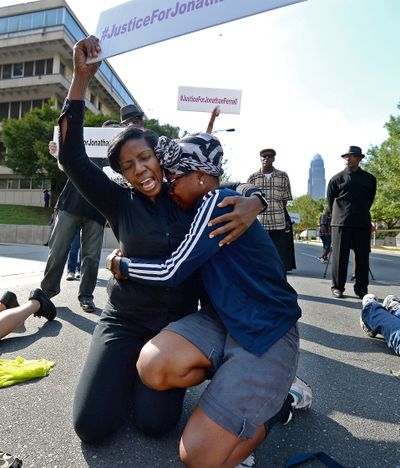
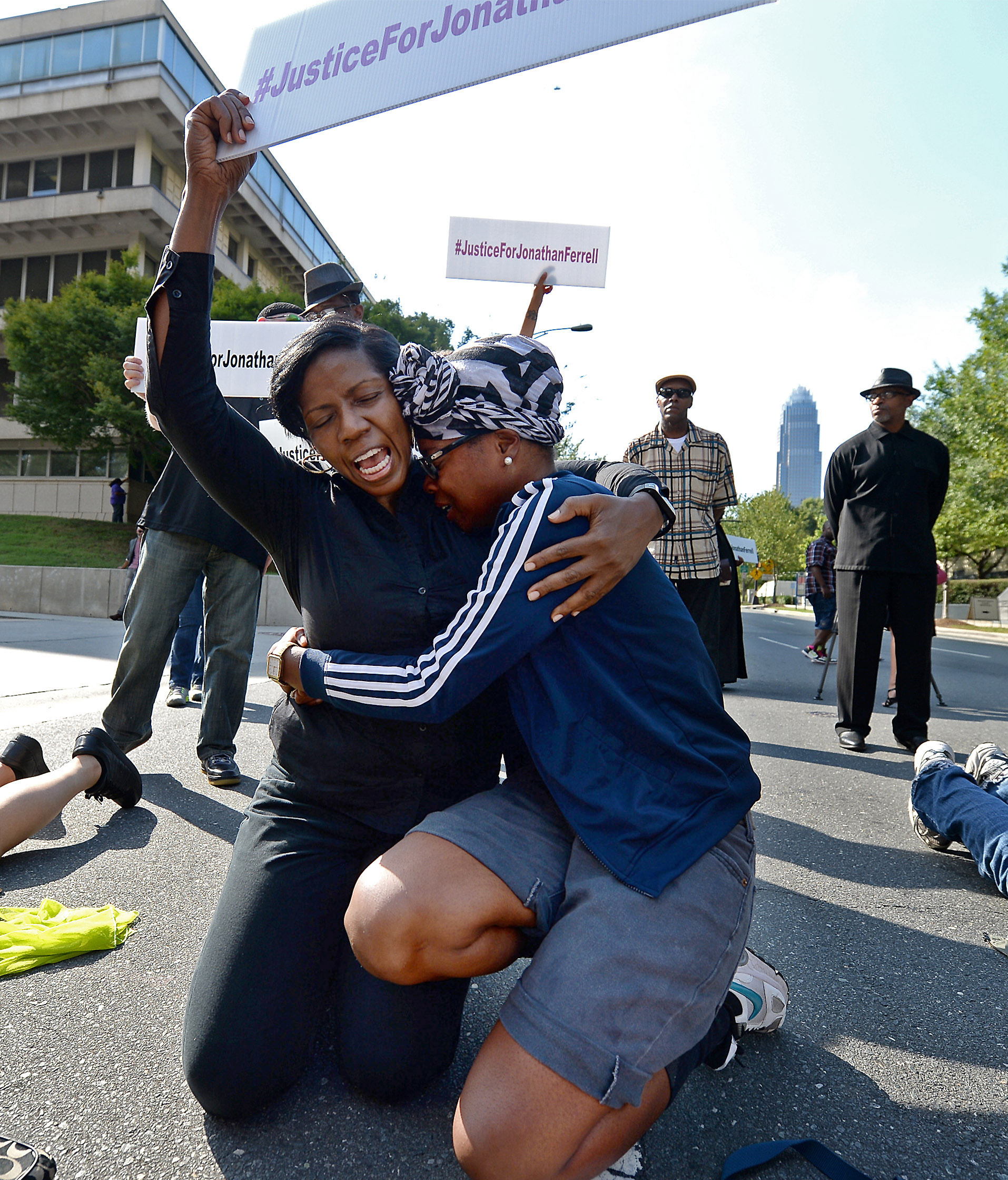
Outside the courthouse, a handful of protesters lay down in the middle of the street to protest the decision. Several shouted “No justice, no peace” at members of Kerrick’s family as they left the courthouse. They later dispersed.
The family of Jonathan Ferrell, the man who was shot, held a news conference, calling for a new trial and asking the community to react peacefully to the mistrial.
Kerrick had faced up to 11 years in prison.
Prosecutor Adren Harris said officials will review the case and consider whether to retry it.
In a news conference, Charlotte Mayor Dan Clodfelter urged the community to seek to lessen fear and misunderstanding. Police Chief Kerr Putney said his department strives for perfection, and he asked citizens not to judge it by a single incident.
Prosecutors said nonlethal force should have been used to subdue Ferrell, a former Florida A&M football player, in September 2013. Two officers with Kerrick didn’t fire their guns.
But Kerrick’s attorneys said the officer feared for his life when he shot and killed Ferrell while responding to a breaking-and-entering call.
The case was one of several in recent years that raised questions about police use of deadly force against black men.
Police said Ferrell wrecked his car on the morning of Sept. 14, 2013, went to a nearby house and banged on the door, apparently seeking help. The resident called police, and three officers responded. Investigators say one deployed his Taser without apparent effect on Ferrell before Kerrick fired 12 shots, 10 of which hit him.
Kerrick testified he repeatedly fired because Ferrell kept charging at him and he didn’t think his weapon was working.
Holding back tears and in a quavering voice, Kerrick re-created the events, at one point yelling “Stop!” and “Get on the ground!” to a nearly packed courtroom.
Police training expert Dave Cloutier testified Kerrick’s decision to shoot Ferrell was consistent with the department’s training.
However, Police Capt. Mike Campagna testified the shooting violated department policy. He said nonlethal force should have been used.
Kerrick’s attorneys contended Kerrick opened fire because he feared Ferrell was going to attack him and take his gun.
Officer Adam Neal, who also was at the scene, testified he never considered pulling a weapon that night and instead viewed the situation as one that would require physical force.
Defense attorneys noted Ferrell had smoked marijuana and drank alcohol before the wreck.
The Ferrell family has already settled a lawsuit with the city of Charlotte, receiving $2.25 million.