
Boise gets edge in battle with Japanese beetle
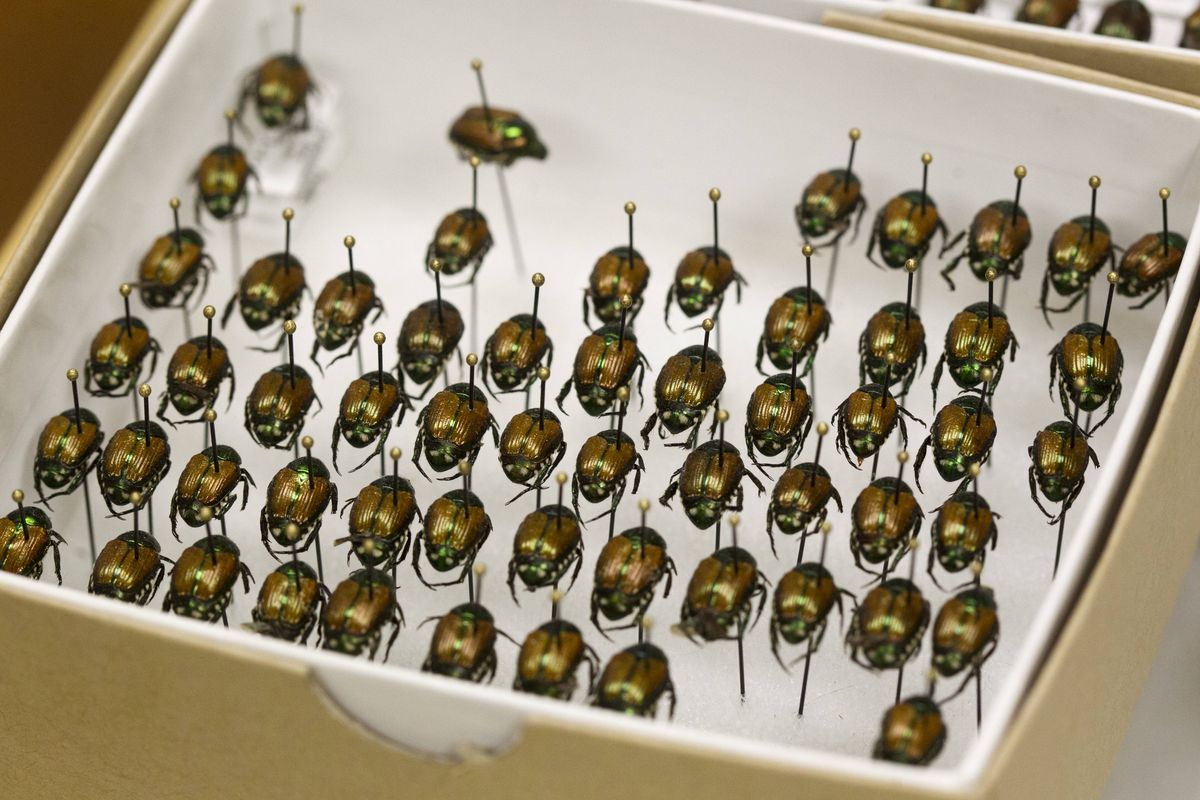
BOISE – Paul Castrovillo first started chasing the Japanese beetle in third or fourth grade in the mid-1960s, catching and collecting them on rose bushes in his New Jersey backyard along with butterflies and whatever other bugs were around.
He researched them, learning about their diet and life cycle. He occasionally roasted one with his magnifying glass.
The Japanese beetle was not then the top insect threat in Idaho, as it is today. But it had already infested most of the eastern quarter of the U.S., chewing through grass, plants and crops as its population skyrocketed.
The metallic green beetles were not a problem in Idaho until 2012, when 61 were collected in traps set by the Idaho Department of Agriculture, all in Boise’s Warm Springs neighborhood. The state set more traps and found more than 3,000 beetles the next summer.
Not wanting to become another New Jersey, Idaho looked for a bug expert to battle the beetles. They found Castrovillo, who, among other jobs, had worked in Micron’s research and development department for 19 years after graduating from the University of Idaho with a doctorate in entomology in 1982.
He had the degrees for the job, as well as experience collecting, identifying and archiving more than 30,000 specimens for the College of Idaho’s natural history museum in Caldwell. He did that on weekends and vacation days over 20 years as he set traps and swung butterfly nets.
Castrovillo told the department officials he had waited more than 30 years for such an opportunity.
“I’ve been doing this out of sheer love,” Castrovillo said. “If you’re looking for somebody to do this as an 8-to-5 job, I’d love to have it.”
Today, Castrovillo works near the epicenter of the beetle outbreak in the department’s office. Two small boxes full of shiny specimens pinned in neat rows decorate his desk. Maps of Boise marking many of the 2,500 traps set in the city decorate the walls.
Castrovillo and his team are in the third year of applying pesticides to select public and private properties in areas showing the highest Japanese beetle concentrations. The treatments, which take a year to take effect, have been successful, knocking the beetle count to 329 across the city this summer, on pace for a 72 percent reduction from last summer and 91 percent since 2013.
The state budgeted $400,000 in each of the past two years for the Japanese beetle eradication program, he said. All other insect surveys, including for gypsy moth and apple maggot, cost about $40,000 annually.
Castrovillo talks to property owners about how the pesticide program works. Some are hesitant to give permission to treat their yards, saying they dislike the idea of chemicals in their soil and around pets, children and other plants. Castrovillo explains that the two chemicals his team uses, acelepryn and imidacloprid, kill immature grass-eating insects such as Japanese beetles and billbugs but are not toxic enough to affect larger humans, pets or insects.
The goal, Castrovillo said, is to wipe out Japanese beetles over seven years, the same time it took to eradicate a similar population in Orem, Utah, a few years ago.
The first 95 properties where owners consented to treatments in 2013 have seen the number of Japanese beetles collected fall from 1,930 to 91 in 2014, a 95 percent reduction. More than 2,000 Boise properties were treated in the last year.
Even if the program decimates the Japanese beetle population in Boise, a single hitchhiking bug could spread the problem to crop fields or cities elsewhere, Castrovillo said.
“We believe it came from nursery stock from the east, probably in a truck,” Castrovillo said.