
Dam relicensing funding is boon to kayakers at popular Spokane River rapid
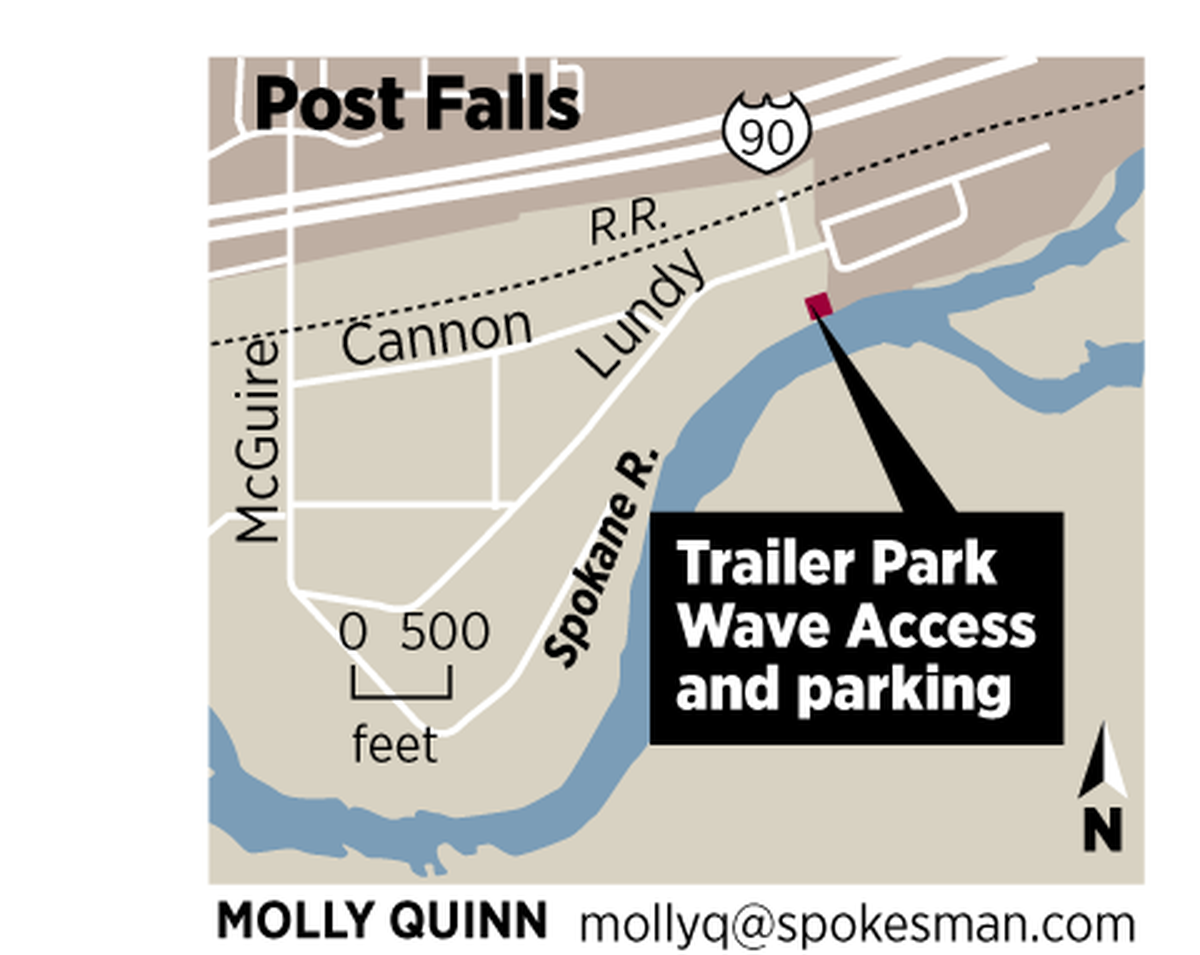
Kayakers are enjoying ritzy new facilities at Trailer Park Wave.
A $480,000 access to the Spokane River geared especially for nonmotorized paddlers, floaters and anglers has been completed by Avista Utilities downstream from Post Falls Dam.
The site includes parking for five vehicles, a vault toilet and a paved trail kayakers can use to carry their boats safely down to the river.
“It’s an awesome improvement,” said Steve Bailey, a local firefighter and ardent kayaker. “Winter is one of the prime times for best flows at the wave,” he said as he donned his special paddlers’ dry suit made for cold-water immersion.
Avista purchased the undeveloped site in 2012 for $280,000 from a private property owner, said Rene’ Wiley, Avista’s recreation, land use and cultural resource specialist. “We went door to door looking for a seller.”
Completed in December, the $200,000 spent on facilities, trail construction, tree planting and other landscaping is appreciated by people in the neighborhood, she said.
The Trailer Park Wave access is named for a natural water feature prized by kayakers. River hydraulics at certain flows create a hole and rapid that allows play-boaters to do tricks where the south channel downstream from the dam meets the north channel to form the main river.
For years, paddlers have had to climb down a steep bank, carrying their boats over boulders and paddling upstream a half a mile to play at the wave.
Occasionally parking issues occurred over the years as the public tried to access the river in this area, along with trespassing and answering the call of nature in the streamside bushes.
That’s changed with the latest improvements completed under agreements Avista made in 2009 during the federal relicensing of five hydropower dams on the Spokane River.
The new trail zigzags down to the river, crossing the old Corbin Ditch that once delivered irrigation water from Lake Coeur d’Alene to the Spokane River Valley. The trail ends at the river’s north bank directly across the river from the wave.
“With the old access, by the time I got geared up and paddled to the wave, I barely had time to do much before I had to head back to pick up the kids,” said Bailey, who preaches the merits of paddling regularly year-round to keep skills sharp.
“Every kayaker has been in a situation where he wishes he’d done a little more practicing,” he said in a presentation to the Spokane Canoe & Kayak Club last year. “We’re blessed to have the Spokane River right here where we can get in a play-training session even if we only have a couple hours to spare.”
The preferred flow for getting the most out of Trailer Park Wave is roughly 3,300 to 6,000 cubic feet per second, Bailey said.
However, skilled paddlers are finding windows to enjoy it almost year-round, depending on how flows are coming out of the dam, said Jud Keiser. He’s one of the experienced local members of whitewater groups that consulted on a flow study to help dam operators understand the relationship of flows to recreation.
“Some people are finding ways to boat the wave at 2,300 cfs – a level the average paddler would say is too low,” Keiser said.
“Then in spring, at 14,000 cfs, some call it a world-class wave – for experts only,” said Dave Turner, who was paddling with Keiser recently. “But at around 6,500 cfs, the wave washes out.”
The trick, they said, is to learn how the flows from the north channel blend in to affect the Trailer Park Wave at the base of the south channel.
“Basically, more water has to be flowing out of the south channel than the north channel to make it work,” Bailey said. “A new flow regime that results in more water out of the south channel started two years ago and we’re still learning it.”
Other boons to recreation along the Spokane River under agreements with the Federal Energy Regulatory Commission include higher base flows below Post Falls Dam for native redband trout fisheries as well as for aesthetics.
“So far, it appears that what’s good for the fish is good for kayakers,” Keiser said. “We’re very pleased at the improvements in flows.”
Bailey said he’s a regular at Trailer Park Wave in January through March and then June and July. “Basically, the flows are too low in July and August, and in the last couple years they haven’t picked up enough for Trailer Park until November.”
Other recreational improvements Avista is developing under the relicensing agreement include 10 boat-in only, semiprimitive campsites on Lake Spokane completed last summer.
“They were immediately popular,” said Chris Guidotti, manager of Riverside State Park, which administers the sites.
A $60,000 nonmotorized boater take out was completed this winter near Nine Mile Dam. The takeout provides a safe place for kayakers and canoeists to pull out of the river after launching upstream in Riverside State Park at Plese Flats.
Mary Tyrie, Avista communications manager, said other projects planned for development this year include:
• Q’emiln Park overlook and boat staging area in Post Falls.
• Higgens Point boat launch and shoreline stabilization on Lake Coeur d’Alene.
• Centennial Trail extension form Sontag Park to Nine Mile Recreation Area in Riverside State Park, a two-year project.