
Avenue West Gallery moves north of Spokane River
Watercolorist Cheryl Halverson likes a close focus on her subjects, giving big play to tiny details: a clump of stems and pale berries on a tree, the spikes on a prickly pear.
It’s a natural tendency for a woman long drawn to nature’s inner workings: She spent a career gazing at body fluids and tissue samples from behind microscopes in labs, where she worked as a medical technologist before retiring in 1999.
But as Halverson’s field of vision narrows − an eye disease called retinitis pigmentosa is claiming her sight from the outside in − she’s begun to step back, creating scenes that put the viewer at a distance from the subject. Legally blind, the artist has a field of vision of less than 20 degrees.
“I can see right ahead of me,” she said. “Somebody expressed it as, ‘You can see the mouse across the room, but you don’t see the elephant right in front of you.’ ”
Halverson, 68, of Tensed, Idaho, will show her work in a show opening Friday at Avenue West Gallery. The show also will feature work by Rebecca York, who makes glass mosaic pieces. The gallery itself is opening Friday, too − again − inviting the public to visit its new location, just in time for the Fall Visual Arts Tour .
Visitors can see work by Halverson reflecting both her close and distant perspectives, including garden plants and landscapes.
Her condition − shared by her four living siblings and her father − also makes it harder to detect varying light levels. She’s become less likely to use certain materials, such as watercolor pencils, whose lines are harder to see. She paints mostly from photos, partly because her eyes can’t handle bright sunlight outside.
But painting is about more than what your eyes tell you, Halverson said.
Mostly self-taught, she credits other artists for teaching her to see color, light, form and composition when she studies a subject. She’s also learned to do more than objectively record an image.
“You’re not looking at something and saying, ‘OK, that’s a barn, I’m going to paint a barn.’ You get caught by the barn because of the way the light hits it or the fact that it reminds you of something,” she said.
“Most of that comes out of your head − and your heart, I guess, but really your brain −and it comes out of all the things that you’ve done in your life, all the things that you’ve felt. And the creativity to do something with it … comes out of you.”
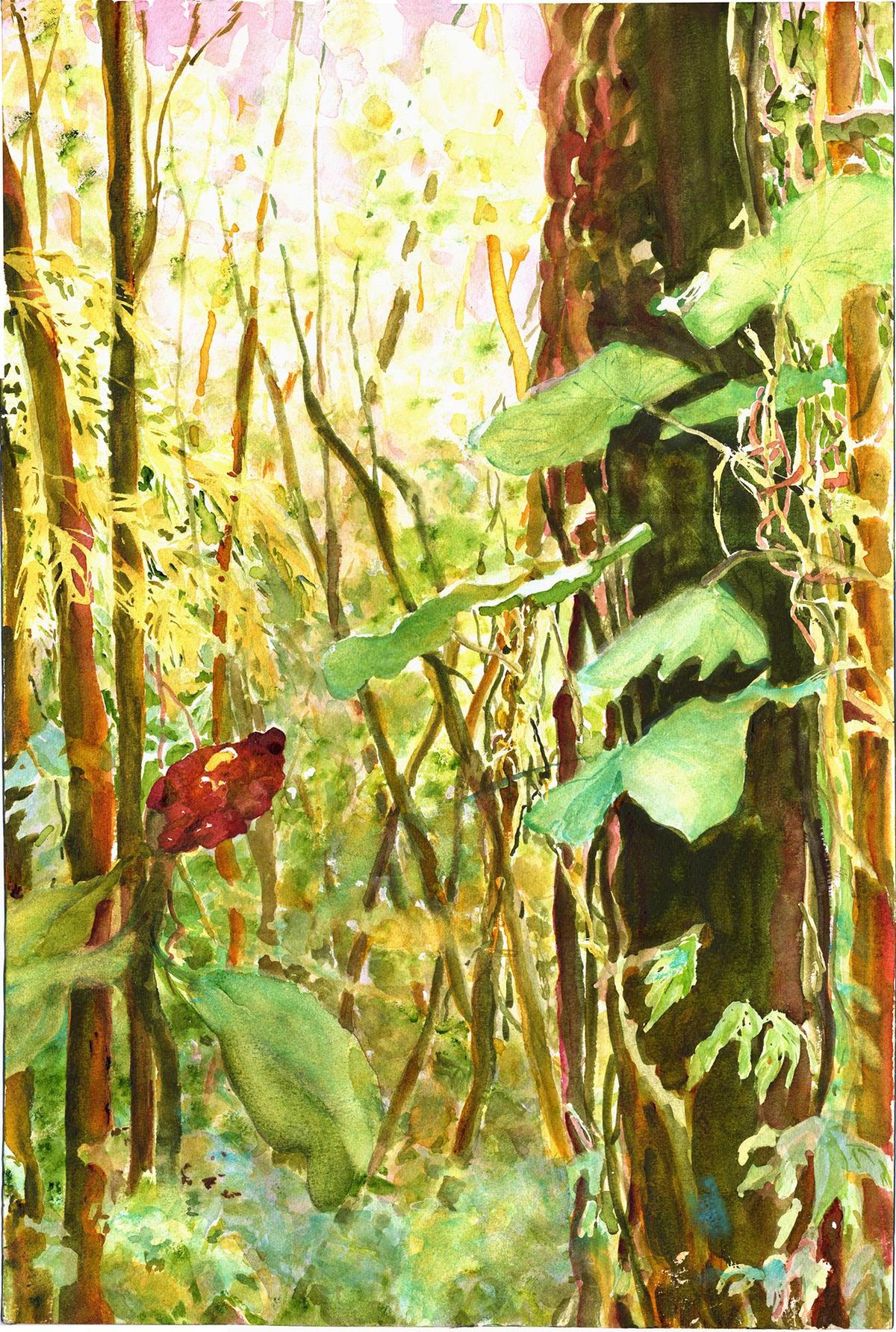
A relatively wide-angle jungle scene at the gallery portrays a tangle of trees and leaves, but also conveys depth (and maybe gets a little ominous) as the sharply defined foliage in the foreground gives way to a darker blur in the background.
Halverson painted the scene from a photo taken during a 2011 trip to Costa Rica she made with her sister, Peggy Meinholtz. Diagnosed in her 20s, Meinholtz was the first of the siblings to be diagnosed with retinitis pigmentosa and has it worse than her, Halverson said.
Together, they explored a rainforest, a coffee plantation, a volcano, a beach.
“She’s the one who said, ‘Yes, you can still paint,’” Halverson said. “ ‘Yes, you can still do things.’”