
Soccer is a translator for students learning English
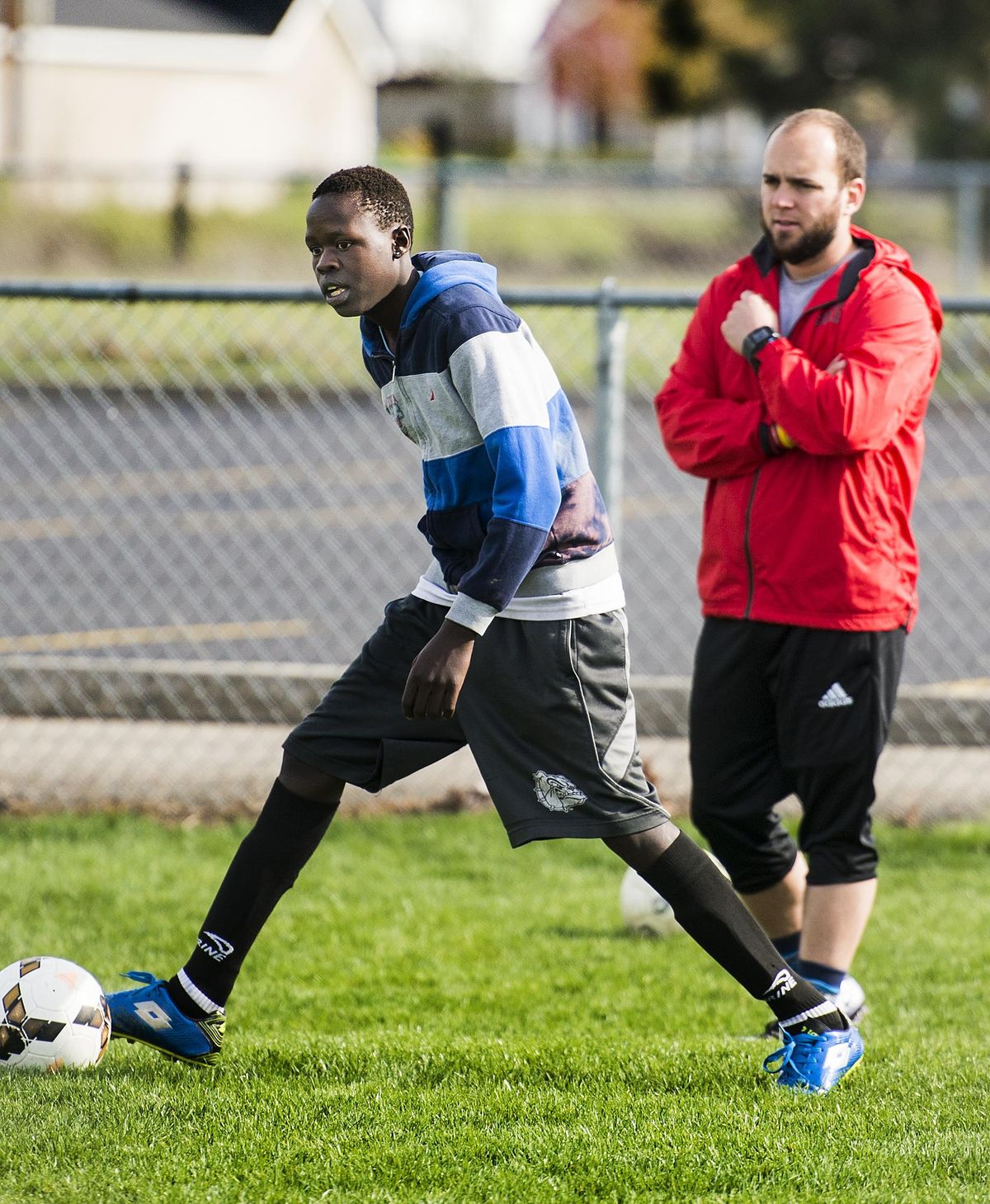
In the latest episode of sports-as-a-metaphor-for-life, the Ferris “C” soccer team endured a little hardship this week.
On Monday afternoon, that meant a 20-minute hike to the soccer field on South Regal Street, where the biggest hazards are two crosswalks and the temptation of a chocolate Frosty at Wendy’s.
Minutes later, coach Alex Bray arrived with a bagful of soccer balls and practice began on the freshly mowed grass at the Southeast Sports Complex.
The scene was still a bit surreal for 17-year-old player Gafishi Gasabato, who until a year ago was living with his parents and six siblings in an overcrowded refugee camp in Rwanda. Schooling was as scarce as the water Gasabato had to fetch at the end of a 3-mile trek on steep trails.
Gasabato gestures to make his point. “Mountains like this,” Gasabato says, his hand tilted at a 45-degree angle.
Now the water flows freely from the pipes in his family’s apartment in Spokane, and the steepest climb is the learning curve at Ferris High School.
That too is becoming more manageable thanks to Bray, a first-year teacher who doubles as Gasobato’s math teacher. The experience has enriched both.
“My favorite subjects are English and math,” said Gasobato, who’s gaining confidence in both thanks to the English Language Development program offered by Spokane Public Schools.
The program helps about 1,600 students, from kindergarten through high school, develop language skills and adjust to American culture.
At Ferris, that includes the Newcomer’s Center for newly arrived high school-age students. English Language Development students number about 80, mostly Arabic speakers from the Middle East and North Africa, but also from East Asia and Africa. Most have fled violence in their homeland.
Gasobato, for example, was born in the Democratic Republic of the Congo but was driven away at age 4 by political violence. His family spent a dozen years in a squalid camp as they awaited deliverance in the form of an exit visa.
“Everything was very bad,” Gasobato said.
Life was even worse for Akir Lual, who was born 15 years ago in Sudan but was taken as an infant to a camp in neighboring Ethiopia. Ten years later, in 2014, Lual and his family emigrated to Spokane.
For Gasobato and Lual, soccer has eased the transition to American life. It gives them a chance to connect passes – or just connect.
“Because of soccer, I’m making friends,” said Lual, one of six English Language Development players on the 20-man roster. “Soccer is the same everywhere.”
If only that were true.
Bray learned the hard way that even in the universal language of sports, a few things get lost in translation. As it turns out, playing styles in Africa and the Middle East have as much in common as Swahili and Arabic.
In a certain situation, “some players want to (keep) the ball, while others want to pass it – it’s what they’ve learned growing up,” said Bray, whose squad includes players who didn’t make the varsity or junior varsity teams.
His players needed some direction, but Bray learned early that staccato commands didn’t work on the field. “If I speak too fast or use slang, my message gets completely lost,” said Bray, who got the same blank looks in the classroom.
The answer: a translation chain. For example, soccer player Reza Ruez – a recent immigrant who speaks Turkish – speaks just a few words of English, but gets direction from Iraqi native Zaid Almeri.
“It turns out that Reza can understand broken Arabic,” Bray said, laughing.
And so it goes on the soccer field and the classroom, where Bray hears up to 20 different accents. “If I can’t do a good job communicating, we’ll have someone who can,” said Bray, who also teaches four classes outside of the English Language Development program.
Warming to the subject, Bray said everyone benefits. “We’re getting the exposure to a bunch of different cultures in a positive way,” Bray said.
“We all have the same goal,” Bray said.