
For 125 years, the Salvation Army has aimed to do “the most good” in Spokane
Salvation Army officers first marched into Spokane on a summer evening 125 years ago.
Playing brass instruments and drawing a crowd, three women and one man in uniform stopped at a crossroads in present-day downtown to herald the city’s corps. Today, near the southwest corner of Riverside Avenue and Howard Street, a sidewalk plaque marks those officers’ initial stop on Aug. 22, 1891.
Spokane was one of the earliest U.S. cities to have a Salvation Army unit, about 26 years after founder William Booth started the organization in London to reach the destitute.
The Salvation Army came to the U.S. in 1880 and by late that decade had spread to major West Coast cities, said Maj. Steve Ball, Salvation Army Spokane Citadel Corps officer with his wife, Nancy.
“What I find amazing is they hit New York, and from there they started their work and spread, to where between 1888 to 1891, they were in Spokane.”
In Spokane, early Salvationists and their Christian evangelical meetings faces both outcry and appeal, while the group grew to about 200 people in its first two years. City officials early on tried to ban their bass drums as a “nuisance” and outdoor rallies because they would “frighten horses or interfere with traffic flow.”
Captain Ida Bennett was killed in 1893 while preparing for a routine visit to the jail. Her killer was a man smitten with her, but she “refused to encourage his suit,” according to an early “War Cry,” the corps’ official publication.
By 1897, the Spokane corps was providing shelter and food to men. Free Christmas dinners for poor families soon followed, along with other community support. Another early outreach was the Booth Women’s Home and Hospital for unwed mothers and their babies, at 3400 W. Garland Ave.
Nationally, the organization gained wider public acceptance after the 1906 San Francisco earthquake and fire, when it organized large-scale, systematic emergency aid. By 1921, the Spokane unit built a downtown building on Main Avenue, where it operated until 1972. Today, the site houses Luigi’s restaurant and is listed on the Spokane Register of Historic Places.
Luigi’s is where the corps will celebrate its 125th anniversary Monday night with a dinner. Ball said he’ll talk about a heritage of spiritual teaching and encouragement, “while we do the practical.”
“That includes everything from youth-character building and youth activities to our warming center, our community dinners, food bank, and caring for children, as well as summer camp experiences for thousands and thousands of children,” Ball added.
“We do it all for the love of God and for the truth of God’s word.”
Salvation Army Spokane provides a “continuum of care” – services and spiritual support to families in distress, poverty, and homeless situations, Ball said. Salvation Army’s six-acre campus at 222 E. Indiana Ave. includes administrative offices, emergency foster care for children, family housing, a food bank and other social services.
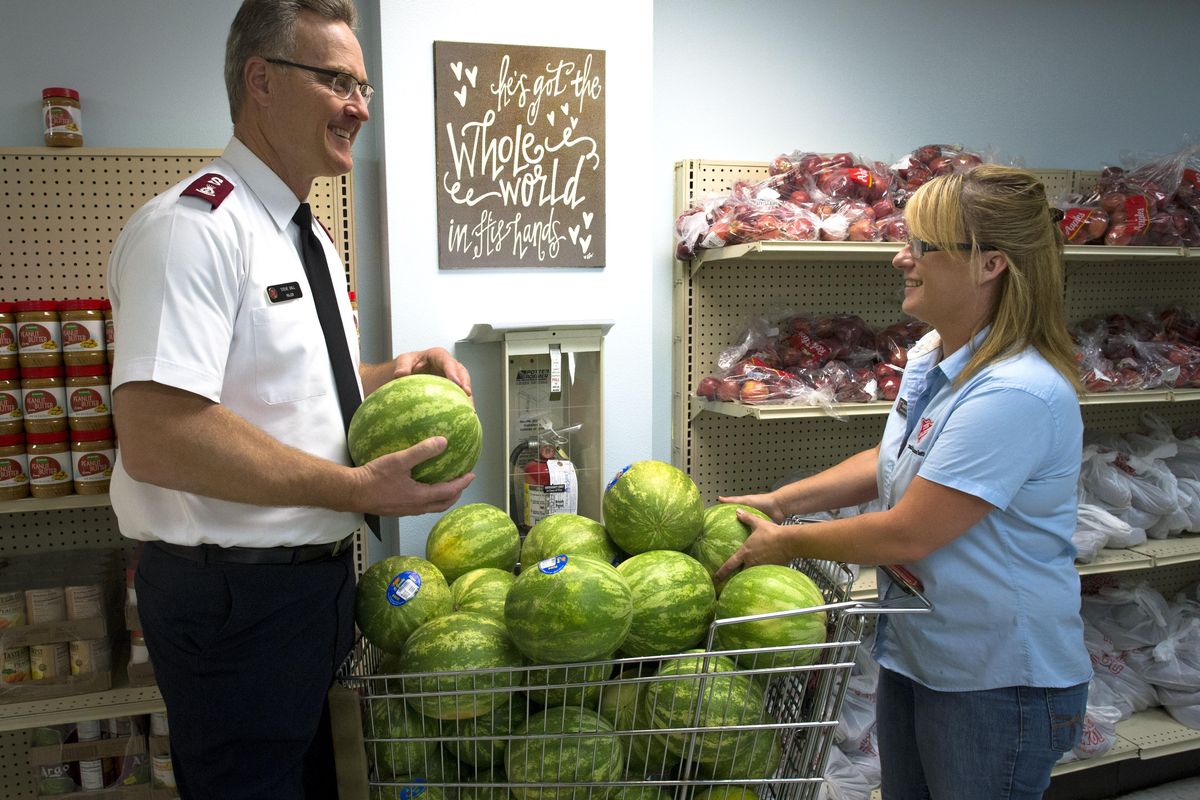
“We have the largest food bank in Spokane County, serving about 1,500 people a month,” Ball said.
Another central service is Sally’s House, a 24/7 emergency facility for children ages 2 to 12 who are removed from home because of abuse or crime. Ball said the Salvation Army has only one other such emergency foster care facility in the U.S., on the East Coast.
Sally’s House, titled such as both a common children’s name and term for Salvationists, started in 2002. Community leaders approached the organization after a case worker spent 12 hours trying to place a child in a foster home, said Sheila Geraghty, corps business administrator.
Children can stay up to 90 days while receiving clothing, toys, meals and regular activities as the Department of Children and Family Services works to find a relative or foster placement. Between 2002 and 2015, Sally’s House cared for more than 3,600 children. “We serve approximately 365 children a year,” Geraghty said.
For the past two years, Salvation Army Spokane has operated the city’s warming center, offering an overnight stay for homeless people when temperatures drop to 32 degrees or below. In 2015, the center took in nearly 1,000 unduplicated individuals, and a record night brought in 168 people.
The Spokane corps also operates Camp Gifford, the oldest summer youth camp in Eastern Washington, located on 112 acres at Deer Lake. The camp serves low-income children primarily through scholarships.
Through all its years in Spokane, Ball said the corps remained flexible. “We’ve kind of adapted to the needs where they’re unmet.”
Salvation Army uses the term, “Doing The Most Good,” toward its mission—to feed, to clothe, to comfort, to care. In the U.S., it operates 7,546 centers. Work includes food distribution, disaster relief, rehabilitation centers, anti-human trafficking efforts, and multiple children’s programs.
Its work is funded mainly through grants, donations, Red Kettle contributions, corporate contributions, and the sale of goods donated to its thrift stores.