
Bait fishermen master the method
Bait fishing as practiced by two veteran Lake Roosevelt anglers rises to an art form.
It’s a beautiful thing to watch as Jim Kujala and Dave Ross “harvest” rainbows week after week to feed their families fine-tasting trout from one of Washington’s most productive year-round fisheries.
The Spokane Valley anglers are so confident in their well-honed worm-dunking techniques, they pack along their spinning rods and night crawlers whether they’re heading out by boat or on foot from shoreline access points.
“Trolling can be good, but we do even better by anchoring in bays and casting bait,” Ross said, noting that they’ve often – not always, of course – caught their five-trout limits in less than an hour.
Here are some of their tips and tricks I noted during a bait-fishing adventure on Tuesday. We visited one of the national recreation area’s many shore access points on the 125-mile-long reservoir that backs up behind Grand Coulee Dam.
The lesson began with a pre-dawn white-knuckle drive west from Spokane through a short but intense snow storm that greased the rural roads.
“We’ve learned to pay little attention to the weather man,” Kujala said. “The report is wrong as often as it’s right for Roosevelt.”
Whether in a boat or on shore, they waste no time. With two rods in one hand, a small cooler in the other and a bag slung over a shoulder, they head out with the efficiency of a SWAT team and get to work.
They generally look for a shoreline shelf under 10-15 feet of water and cast gear near the drop-off into deeper water.
The spinning rods are rigged with:
- 8-pound monofilament line.
- 24-30 inches of 10-pound leader (extra heavy to take a beating with fewer breakoffs) with a loop tied at one end. The loop can be quickly attached to the main line, which has a snap swivel below a plastic bead, a 3/8- to 1/2-ounce sliding sinker and another colored bead.
- A No. 2 long-shank bait hook that’s tied on the business end of the leader and baited with two mini-marshmallows and piece of nightcrawler.
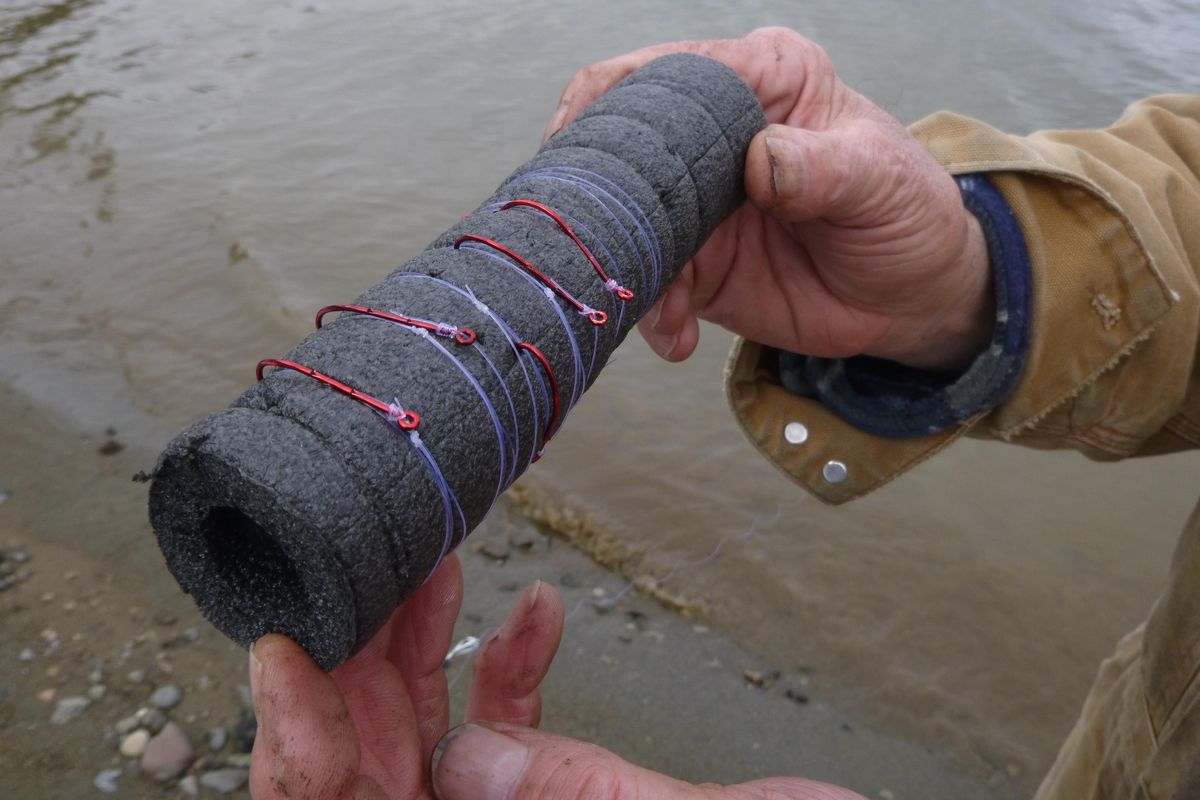
Each angler has about a dozen hook-and-leader rigs ready to change onto the snap swivel if necessary so he can minimize down time when the bite is on. The extra leaders are wrapped on a foam tube of pipe insulation.
Keeping at least one rig in the water as a school of rainbows circulates through an area is an excellent application for the two-pole endorsement on the Washington fishing license. The extra $14.80 ($6 for seniors) is worth the investment, they say.
Once they cast and lean their rods on extendable forked rod holders they made, they immediately unwind another leader or two. They bait the hooks and have them ready to quickly to swap out.
When Kujala would land a rainbow, he’d unclip the leader from the snap, attach a baited leader and recast before tending to the fish.
“I get the hooks out of the fish later,” he said. “If it’s a wild redband, I cut the leader at the mouth and let it go immediately.”
The hatchery rainbows tend to be most active for a short period in early morning and again when the wind changes around noon and then in the afternoon, although trout can be caught throughout the day and night.
“When you get a good bite, you want to take advantage of it because it might not last long,” he said.
Ross has several home-made tools to enhance his fishing, including a threader that facilitates adding the buoyant marshmallows. It’s a 3-inch long wire with 1/4 inch of one end bent 180 degrees, much like a crochet hook. With the leader loop hanging from the wire’s hook, he threads two marshmallows down the wire and neatly onto the leader all the way to the eye of the hook.
This is faster than attaching the marshmallows over the point of the fishing hook and leaves them in better condition.
Kujala likes to leave the bail on his reel open after casting to eliminate resistance to the initial take. “These rainbows can be very light biters that will drop the bait if they feel anything,” he said letting a fish take the line off the reel as he reached for his rod before flipping the bail and setting the hook.
“When the wind is blowing, I angle my rod low to the ground in the rod holder to reduce the amount of line that will belly out in the breeze,” he said. A big arc of line between the rod and the terminal gear increases resistance a trout feels when it takes the bait.
Anyone can catch the fish that strike viciously. Kujala and Ross stand out for also catching the timid and finicky trout.
A five-fish limit of rainbows from Lake Roosevelt is a beauty to behold in winter, when the fish released from net pens in summer have had a chance to go wild putting on length, girth and thick salmon-colored slabs of meat.