
‘A gentle soul in high gear’: Spokane craftsman turns out personalized urns

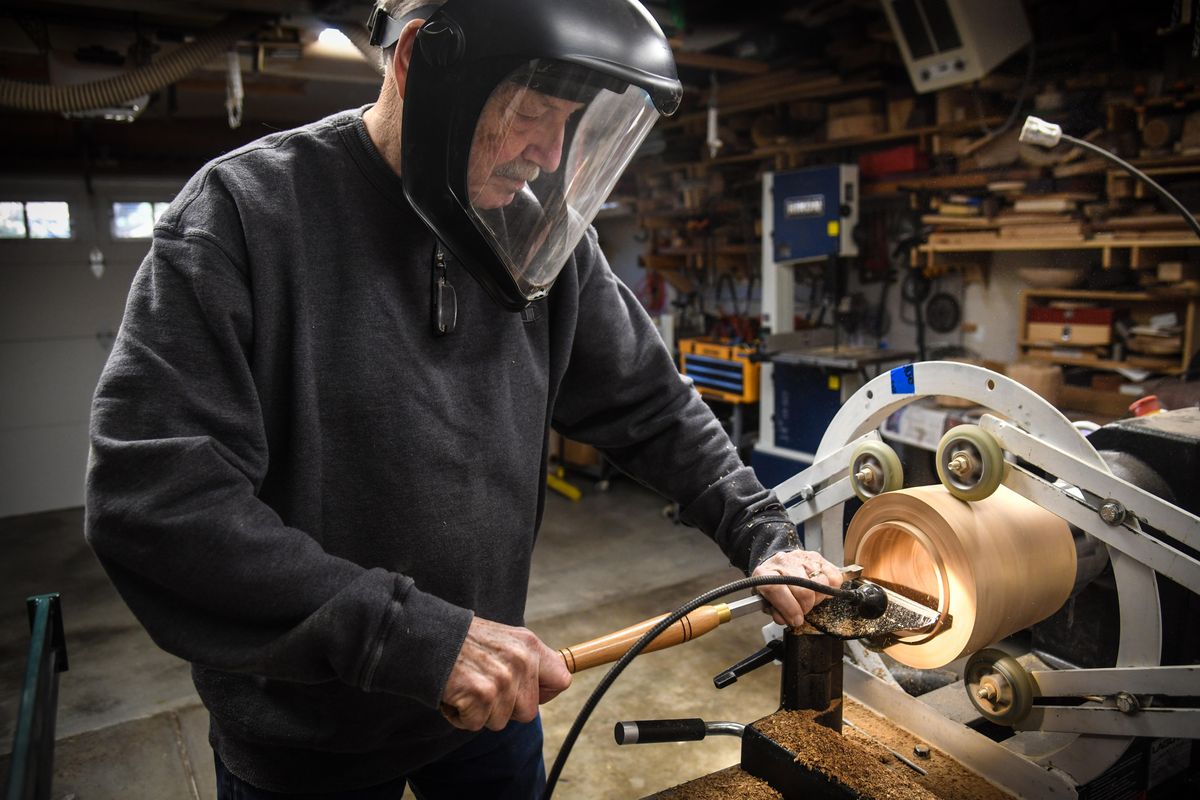
Ron Valley spends a lot of time up to his knees in sawdust.
Tucked away in his garage-turned-studio in Spokane, with the sound of the lathe, his two air-filtration machines and classical music from KPBX blasting, he doesn’t always hear his wife, Renee Valley, ring the garage for lunch. In fact, other than mealtimes and walks with Ike, his Yorkshire Terrier, Valley doesn’t surface much.
He’s made nearly 700 objects as a woodturner. Six of those objects are urns for his siblings.
Bob Weaver, Valley’s friend and “wood guy,” described Valley as “a gentle soul in high gear, who hasn’t found the brake pedal.”
Weaver is the owner of Weaver Industries, a marine products company in Rathdrum. Selling wood is a hobby that helps fellow woodturners develop their craft.
Weaver has known Valley for years because Valley used to own a trawler, and he helped him learn the ropes with woodturning. Now, Valley is the Inland Northwest Woodturners vice president, eager to impart his knowledge to others.
Jason Valley, Ron’s son, said he is envious of his father’s ability to dive deep into the various hobbies he’s had over the years: stained-glassmaking, furniture upholstering, tapping out Morse code on a ham radio and more.
Before he retired, Ron was an engineer who built television stations. Renee said she admires her husband’s abilities and passion, but of the woodturning Ron said, “She tolerates it.”
Renee sat on the couch in the den, petting a content Ike, and Jason – who lives in the Seattle area but was home to help with leaf cleanup – gestured at the shelves behind his mother, nearly covered with wooden bowls and knickknacks. The shelf used to house books. But when Ron takes up a hobby, he’s all-in.
The main issue is room, they explained. One of the solutions was displaying his work at Burl Wood Dreams in Sandpoint. Corey Obenauer, owner and artist, said he has more than 30 of Ron’s pieces and described Ron’s workmanship as “meticulous.” But Obenauer is far from the only person in Ron’s life who would describe him this way.
“He used to be a ham operator when he was in high school, and he was really good at it,” said Linda Pagel, Valley’s sister. “I used to sit in his bedroom and talk to people all over the world, and he always wanted to do things right. He was more or less a perfectionist.”
Pagel spoke of her big brother with obvious admiration. She was the first sibling to request an urn at a family reunion in Wisconsin. She said it was an honor that her brother agreed to it; Valley said the honor was being asked. Linda’s husband, Tom Pagel, is in remission from leukemia.
“He said he would be glad to, and I said I would be honored if he would do one for me,” Pagel said. “I’m anxious to see it. I thought it’d be an honor to have one made by my brother. I had strong feelings about that.”
Not all of the siblings want to call it an urn. Ron said his sister, Ginger Galbraith, is in perfect health, and though she requested one, she said, “That’s not an urn, that’s a vase. Until I need it.”
Woodturning is not unlike pottery. After being processed and dried, a large block of wood is placed on the lathe, and then the woodturner uses various tools to shape the block into whatever they imagine within the wood.
Valley is an artist, but he is pragmatic. When you ask him about his siblings’ urns, he can tell you about the 300-pound piece of wood they were all turned from – “One of the more difficult things to do is to find a piece of wood that is not split” – how he dried the wood, what varnish he used to coat the wood.
He can tell you about his visit to a crematorium to ask questions about urn dimensions (rule of thumb: For every pound a person weighs alive, their ash will take up 1 cubic inch). A more difficult question for him to answer is how he felt while he was making the urns.
“I was thinking, What can I make that would please him? That would say, ‘Yeah, that’s me,’ ” Ron said of his brother-in-law Tom’s urn. “When I’m doing this work, I know that I’m not taking shortcuts. It’s going to be, if I had to use it myself, I’d be happy.”
A man whom many around him describe as a perfectionist said it was more important than ever to make things exactly right.
Ron said when he sends the urn, it will come with a set of directions: “Under no circumstances do you use this one until you really have to, I don’t want you to go.”
Renee described the family as practical people who highly appreciate art. For them, the urns make sense, as a perfect culmination of the two.
Renee doesn’t want Ron to make her an urn, and Ron doesn’t want one himself.
“I would prefer, at this point in my life, I say just scatter me to the wind,” Ron said. “I think what you do in life has more of the memories than a tombstone.”
Ron turns 80 this Christmas Eve, and when he reads the newspaper obituaries, he’s been noticing about half the folks listed are younger, and says to himself, “Well, so far, so good.”
The only question Ron asked his siblings about their urns was, “What are you going to do with it?”
Part of the reason Ron finds this question important has everything to do with why he doesn’t want one himself. He doesn’t want his children, or grandchildren, having to hang on to his urn out of obligation.
Ron has a friend who works estate sales, and he told Ron that urns are frequently found in the basements.
“If I had my grandparents’ urns here, what would do I with them?” Ron said. “Life goes on. I don’t want my kids to have that.”
Pagel remembers her brother asking that question.
“I said, ‘I’m going to bury it,’ and he said, ‘Good, because that’s where urns should be,’ ” Pagel said.