
A Grip on Sports: The equation colleges are using to decide on football this fall includes many variables, but financial concerns may be the key to the decision

A GRIP ON SPORTS • You have a question on whether college football will be played in the fall? Well, long ago a wise man once told me the answer to all my questions was money. Follow it and you will find the truth. Let’s apply that lesson this morning.
•••••••
• There are huge financial reasons why colleges need to be open in the fall. Not just why college sports need to be played mind you, but the colleges themselves need to be there for students. Without the revenue students (and their parents) supply, one of the larger industries in the nation could fail.

Yes, higher education is, at its core, an industry. People pay for a service. An education. Most don’t pay for it out of some sort of noble calling. They want a reward. That reward is four or five years of education – and peripheral events such as, well, let’s just call it “socialization” – which is expected to lead to a better life.
If colleges and universities can’t open in person, the underpinnings of the system begin to fray. Very few schools can pull what we like to call a Harvard, charging the same for a virtual education as a real one. Most will have to cut prices, even as a majority of expenses remain. That’s not good for the bottom line – or long-term prospects. Thus the pressure on schools to be there in the fall for their students, even if the students’ health may be nearly impossible to ensure. The choice facing administrators features two evils. It’s a tough one and we don’t envy them their decision.
Their athletic departments have it a bit easier. If the school is closed, then the decision is made for them. If it is too dangerous to have students on campus, then how can a school expect student/athletes to be there? It can’t.
But what if the school opens part way, allowing small numbers of non-athletic students and having the rest learn virtually? Or if the school opens up with some sort of bubble-like plan. Then the quandary is pushed toward the athletic department offices.
How does a school play a football schedule – to use the most high-profile and economically crucial sport – while also keeping its athletes safe? And why would it want to tempt fate, putting the athletes at risk?
The answer to the second question is easy. Money. The survival of the department. Financial health trumping athletes’ health. A certainty (if football is out, the department will lose X-amount of dollars) versus a possibility (a certain number of players will surely get the virus but there is a chance no one will suffer long-term effects).
If balancing the books is important for the long-term health of the school’s athletic mission, then the short-term risks might be worth taking. If those risks can be minimized.
Thus, two Power 5 conferences, the Big Ten and the Pac-12, have already decided to eliminate nonconference games and move to a conference-only schedule. It’s a way to control risk. Other conferences are contemplating their next moves.
But it brings a different type of risk on the financial side. The schools that signed up for those nonconference games with Big Ten and Pac-12 teams? They want the money they were counting on.
For a school like Portland State, a Big Sky member who was expecting to earn almost a million dollars playing at Arizona and Oregon State, the money is crucial for balancing its budget, as Ken Goe’s story in the Oregonian explains. The Vikings figure if it safe enough for the Pac-12 to be playing each other, it has to be safe enough to play PSU, right? Wouldn’t it seem appropriate if some games are played, the force majeure argument flies out the window? Well, a judge might be asked to look at it that way in the near future.
See, schools like Portland State and Idaho and Montana State and others who signed a contract for a guarantee game – playing without a return game, only a financial guarantee – need the money for their financial well-being as well. And they aren’t going to sit still while it disappears. If they have a legal avenue for reimbursement, they will at least examine it.
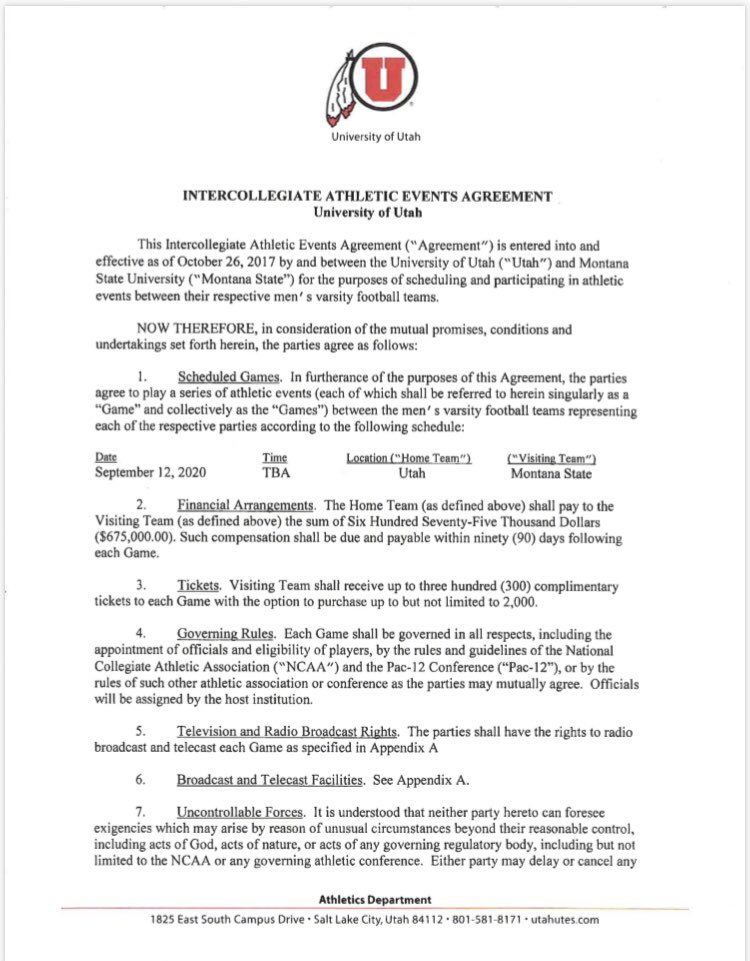
The contract Montana State had with Utah for its since-canceled game showed up on the Internet recently. Included within the section concerning a possible cancellation is a line about a conference decision as the reason for a change. It was sort of a get-out-of-jail-free card for Utah. Such language may not be in every contract, but it would seem to indemnify Pac-12 members from liability, as the conference made the choice to play a conference-only schedule this year.
Which brings us back to the bottom line. Say a Pac-12 school is forced to pay for a game that didn’t happen. Maybe two. That financial burden would have to be included in the ever-more-complicated equation concerning playing in the fall. At some point, adding in every measure possible to ensure the players’ safety, it becomes as expensive to play as it would to not play.
Heck, if it is even gets close, what with the costs – financial and otherwise, such as bad publicity – of exposing your athletes to a deadly virus, the decision is made for the schools.
There is a tipping point. If it is reached, the season will be canceled. Bank on it.
•••

WSU: We had found a whole bunch of links this morning on the preseason Doak Walker Award watch list. It’s an award given to the best running back in college football. Max Borghi was included, as Theo Lawson notes in this story. All well and good. But then this morning the Biletnikoff Award watch list was released and there is Borghi’s name again. But the award is for the best receiver in the nation. What’s up with that? Theo tries to explain in this story. … We talked about the Pac-12’s decision to go to a conference-only schedule this season. Theo does as well in this piece from the morning paper. He rates the relative intrigue inherent in each contest. … Dan Doornink was a running back at WSU as well. But it’s his life after the time on the Palouse that has been most memorable, from his Seahawk days to his current career, that of a doctor. Dave Oriard talked with Dr. Dan recently and has this story as well as a second piece on his teammates. … Around the Pac-12 and college sports, Arizona’s best defensive player has decided to transfer. … Oregon State coach Jonathan Smith really doesn’t want to see games in the spring. … Oregon’s CJ Verdell, Alex Fontenot of Colorado, Oregon State’s Jermar Jefferson and others from the conference joined Borghi on the Walker list. … UCLA announced its latest Hall of Fame class and there are some familiar names. … A former player’s family sues Arizona State, NCAA over CTE. … In basketball news, Bobby Hurley is guardedly optimistic. … Don’t forget, other sports happen in the fall.
Gonzaga: Larry Weir’s most-recent Press Box podcast includes a conversation with Steven Karr of the Slipper Still Fits. … Elsewhere in the WCC, Gavin Baxter gave up a lot when he decided to play for BYU late last season.

EWU: Let’s also add “Shock” to this section, as the local indoor football team has been adding Eagles to its roster with fervor recently. Ryan Collingwood adds more in this story about safety Dehonta Hayes signing with Spokane.
Idaho: If there is a college football season, the Kibbie Dome will welcome fans. Just not as many as it usually holds. The school announced yesterday the facility will be limited to 5,100 folks during football games.
Hoopfest: The tournament may be canceled, but that doesn’t mean the spirit of the event doesn’t live on. One of the physical manifestations of that spirit is visible on the Peaceful Valley court. Riley Haun has the story of the court’s new, bright look.
Mariners: Once the season was canceled, each member of the M’s had some “me” time. Pitcher Kendall Graveman used his to perfect a new pitch. It seems to be working. … Jake Fraley has something to prove.
•••
• I tried to see the comet last night. Failed miserably. But I’m not a quitter. Nope. Tonight I’m going to get in the car and drive somewhere in the hopes of finding a spot to clearly see a celestial event that won’t happen again in my lifetime. Well, who knows? I could live to be as old as Methuselah – but I doubt it. But it sure would be interesting to see how I would produce this column in the 23rd Century. Until later …