
John Blanchette: Washington State’s Paul Ryan rounding into form at the right time ahead of Olympic trials
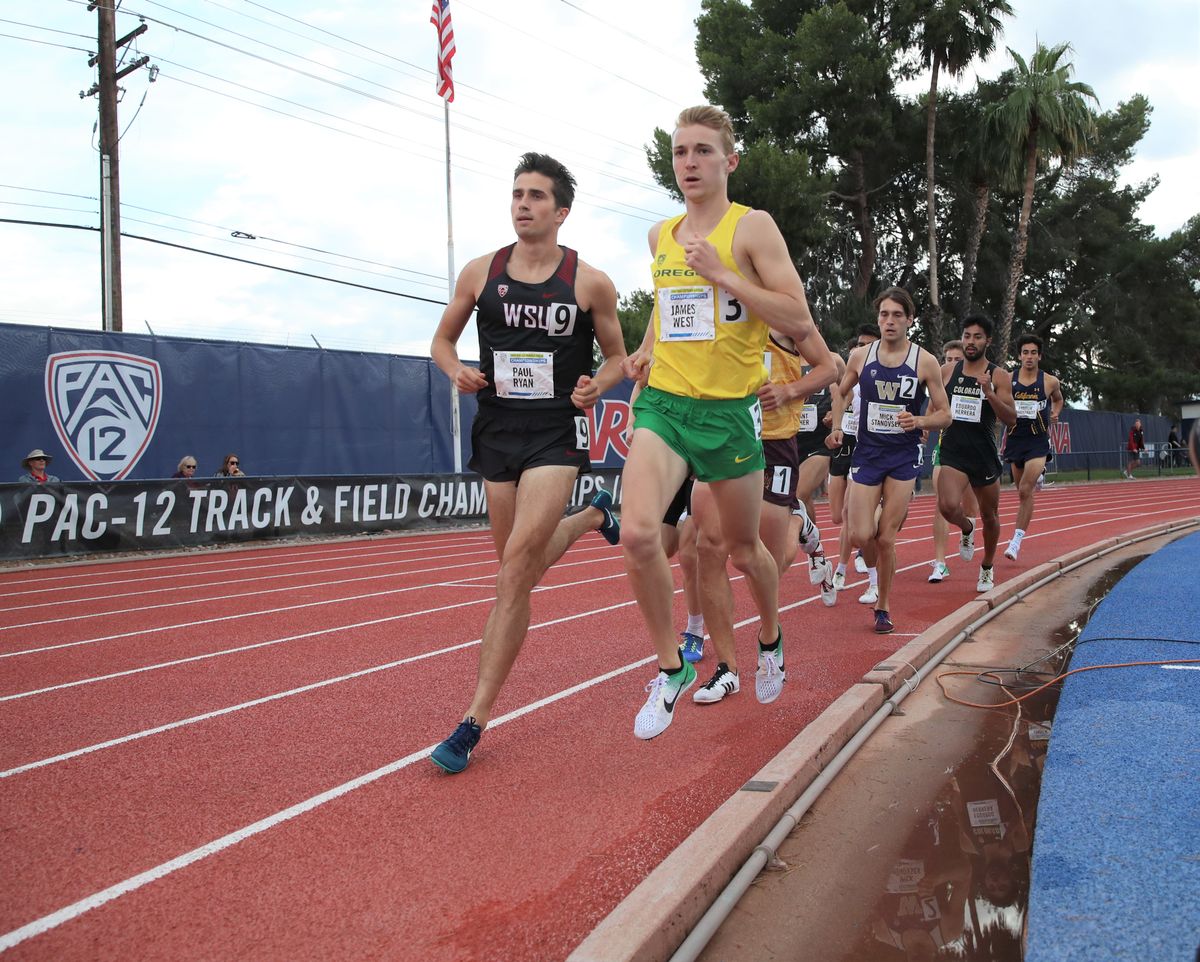
Take it from someone who knows. Procrastination is the oxygen of deadline pressure.
Not that Paul Ryan was intentional in his dance with last-minuteness. But he sees now that it probably makes for a better tale.
And you can’t beat the adrenaline rush.
There are but three collegians from Inland Northwest schools who earned the right to be part of the ongoing U.S. Olympic Track and Field Trials in Eugene, and all have a story about it. Gonzaga’s James Mwaura bettered the qualifying standard for 10,000 meters with a remarkable run at the NCAA finals, but had to navigate an appeal to get into the trials because he hadn’t sent in an entry before he’d qualified – a bit of convoluted policy-making the trackocracy sheepishly rectified. Eastern Washington’s Parker Bowden of Spokane entered without quite meeting the standard in the high hurdles, but benefited when a few nonqualifiers had to be invited to fill out the field.
Paul Ryan sort of played chicken with the whole idea.
The Washington State runner clocked a swift 1,500 meters in a late-April meet in Fresno, California – 3 minutes, 37.73 seconds – that missed the trials cutoff by just .23. But he figured, similar to Bowden, he was in good position to be summoned to fill out the prescribed starting list of 30.
“Then everyone started running crazy fast,” he said.
He kept running well, too. But his only remaining meets were the Pac-12 and NCAA championships “and those tend to turn tactical and not as fast,” he said. He was second at Pac-12s and eighth in the NCAA final on June 11 but, sure enough, didn’t improve on that April time. Meanwhile, a couple of late-spring invitationals in Portland produced a slew of qualifiers, and Ryan slipped below 30 on the national list.
A day later, Ryan was commiserating with another runner still in need of a qualifying time, Oregon’s Reed Brown, who mentioned a Sunday last-chance meet at Hayward Field was being hastily cobbled together.
And 24 hours before the trials deadline, Paul Ryan made it through.
“And I still think I can run a lot faster,” he said.
Track can bring out the Monday morning quarterback in a guy. Ryan had just run his third full-out 1,500 in five days, but was lamenting an impatient surge with 250 meters to go that robbed him of the finishing strength that might have turned his 3:37.03 into 3:35 or so.
“But I’m in, and that’s the important part,” he said.
He brings no illusions into Thursday’s first round at the trials. He’s 21st on the performance list in a group led by 2020 Olympic gold medalist Matthew Centrowitz and Oregon’s fab freshman Cole Hocker, “who I think can medal this year,” Ryan said.
But if Ryan had been preoccupied with the odds, he might not have come this far.
He did his high school running at Logos School in Moscow, enrollment less than 100, in Idaho’s smallest division, with his mother, Allison, as his coach. Of course, Mom also held the University of Idaho record for 800 meters for 20 years, and Ryan often ventured from the small pond to test himself against the region’s best runners. Or sometimes he just ran more – at the state meet his senior year, he won every race between 400 and 3,200 meters.
The move across the state line to WSU seemed a bit bigger than just 8 miles, however.
“It was hard at the start,” Ryan acknowledged, “going from winning everything and then getting your butt kicked the first couple years at the college level. It hurt my confidence a lot. There were some low moments. I remember in 2017 and ’18, I couldn’t even make the Pac-12 final. It’s really been a journey.”
But in 2019, he broke 4 minutes in the mile for the first time and qualified for the NCAA indoor championships. As with every breakthrough, there had to be momentum, though. Ryan built his with two seemingly contrary adjustments – more mileage and less stress.
“I stopped putting so much pressure on myself and really started enjoying running – not taking myself so seriously,” he said. “A lot of it is balance. Running is such a time-consuming sport and if the only thing you do is run, eat and sleep, it chews you up. Sometimes it’s just a matter of not being around runners. I love my teammates, but it’s good to not talk about running all the time.”
Not much chance of that at the trials, however. Ryan arrives in Eugene at a crossroads, his eligibility finished at Wazzu and a pro career ahead – with an eye on 2024 more than 2021.
“It’s an outside shot this year, realistically,” he said. “It’s three tough rounds. But you line up every race to win. And if I can make the final, why not?”
No sense going home early, as long as it took him to get there.