
‘Three Thousand Years of Longing’: All talk and no magic
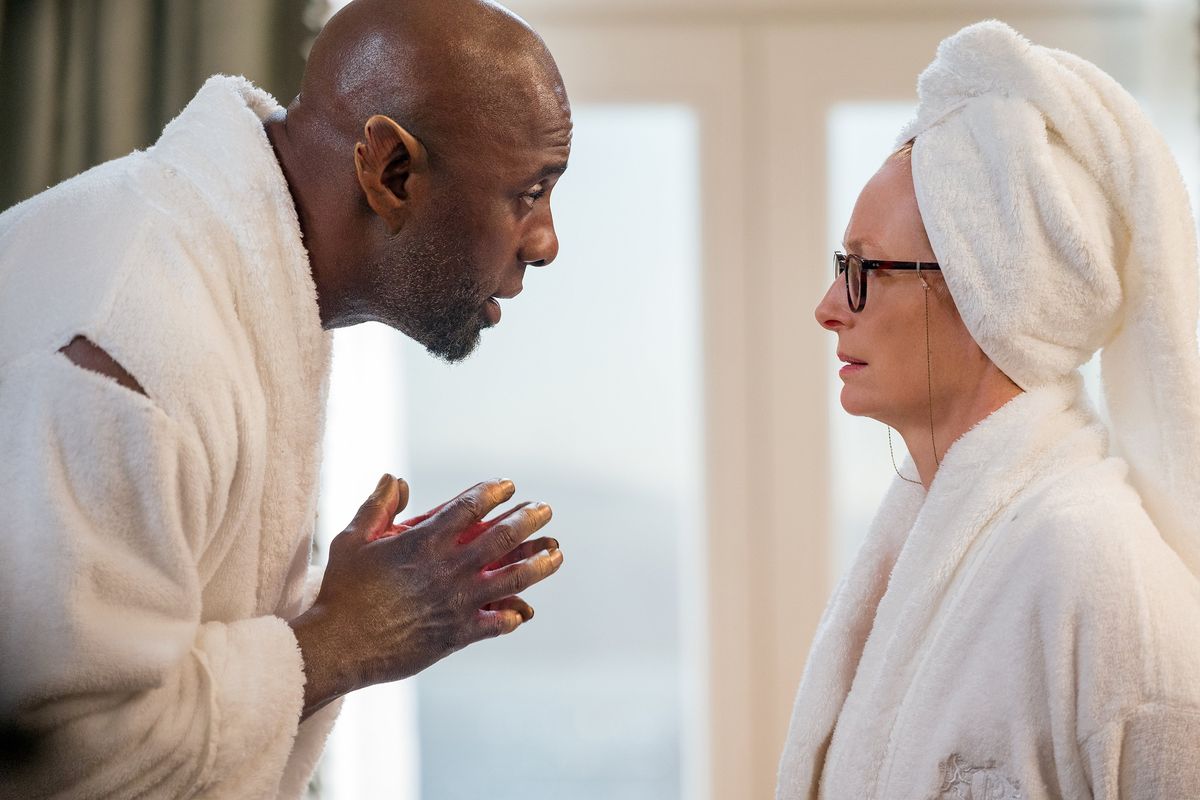
On paper, “Three Thousand Years of Longing” might have looked like a sure thing: An adaptation of an A.S. Byatt short story, it has wonder and fantasy and sexual heat; it also has Idris Elba and Tilda Swinton, two of the most fascinating and charismatic performers on any screen, big or small.
But what should be a cinematic journey into amazement and otherworldly adventure instead becomes a tedious, word-heavy slog – all the more disappointing considering the director in charge is George Miller. Miller is known for the artistry and imagination he brought to bear on the visionary Mad Max franchise; here, his instincts seem to fail him as he falls prey to the pictures-of-people-talking trap that has ensnared so much of modern cinema.
Swinton plays Alithea Binnie, a scholar on her way to a conference in Istanbul, where she is slated to deliver a talk on narratology or, in her words, “tell stories about stories.” It gets even more meta once she lands: Alithea spies, or maybe hallucinates, a mysterious man at the airport in Turkey, then another maybe-not-real character in the audience of her lecture. Back at her hotel – where she has pointedly been given the same room Agatha Christie occupied while writing “Murder on the Orient Express” – Alithea is scrubbing a glass bottle she purchased in a nearby market when an altogether more alarming figure appears: a djinn, played by Elba with pointy ears, a dramatically outsize physique, and his reliable combination of reassurance and seductiveness.
What ensues is a dialogue wherein the djinn explains his various loves and captivities to Alithea, who listens enraptured with her wet hair wrapped in a towel. The djinn recalls his exploits in the time of Solomon and Queen Sheba, Suleiman and the Ottoman Empire, his tales illustrated in flashbacks that Miller stages as elaborate tableaux, complete with special effects and stylized storybook-like designs.
It all gets very heady, with Alithea and the djinn jousting about whether science has replaced myth, whether fate exists and the nature of desire, contentment and purpose. But at the end of the day, and despite its metaphysical ambitions and air of epic romance, “Three Thousand Years of Longing” is essentially two people in a room conversing, with occasional breaks for illustration. There are moments in the film when viewers could be forgiven for thinking that if they wanted to watch two preternaturally attractive people chat in their bathrobes, they could watch “Good Luck to You, Leo Grande” for a third time.
That’s snarky, perhaps unfairly. Eventually, “Three Thousand Years of Longing” escapes the Istanbul hotel room and absconds to London, where the story becomes choppier and even more episodic, but also more of a modern-day fairy tale. It’s also when the politics of the story become subtly problematic, as Alithea constantly refers to Elba as “my djinn,” as if he were the ultimate magical Negro.
Thanks to his self-possession and towering presence (even when his character is human-sized), Elba comes through “Three Thousand Years of Longing” with his dignity and star power intact. So does Swinton, whose character could so easily be made to seem ridiculous and pathetic. If they were placed inside a more involving movie, their chemistry would be truly magical.
Instead, like the recent “Mrs. Harris Goes to Paris,” Miller’s “Three Thousand Years of Longing” seems to have been engineered for a moment that demands tenderness and hope above all else. If the audience is nodding off by the end, it’s due as much to the story’s comforting contours as to its inertia.