
Race is on to save the Great Salt Lake: Will it be enough?
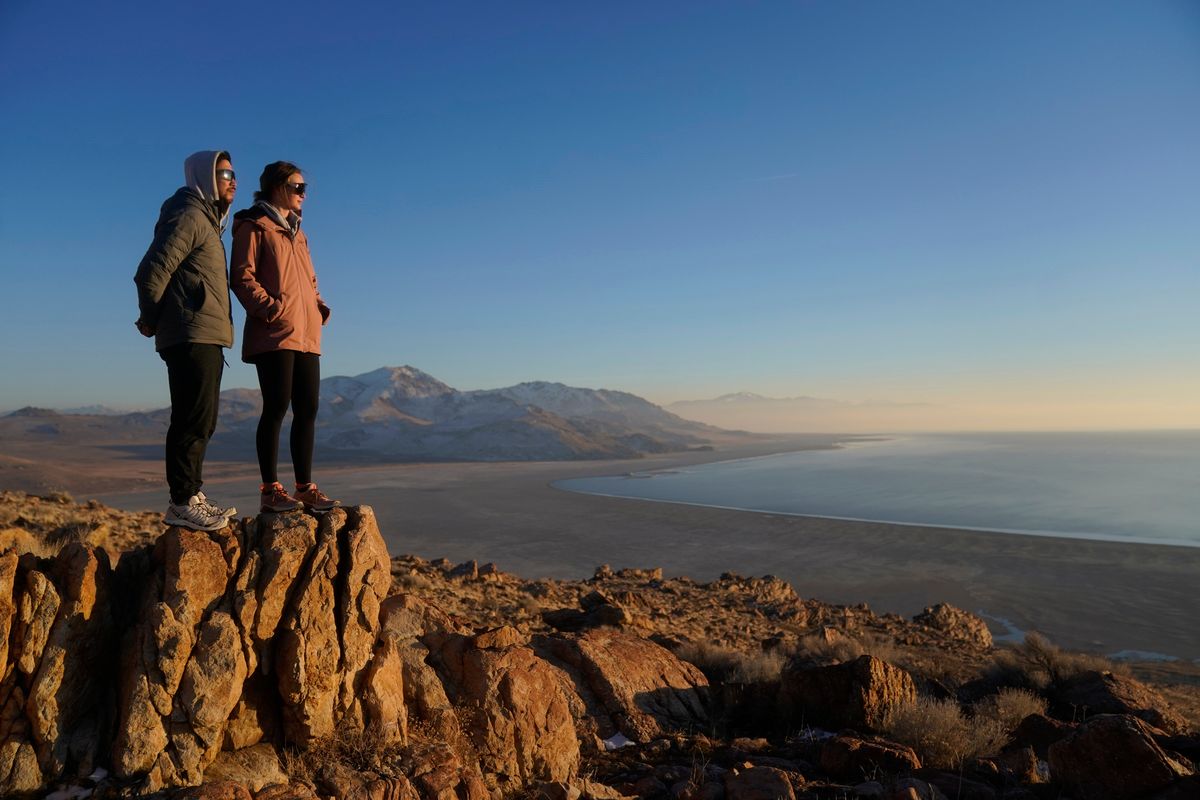
SALT LAKE CITY – The largest natural lake west of the Mississippi is shrinking past its lowest levels in recorded history, raising fears about toxic dust, ecological collapse and economic consequences. But the Great Salt Lake may have some new allies: conservative Republican lawmakers.
The new burst of energy from the GOP-dominated state government comes after lake levels recently hit a low point during a regional megadrought worsened by climate change. Water has been diverted away from the lake for years, though, to supply homes and crops in Utah. The nation’s fastest-growing state is also one of the driest, with some of the highest domestic water use.
This year could see big investment in the lake that’s long been an afterthought, with Gov. Spencer Cox proposing spending $46 million and the powerful House speaker throwing his weight behind the issue. But some worry that the ideas advancing so far at the state Legislature don’t go far enough to halt the slow-motion ecological disaster.
One proposal would tackle water use in homes and businesses, by measuring outdoor water that’s considered some of the country’s cheapest. Another would pay farmers for sharing their water downstream, and a third would direct money from mineral-extraction royalties to benefit the lake.
“I long took for granted the lake. It’s always been there, and I’ve assumed it always would be there,” House speaker Brad Wilson said at a summit he convened on the issue. But learning about the lake’s precarious position this summer left him terrified. “The Great Salt Lake is in trouble. … We have to do something.”
The shrinking of the lake poses serious risks to millions of migrating birds and a lake-based economy that’s worth an estimated $1.3 billion in mineral extraction, brine shrimp and recreation. Health risks exist too: The massive dry lakebed could send arsenic-laced dust into the air that millions breathe.
“The Great Salt Lake needs some leaps to be saved. It’s not going to do it with baby steps,” said Zach Frankel, executive director of the nonprofit Utah Rivers Council. “These are tiny baby steps that should have been taken 20 years ago.”
The lake took a pummeling last year, with especially devastating effects on its microbialites, the Great Salt Lake’s version of a coral reef. The mushroom-like structures are formed by furry, deep green mats of microbes, which are the base of the lake’s food chain and main sustenance for brine shrimp.
The shrimp both support a multimillion-dollar industry supplying food for fish farms and nourish millions of migrating birds whose massive flocks can show up on radar. The lake is also the nation’s biggest source of magnesium and could soon provide lithium, a key mineral for renewable energy batteries.
But last year the lake matched a 170-year record low and kept dropping, hitting a new low of 4,190.2 feet in October. A significant portion of the microbialites were exposed to air, killing the vital microbes. The die-off will likely take years and years to repair even if they are fully submerged again, said Michael Vanden Berg, a state geologist.
If the water levels continue to drop, the lake could get too salty for the edible microbes to survive, something that’s already happened in the bright pink waters of the lake’s north arm.
Still, Vanden Berg is cautiously optimistic for the south arm, where a portion of the green microbialites did survive last year’s lake drop.
“It’s bad but not catastrophic yet,” he said. “There is still time to fix and mitigate the situation.”
In some ways, the fix is simple: The lake needs more water.
But that’s no small task in the state that grew to nearly 3.28 million people in the last decade.
Utah has relatively inexpensive water overall, but a subset of homes has access to especially low-price water – the cheapest in the nation, according to the Utah Rivers Council.
About 200,000 homes and businesses pay a flat fee for an entire season of irrigation water. It’s called a secondary water system, made from converted agricultural supply in communities that are now largely suburban. Those account for a disproportionately large segment of the state’s water use – and many of them are on the Great Salt Lake watershed, Frankel said.
“It’s like an all-you-can-eat buffet,” he said. While most people have a water meter on the side of their homes, usage isn’t measured for secondary-water users.
But small-scale projects have shown that simply being aware of how much they’re using makes people cut back by 20%, GOP Utah Rep. Tim Hawkes said.
There’s been pushback to change the system before, and part of the reason is the per-meter cost of about $1,500, but the governor has backed spending about $250 million in federal pandemic relief money to install them.
The Utah Rivers Council would like to see people pay more for that water, but there’s been little public discussion of that this year. Hawkes argues that even conserving 20% through awareness would dramatically increase the chances that the lake stays healthy.
This year is shaping up to be a wetter year than 2021, but that doesn’t immediately translate to more water for the lake. First comes replenishing drinking water supplies. Then comes the lake.
And it’s not just homes and businesses. About 65% of the water on the Great Salt Lake watershed goes to agriculture. Under historic laws, farmers could lose the water they don’t use.
“Right now, there’s actually a disincentive for agriculture to conserve, or optimize, the water they’re using,” said Republican Rep. Joel Ferry.
Republican Rep. Joel Ferry is sponsoring legislation that would let farmers get paid for water they let flow to the Great Salt Lake and other bodies. Due to a farm’s size, even slight adjustments can have a major impact.
Under his plan, which has advanced at the state Legislature, it would be up to each farm to decide whether to sell water in a given year. The fund would also likely start with some federal pandemic money, and backers would hope to get donations as it continues.
“This is going to be a slow start,” said Ferry, who is a farmer. “We recognize there’s a problem, and farmers want to be part of the solution. … Ultimately, the solutions to this are going to be expensive.”
The costs of doing nothing may be even higher. The draining of California’s Owens Lake as Los Angeles grew has cost billions. Overseas, the Aral Sea became as source of toxic dust after its water was diverted away by the former Soviet Union. Experts estimate a drying Great Salt Lake could cost Utah more than $2 billion every year.
“There’s a real question about what happens next. Are we going to break through some critical thresholds here in the next little bit if we continue to go lower?” Hawkes said. “If we act now and we are thoughtful about it … there’s a good chance we can keep the lake healthy and happy – and us along with it.”