
Idaho cost-of-care policy widens racial, financial inequities across the state
After years of struggling with addiction, Idaho resident Sarah Hill is now using her personal experience to educate and uplift others as a recovery coach at St. Vincent De Paul Reentry Center and Chrysalis, a sober living program for women in Boise. While in recovery, Hill lost custody of her son, who ended up in foster care and juvenile detention centers.
Even though she lost her parental rights, Hill was still assessed cost-of-care fees. Also known as parent reimbursement fees, cost-of-care fees are fines that reimburse the Department of Juvenile Corrections for the costs of caring for youth in custody. Hill is working with Idaho programs that look to eradicate inequities for the state’s incarcerated youth, including making amendments to cost-of-care fees.
“At that time, I was trying to work my recovery and stay compliant with my fines and fees and probation obligations, I was working a minimum wage job and really struggled to come up with a deposit on an apartment for us and figure out a budget for the rent and utilities,” Hill said in a written statement.
Juvenile detention centers across the country charge a variety of fees to the families of youth they detain. But some states go beyond collecting court-ordered fines or restitution. In Washington, for example, some families of incarcerated youth are forced to pay a percentage of their income to the Department of Children, Youth and Families and to cover the costs of some treatment and residential services. In Idaho and other states, the fees can further criminalize and demean struggling families into financial ruin. And, as there is clear evidence of racial disparity within the detention system, families of color are more likely to be impacted by these fees.
The Idaho Center for Fiscal Policy, a nonpartisan think tank based in Boise, studied cost-of-care fees and their financial impact from 2016 to 2020. Only 5% of Idaho’s cost-of-care fees are implemented in juvenile cases. However, the practice of imposing cost-of-care fees affects the financial well being of families, widening financial inequity across the state.
“An analysis of juvenile cost-of-care fee data obtained from (the Idaho Department of Juvenile Corrections) over a 5-year period reveals a system plagued by burdensome charges and wide disparities in charges, as well as racial inequity,” writes Kendra Knighten, one of the main researchers of the cost-of-care assessment.
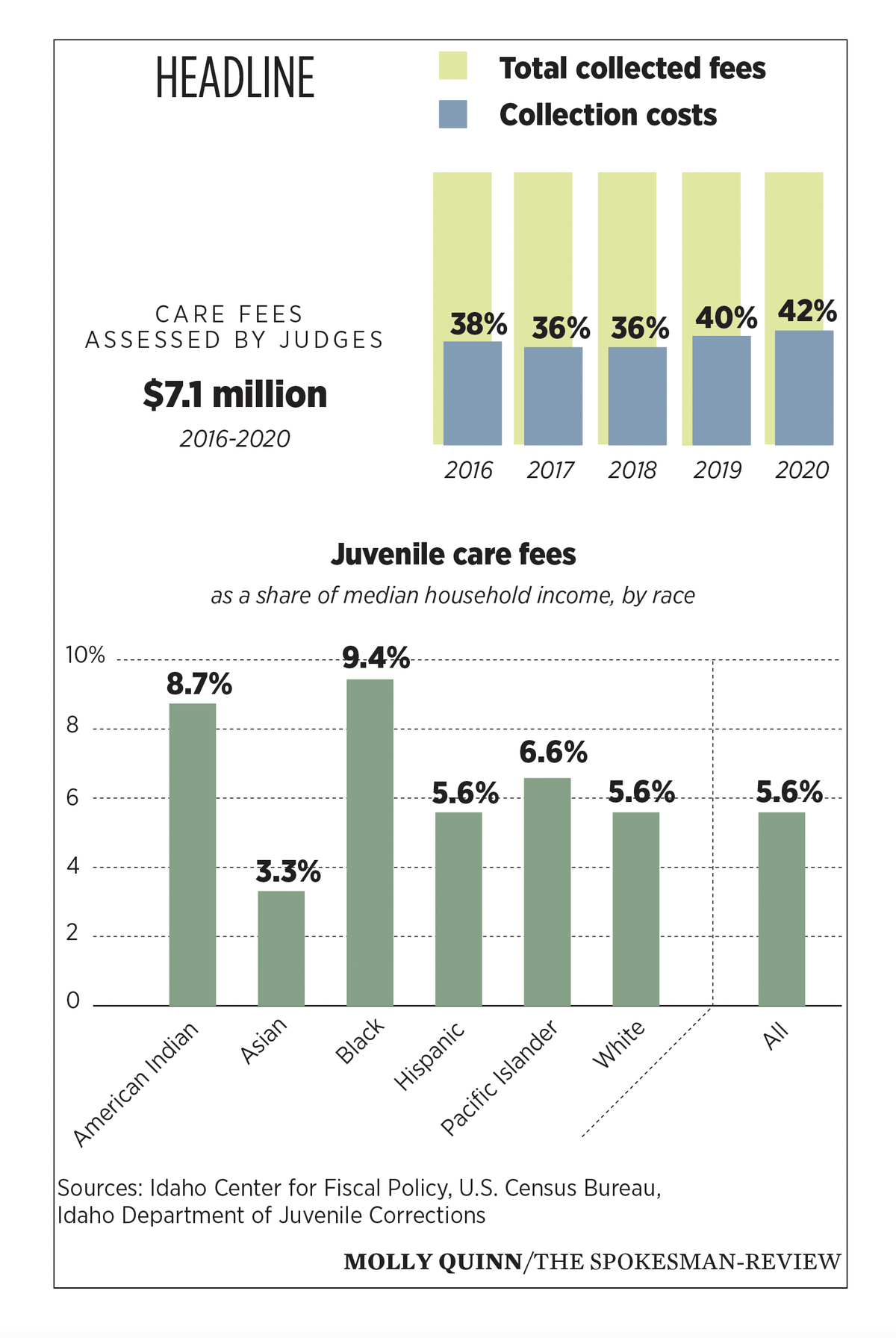
Cost-of-care fees vary case by case, but it is standard practice that judges ask courts to set $150 per month per parent. Throughout the fiscal years of 2016 to 2020, judges have assessed nearly $7.2 million. Only $1.2 million has been collected from 682 families with youth in juvenile custody. This averages out to $246,849 per year and $1,807 collected per case per year. The highest amount for one family was $13,425. Across 907 cases, 60 accounts and 492 accounts in collection, there is over $2.2 million in outstanding balances. When legal guardians aren’t able to pay cost-of-care fees, a 33% collection fee is assessed. As of late November, there is nearly $5 million in outstanding debt for probation, detention, training academy and other fees assessed in cost-of-care. This does not include restitution fines.
Racial inequities are evident in the cost-of-care fees system. According to the Idaho Center for Fiscal Policy, the highest outstanding cost-of-care balance is a staggering $27,950, owed by the family of an incarcerated Hispanic youth. Although Black youth only make up 1% of Idaho’s young population, they make up 3.6% of debt collections cases, the center reported.
Pacific Islander youth, meanwhile, have the highest average outstanding debt per case at $3,731. The report also states that cost-of-care fees are more common for families of color.
Cost-of-care fees also stifle Idaho’s poor families and families of color the most, harming the overall fiscal wellbeing of the state. According to the Massachusetts Institute of Technology, a family of four in Idaho “must earn between $5,425 and $6,680 per month” to meet the standard of cost living in the state. The Fiscal Policy report states that the average Idaho family only earns $4,648 per month.
“You can see that it’s a very significant amount of a family’s income when they’re being assessed cost-of-care fees at this rate and that the burden of the cost-of-care fees really impacts Black and Native American families here in Idaho,” Knighten said.
Mike Satz serves as the executive director of the Idaho 97 Project, an organization that examines the democratic processes in Idaho. Satz considered cost-of-care fees as ineffective yet holds a “desperate impact” on families in Idaho.
“You don’t want policy that acts and affects like a penalty,” said Satz, a lawyer and former interim dean of the University of Idaho College of Law. “We don’t pay a lot of attention to economic discrimination, but it’s clear that the average family salary in Idaho doesn’t even match the living wages in Idaho, yet these are the people they’re penalizing with this policy. There is no economic advantage to this policy.”
A former collections attorney, Satz expressed concerns at the cost-of-care fees only being assessed to certain families, especially when so little of the fees are collected.
“At the foundation level, the type of families that typically have kids in the juvenile system, are not well off families,” Satz said. “The vast majority are going to be below the median of salary in the state and most of them are going to be at or below the poverty level. These fees are asking a lot for a family to pay them and there is a punitive nature to it. It’s actually penalizing the families of these children based on the child’s acts. It’s penalizing them where they are most resource challenged.”
Hill was initially fined $300 for her son’s ankle monitor and did not have the funds to pay for it. The case was sent to collections. After Hill explained that she and her son were low-income, she worked out a payment plan. With the discounted fees, Hill had to pay $180, but her case is an indicator of how the cost-of-care policy stacks up inequities against the families.
“I watched the struggle that the parents of the friends that my son had, whom he frequently got into trouble with, go through the same thing,” she said. “I was fortunate to only have a small amount of fees to pay. One mother had to borrow money from her father to pay her son’s court fees.”
After presenting the cost-of-care policy data, Idaho Rep. Marco Erickson has introduced a bill to the Judiciary, Rules and Administration Committee in the Idaho House. House Bill 500 looks to “amend, adds to, and repeals existing law to remove certain fees regarding juvenile corrections.” Hill supports the bill and hopes that Idaho’s lawmakers could introduce new policies that would effectively rehabilitate incarcerated youth and promote an equitable justice system without penalizing legal guardians in the process of doing so.
“I have a hope that one day, we will see more returning citizens recover because they have more opportunities and less obstacles to face upon release or sentencing,” Hill said.
Editor’s Note: Rep. Marco Erickson, R-Idaho Falls not the Idaho Center for Fiscal Policy introduced HB 500 to the Idaho Senate and House. Kendra Knighten, not Kendra Knight, is the correct spelling of the name.