
Review: ‘Mothering Sunday’ makes for thoughtful but inert book adaptation
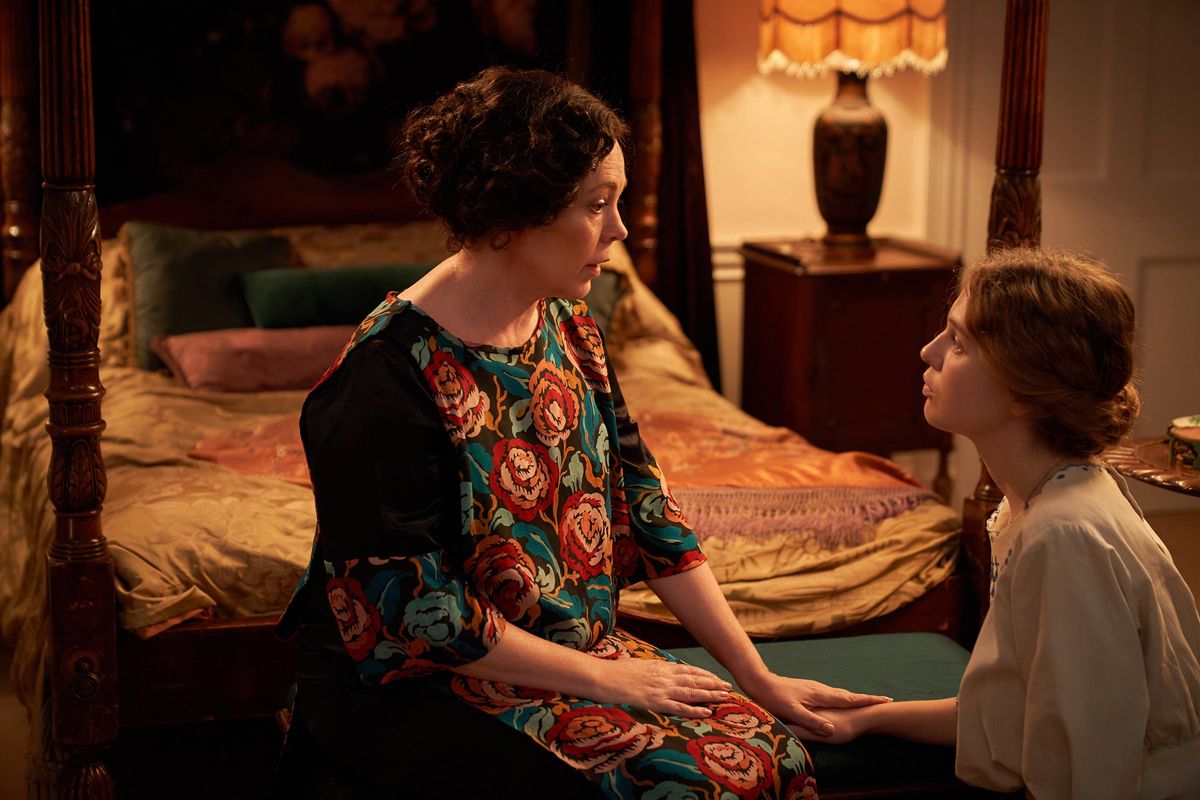
“Mothering Sunday” neatly embodies all the promises and pitfalls of literary adaptation. Based on a spare, exquisitely crafted novel by Graham Swift, this thoughtful but ultimately inert dramatization respects its source material and tries valiantly to give arresting visual expression to its finely layered themes.
But it can’t escape the plain fact that it isn’t Swift’s plot and characters that make “Mothering Sunday” a memorable work of art but his writing in all its sensitivity, detail and heartbreaking restraint. Given that glaring fact, director Eva Husson, working from a script by Alice Birch, does her best to create a visual language worthy of Swift’s elegantly allusive prose.
Most of the action of “Mothering Sunday” takes place in 1924 on the eponymous holiday known in the U.S. as Mother’s Day. Jane Fairchild (Odessa Young), who has worked for the aristocratic Niven family since she was 14, is looking forward to having the day to herself; she’s an orphan and thus is not expected to visit her parents, as most of her domestic colleagues will do.
The Nivens, played with trembling stoicism by Colin Firth and Olivia Colman, will picnic with two equally upper-crust neighbor families who, like them, suffered unspeakable losses during World War I. Between the Nivens’ dead sons and two others belonging to the Sheringhams, only one boy is left: Paul (Josh O’Connor), whose phone call to Jane on Mothering Sunday morning sets the action in motion.
Husson films “Mothering Sunday” in extreme close-ups and quick, epigrammatic shots, jumping back and forth in time to Jane and Paul’s meeting “before the boys were killed” and forward to the 1950s and beyond. The technique gets at the slippery nature of time, which here expands, contracts and almost seems to stop, but it also fatally deflates the compression of Swift’s story, which takes place not just on one fateful day but mostly in one house.
It’s there that Jane embarks on a remarkable journey of discovery and self-knowledge. Although she’s working amid the most hidebound traditions and taboos of England’s landed gentry, she’s an avatar of modernism, even transgression: At one point, she even becomes a literal nude descending a staircase.
True to modernism’s great subjects – sex and death – “Mothering Sunday” centers on the costs of their repression, as well as their annihilating, liberating properties. Young and O’Connor inhabit their characters with the lack of inhibition and offhand attractiveness the roles require, although they feel as if they’ve been cast in a series of tableaus rather than a fleshed-out story.
As “Mothering Sunday” opens to its conclusion (yet another time shift featuring a lovely cameo by Glenda Jackson), the narrative becomes less a meditation on unresolved loss than art as an act of appropriation, just as young Jane casually nicks a book and pen she admires in a house she isn’t really supposed to be in. “Mothering Sunday” is an intriguing, visually rich film, if not an entirely necessary one.
It proves – yet again – that the best books are probably better left alone.