
Zelensky says Russia made no military gains in 2023, expresses faith in U.S.
KYIV, Ukraine – Ukrainian President Volodymyr Zelenskyy – facing internal disputes at home and stalling aid from abroad – said Tuesday that military commanders have advised him that Ukraine will need to mobilize another half-million troops next year if it hopes to stop Russia’s continuing invasion.
Zelenskyy, answering wide-ranging questions at a year-end news conference, also acknowledged that his country is running out of artillery shells and conceded that his counteroffensive had not yielded the hoped-for results in pushing back the Russian forces occupying one-fifth of Ukraine’s territory.
But Zelenskyy also firmly brushed aside claims of battlefield setbacks, mirroring defiant statements in recent days by Russian President Vladimir Putin and signaling that positions in Kyiv and Moscow are hardening just as soldiers on the two sides dig in for winter on the sprawling front line.
Although Putin has claimed that Russian forces are improving their positions nearly everywhere along the line of contact, Zelenskyy insisted that the invaders had made no military advances during 2023.
“With regard to the battlefield, Russia hasn’t achieved any of its goals this year,” he said.
“Not one of their goals,” Zelenskyy added, “despite the fact that the message from the Kremlin hasn’t changed.”
Putin has insisted that Russia’s war aims, which include seizing four regions in southeast Ukraine in addition to Crimea that he considers historical Russian territory, have not changed, and he expressed confidence that Western assistance for Kyiv would dissipate. Zelenskyy, by contrast, said he believed that the United States and European countries would come through with billions in aid stalled in Washington and Brussels.
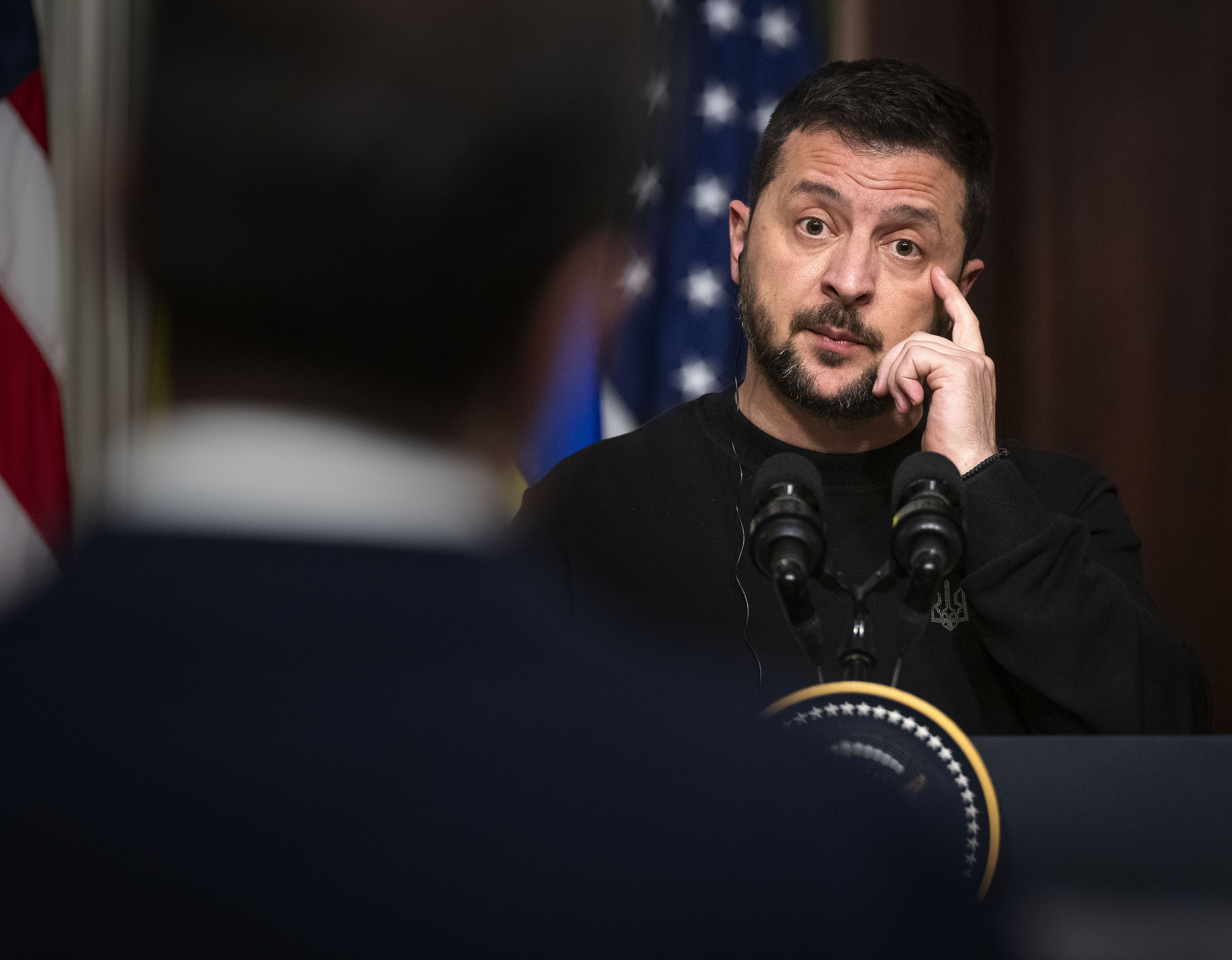
Zelensky fielded questions from Ukrainian and international reporters for two hours – in front of a large screen that alternated between images of a map of Ukraine, Ukraine’s blue and yellow flag, and the circular, starred symbol of the European Union. Last week, Brussels delivered a morale boost by agreeing to open formal membership talks with Kyiv – a goal Ukrainians had striven for since the Maidan Revolution in 2013-14.
Zelensky on Tuesday batted back questions over the failure of Ukraine’s counteroffensive to oust Moscow’s invading troops, and he waved off reports of divisions among the country’s political and military leadership.
Asked if Ukraine had begun to lose the war against Russia, he responded flatly: “No.”
Zelensky said Ukraine was preparing its own proposals for a peaceful resolution to the war, which it would deliver to Russia. But he said Kyiv would not waver from its insistence that Russia withdraw all of its forces.
“The strategy cannot be changed, according to our Constitution – these are all our territories,” he said.
Over the past week, Putin had staked out his own not-give-an-inch position. The Russian leader claimed at a news conference on Thursday that if Ukraine and the West refuse to surrender to Moscow’s demands, he would employ all available means to impose his will.
Appearing at a meeting with Putin on Tuesday, Russian Defense Minister Sergei Shoigu said Russia’s military would have 1.5 million troops by next year. “Today, the Russian army is the best-trained and most combat-ready in the world,” Shoigu said.
Putin at the meeting said he was ready to negotiate with Ukraine but “based on our national interests.” He added: “We will not give up what is ours.”
Zelensky seemed to recognize that conscripting an additional half-million soldiers would be difficult to sell to a war-weary Ukrainian public. He said he was still considering the military’s request, as it was a question of additional finances, defense capability and “of people,” he said.
“This is a very serious number,” Zelensky said. “I said I would need more arguments to support this move.”
Kyiv’s situation seems increasingly difficult, however, with crucially needed military and economic aid stalled in Washington and Brussels, and with frequent reports of shortages in military personnel and weapons. Ukrainian cities are still under constant bombardment by Russian missiles and explosive drones, and Moscow’s troops are pushing to advance at several points along the front line in the east and south.
While the European Union agreed to open membership talks, Hungarian Prime Minister Viktor Orban blocked a proposed $55 billion aid package. A proposal by President Biden, for roughly $60 billion in aid, has been blocked for months by Republicans in Congress, who are demanding sweeping changes in border security and immigration policy in exchange for approving the funds.
At his news conference, Zelensky expressed confidence that the U.S. aid would be approved in the near future. “We’re working very hard on this. I’m sure that the U.S.A. won’t betray us,” he said.
Zelensky visited Washington this month in hopes of breaking the logjam but returned to Kyiv empty-handed. He also visited other capitals, including Buenos Aires and Oslo, in a bid to drum up – or sustain – support.
In recent days, Zelensky and his government have also grappled with rising domestic political tensions. On Monday, Ukrainian authorities said that listening devices had been found in the offices of the country’s top commanding general, Valery Zaluzhny. The Ukrainian security service, the SBU, said it had opened an investigation but did not say if it believed Russia was responsible for the devices.
On Tuesday, Zelensky rejected reports of strained relations with Zaluzhny, who, in an interview with the Economist, said the war with Russia had reached a “stalemate.” Zelensky initially criticized the general for those remarks, but he later conceded the lack of movement in the war.
“We have a working relationship,” Zelensky said at the news conference, referring to Zaluzhny. “He has to be responsible for the result on the battlefield.”
Meanwhile, reports from the front indicate that Ukrainian forces are running low on crucial ammunition, leading them to curtail some operations. Zelensky admitted that there was a deficit in ammunition, along with a lack of air cover, on Ukraine’s southern front, but that this had not affected operations in 2023.
“We don’t control the sky, we don’t have enough shells,” Zelensky said. “But that doesn’t mean that we won’t find a way out, or that we haven’t already found a solution.”
Though Ukrainian industry would face difficulties producing shells to fill the deficit, Zelensky said that the country would “make 1 million drones” – though he did not provide details.
Self-destructing unmanned aerial vehicles have become a major element in the war between Ukraine and Russia, with both sides sending dozens against their opponent’s troops and infrastructure in just the past week.
Hours after Zelensky’s news conference ended, sirens in Kyiv announced an air raid alert due to incoming explosive drones.