
Biden warns of ‘sinister forces’ trying to reverse racial progress
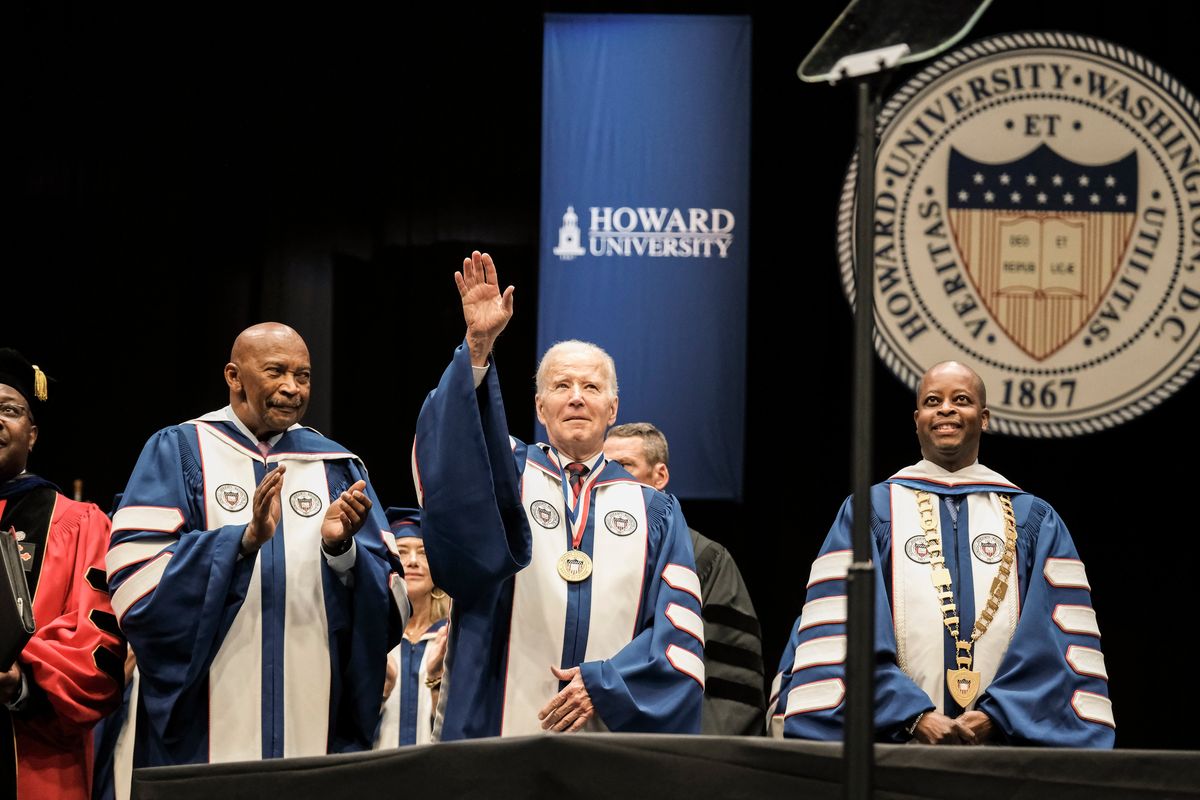
WASHINGTON – President Joe Biden declared on Saturday that white supremacy is “the most dangerous terrorist threat to our homeland” and warned a predominantly Black audience that “sinister forces” embraced by his predecessor and putative challenger are trying to reverse generations of racial progress in America.
Biden never named former President Donald Trump in his sometimes stark commencement address to the graduating class of Howard University, the nation’s most prestigious historically Black college. He alluded, however, to Trump’s past statements to link him to racist elements in American society and suggest that the presidential campaign that has just started will determine whether justice will prevail over hate, fear and violence.
“There are those who demonize and pit people against one another,” Biden said. “And there are those who will do anything and everything, no matter how desperate or immoral, to hold onto power. That’s never going to be an easy battle. But I know this – the oldest, most sinister forces may believe they’ll determine America’s future. But they are wrong. We will determine America’s future. You will determine America’s future.”
Wearing blue and white academic robes, the president sought to enlist the young graduates in what he presented as the cause of this moment. He cited the killing of George Floyd by a police officer in 2020, which touched off widespread protests against police brutality, and expressed empathy with Black drivers who are fearful when they are pulled over by officers.
“Fearless progress toward justice often meets ferocious pushback from the oldest and most sinister of forces,” he said. “That’s because hate never goes away. I thought when I graduated that we could defeat hate. But it never goes away.”
Likewise, Biden said that “after the election and re-election of the first Black American president, I had hoped the fear and violence and hate was significantly losing ground.”
He discovered otherwise, he said, when neo-Nazis and white supremacists clashed with counterprotesters in Charlottesville, Virginia, in August 2017, and he recounted Trump’s reaction. “What did you hear?” he asked. “That famous quote: ‘There are very fine people on both sides.’ That’s when I knew, and I’m not joking, that’s when I knew I had to stay engaged and get back into public life.”
Trump’s supporters have said his line has been distorted and note that he did at one point condemn neo-Nazis. But as he has opened a campaign to recapture the presidency, Trump has more openly embraced racist and extremist elements in American life. Last winter, he hosted for dinner the rap artist Ye, who has made antisemitic statements, and Nick Fuentes, a prominent white supremacist who attended the far-right Charlottesville rally.
The choice of Howard offered Biden an opportunity to shore up support in the most loyal constituency in the Democratic Party, one that he needs to win re-election next year. While polls show continued strong support for Biden among Black voters, political analysts and party strategists have expressed concern about an enthusiasm gap that could complicate prospects for the president, who needs high turnout from his base.
Biden has been stymied on goals such as cracking down on police brutality and bolstering voting rights. He did sign an executive order on federal law enforcement last year, although crucial pieces of the order have not been implemented. Many supporters say he has fallen short on his pledge to make systemic changes to the criminal justice system.
But he chose Kamala Harris (a Howard graduate) as the first Black vice president; appointed the first Black woman to the Supreme Court, Justice Ketanji Brown Jackson; and has put more Black women on the federal bench than every other president combined. Unemployment among Black Americans fell to a record low of 4.7% in April, and the gap between white and Black jobless rates shrank to its smallest ever measured.
Of particular interest to his audience on Saturday, Biden has developed a program to forgive $400 billion in student loans over the next few decades, wiping out up to $20,000 apiece for those who qualify.
But the Supreme Court appears poised to invalidate it.
Biden won 92% of Black voters in 2020, but only 58% said they approved of his performance in the latest Associated Press-NORC Center for Public Affairs Research poll. A May survey by the Economist and YouGov put his approval among Black adults at 71%, but only 46% wanted him to run again.
Biden found a friendly but not exactly exuberant crowd on Saturday. Graduating seniors and their families filled much of Capital One Arena, the home of the Washington Capitals and Wizards, and greeted him warmly, although a dozen stood in protest, some holding signs about issues such as military research. The ambivalence among students and graduates was evident in interviews on campus before the ceremony.
“He’s a pretty good person,” Mariah Davis, 19, a mechanical engineering major, said of Biden. “He’s just really trying to advocate for a lot of groups of people who are unheard.”
But some students said they were not sure they could connect with him.
“We feel a little strange about him coming to commencement because obviously he can teach us things about values, but what is he going to say that hasn’t been said before?” said Alisa Drake, 19, a sophomore. “What can Biden say to us as Black students going out into the workforce?”
If the choice next year was between Biden and a Republican, she said she would vote for Biden. But she was lukewarm about it.
“I’m not really excited,” she said. “I feel like there hasn’t been a candidate recently that has just caught my eye, that is just like, ‘Wow, they’re really about something and interested in helping my generation.’ ”
This article originally appeared in The New York Times.