
Ryne Sandberg’s legendary example for this Cubs team: ‘He never took shortcuts’
MILWAUKEE – Chicago Cubs players and staffers wore blue T-shirts with white letters and two numbers highlighted in red: FO23ver. Each gray jersey hanging in the lockers was adorned with a commemorative sleeve patch. The video boards listed Tuesday’s pregame schedule, which included a moment of silence.
The night before, in American Family Field’s visiting clubhouse, Cubs manager Craig Counsell gathered the team and broke the news that Ryne Sandberg had died. Some found out during Monday’s 8-4 loss to the Brewers. The group was already aware of Sandberg’s cancer diagnosis and his recently declining health. The atmosphere in the room felt heavy.
That somber, respectful tone did not disappear. Roughly 18 hours later, as players and pitchers went through their pregame routines, the Sandberg reminders were impossible to miss. The clubhouse TVs showed MLB Network, which ran highlights from “The Sandberg Game” in 1984 and a screenshot of a message from former President Barack Obama.
“Hall of Famer and Cubs stalwart Ryne Sandberg wasn’t just a great baseball player – he was a class act who never cheated the game,” Obama posted on X. “Everyone in Chicago – including White Sox fans – will miss him deeply.”
As well as anyone, Sandberg understood that the game never stops. It fueled the second baseman’s relentless attention to detail, which turned him into a nine-time Gold Glove winner. That constant drive turned him into a new prototype for a power-hitting middle infielder. When he retired on two separate occasions as a Cubs player – and resigned as the manager of the Philadelphia Phillies in the middle of the 2015 season – “The Show” continued.
But for the rest of this season, the Cubs will be carrying a different kind of emotional weight.
“It’s sad because it hits home a little more,” Counsell said, sitting in the visiting dugout before Tuesday’s 9-3 loss to the Brewers. “But in the other way, we want to honor Ryno the best we can, and shine a spotlight on a great life lived, and for all the great things that he represented as a man and a Chicago Cub.”
Music first connected Sandberg and Bob Dernier.
Years before legendary WGN broadcaster Harry Caray coined the “Daily Double” nickname for the top of Chicago’s lineup, they rode the buses together in the minor leagues. With an old-school Walkman that featured plug-ins for two sets of headphones, the two Phillies prospects listened to one album after another, mostly classic rock and some country music, to help pass the time.
Sandberg could be introverted. Even when he conquered the highest level of baseball, he did not enjoy talking about himself. He didn’t have to say much.
The image is seared into the minds of generations of Cubs fans and memorialized with a bronze statue outside Wrigley Field. The flip sunglasses, the pullover V-neck jersey, the blue Nike cleats and the defensive crouch at second base created an aura.
Like a world-famous musician, he became identifiable by one word: Ryno.
“He was so consistent,” Dernier said. “That was his real trademark. Just ungodly consistent.”
That regimented routine grew out of Sandberg’s relationship with Larry Bowa, the Phillies shortstop who was traded to the Cubs for Iván de Jesús in January 1982.
Dallas Green, the ex-Phillies manager hired by Tribune Co. to run Chicago’s front office, demanded that Sandberg be included in the deal, which would change the course of franchise history.
Bowa suggested to Sandberg that they report to spring training early that year, so they could work on turning the double play and build more chemistry. In time, Bowa would come to think of Sandberg as a younger brother.
The repetition in the Arizona sunshine became part of Sandberg’s rhythm, as well as the eventual thesis for his Cooperstown induction speech, which emphasized the importance of playing the game the right way.
Those words echo louder after Sandberg’s death at 65. It still resonates far beyond the world of baseball, with big themes of discipline, morality and modesty.
“He never took shortcuts,” Bowa said. “He had to do this, this and this before he felt he was ready to play a game of baseball.
“And he felt like he was cheating if he couldn’t get on the field to take groundballs.”
Decades later, that sense of precision would consume Sandberg’s abbreviated run as Philadelphia’s manager.
Between 2013 and 2015, the club went 119-159 under his guidance. His obsession with being ready for every pitch – and a somewhat guarded nature – did not mesh well with a Phillies organization in transition.
“I just wish things could have turned out a little bit better when he managed here,” said Bowa, a senior advisor for the Phillies. “He had a baseball IQ that was off the charts. I think he was getting frustrated. He wanted to do some things because that team wasn’t really good. He wanted to get some young guys up here and let them play. It never happened.
“When he quit, we had just won two out of three in New York. We were riding back on the bus, and he was happy. The next day, when I found out, he said, ‘I can’t do this anymore.’ Because he was such a perfectionist.”
Before a game at Wrigley Field last year, Sandberg walked by the batting cage and noticed Cubs outfielder Ian Happ working on his swing, trying to get through an early-season slump. In many ways, Sandberg was old school. He hammered the fundamentals as a player and preached those concepts as a manager in the minor leagues. But he talked about his career from a place of empathy.
Rather than bragging about his accomplishments, Sandberg pointed out his own struggles as a form of encouragement. He notched one hit in his first nine games as a Cub in 1982, a span of 34 plate appearances. He pulled Happ aside for a quick pep talk.
“I was really grinding,” Happ said. “He told me his career numbers in April, and that he always came out of it.”
Sandberg knew all the dimensions of Wrigley Field, the taxing nature of extra day games and the unpredictable winds off Lake Michigan. April was, by far, his worst month (.660 OPS) in a career that cannot be fully measured by numbers.
“It’s just cool to have somebody who played forever and went through moments to take the time,” Happ said. “And to be paying that much attention, to be watching that closely, to know how much weight his words carry. I know I’ll miss him a ton.”
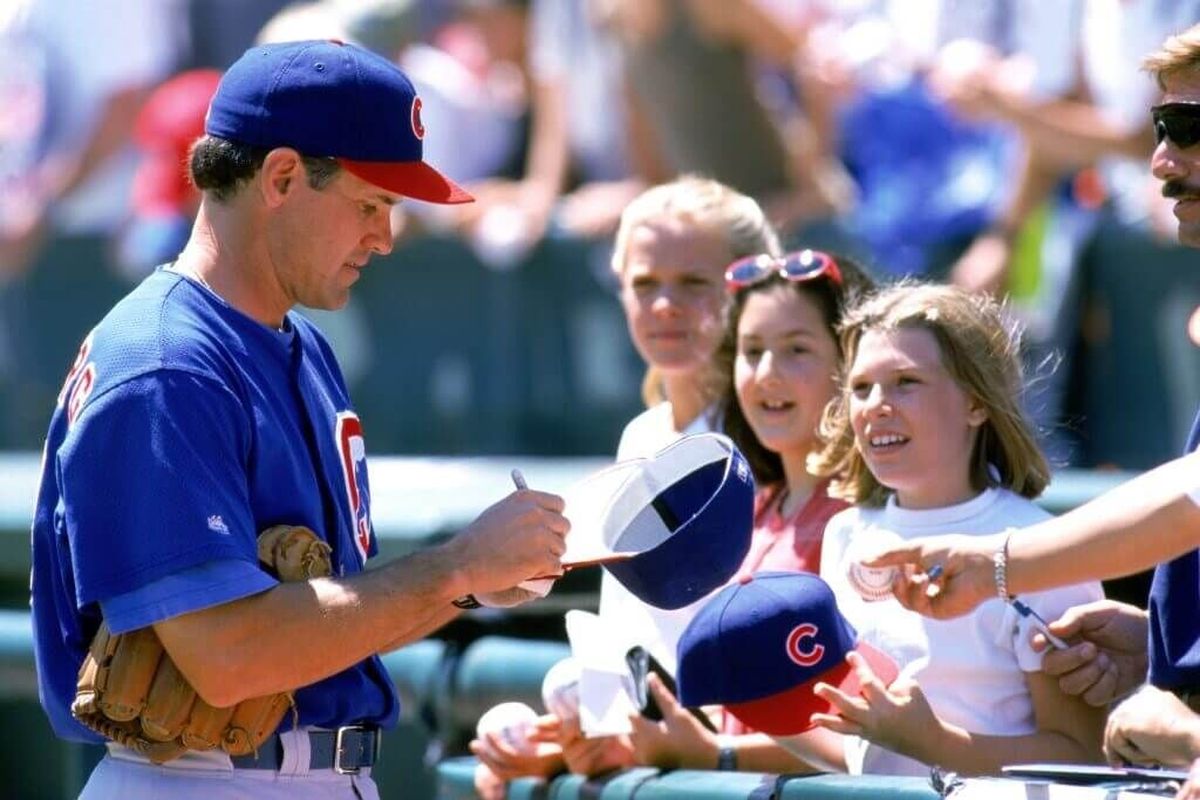
The little things matter. Sandberg was not the loudest or most outgoing person, but he understood that a small, simple gesture could make someone’s day and create a priceless memory. For fans, he signed autographs and posed for photos with an uncommon graciousness.
Instead of prattling on about how things were back in the day, Sandberg tried to stay current, recognizing the game’s degree of difficulty. He was so humble that talking about golf could sometimes be an easier way for a player to break the ice. He enjoyed hanging around the guys, but only in a way that would not be considered obtrusive.
Even as a young player who debuted with the Cubs in 2015 and earned a 2016 World Series ring, Phillies slugger Kyle Schwarber felt that presence.
“He was always respectful,” Schwarber said. “It just felt like it wasn’t needed, right? You’re Ryne Sandberg.”
Upon arriving in Arizona for spring training this year, Sandberg asked Counsell if he could address the coaching staff. Sandberg knew his audience, which included special instructor Rick Sutcliffe, the Cy Young Award-winning pitcher from that rollicking 1984 season, which was also Sandberg’s National League MVP campaign.
“The only reason I’m here is to save you guys,” Sutcliffe recalled Sandberg telling the coaches.
Sandberg’s deliberate delivery contrasted with Sutcliffe’s big personality, which was again on display during Tuesday’s appearance on ESPN 1000’s “Waddle & Silvy” show.
“I know that at one point ‘Sut’ has cornered every one of you and started wearing you out talking about how great he used to be,” Sutcliffe recalled Sandberg saying to the entire coaching staff, relaying the rest of the story. “If he gets you again, just say ‘Barracuda!’ And I’ll come bail you out. I’ll take him off of you. I’ll get him off your hands
.”
Counsell thought the code word might have been “Bobcat.” In any event, Sandberg looked energized while roaming the fields at the Sloan Park complex. He also approved of the organization’s renewed emphasis on base running.
“He was very supportive,” Counsell said. “And he kept Sutcliffe away from pitchers.”
One of those major-league coaches, Jonathan Mota, grew up in Venezuela before playing for Sandberg at Class-A Peoria, Double-A Tennessee and Triple-A Iowa. At Chicago’s minor-league affiliates, Mota recalled, Sandberg had two rules: Be here on time and play hard.
Mota, who works closely with Chicago’s infielders, can still feel Sandberg’s influence in his messaging and daily habits. Whenever a Gold Glove defender such as Dansby Swanson or Nico Hoerner comes out early for extra practice, everything should already be set up and organized. Sandberg may have been reserved off the field, but in between the lines, he always took charge.
“That really stuck with me,” Mota said. “His big thing was: ‘When I played, I could not live with myself if I wasn’t ready for one pitch of however many it took. Because with that one pitch, we could have lost the game. And I wasn’t going to go to bed knowing I could have done something better.’ ”
By late Tuesday night, the Cubs were moving on from an uncharacteristically sloppy loss that featured three errors. The defeat dropped them to two games behind the Brewers in the division race, dampening the storyline of how this team exhibits Ryno-esque qualities.
Shawon Dunston made that comparison on MLB Network, saying how so many current Cubs carry themselves with a quiet intensity, the kind of stoicism that Sandberg appreciated. By name, Dunston mentioned Hoerner, Swanson, Happ, Matt Shaw, Michael Busch and Kyle Tucker as examples of that consistent, no-frills approach.
Between Milwaukee’s surge into first place and Thursday’s trade deadline, the Cubs are at one of those pivotal moments that could ultimately define their season. The resiliency and simplicity that defined Sandberg’s career are timeless. Be on time for the fastball. Pay attention on the bases. Catch the ball and throw it to your teammate at a chest-high level. Act like you’ve been there before.
“I hope that he’s really enjoyed watching this team,” Counsell said. “He was a quiet man, but he somehow lit up a room.”