
Seeing red? Spokane County uses dye to test flow of wastewater into Spokane River
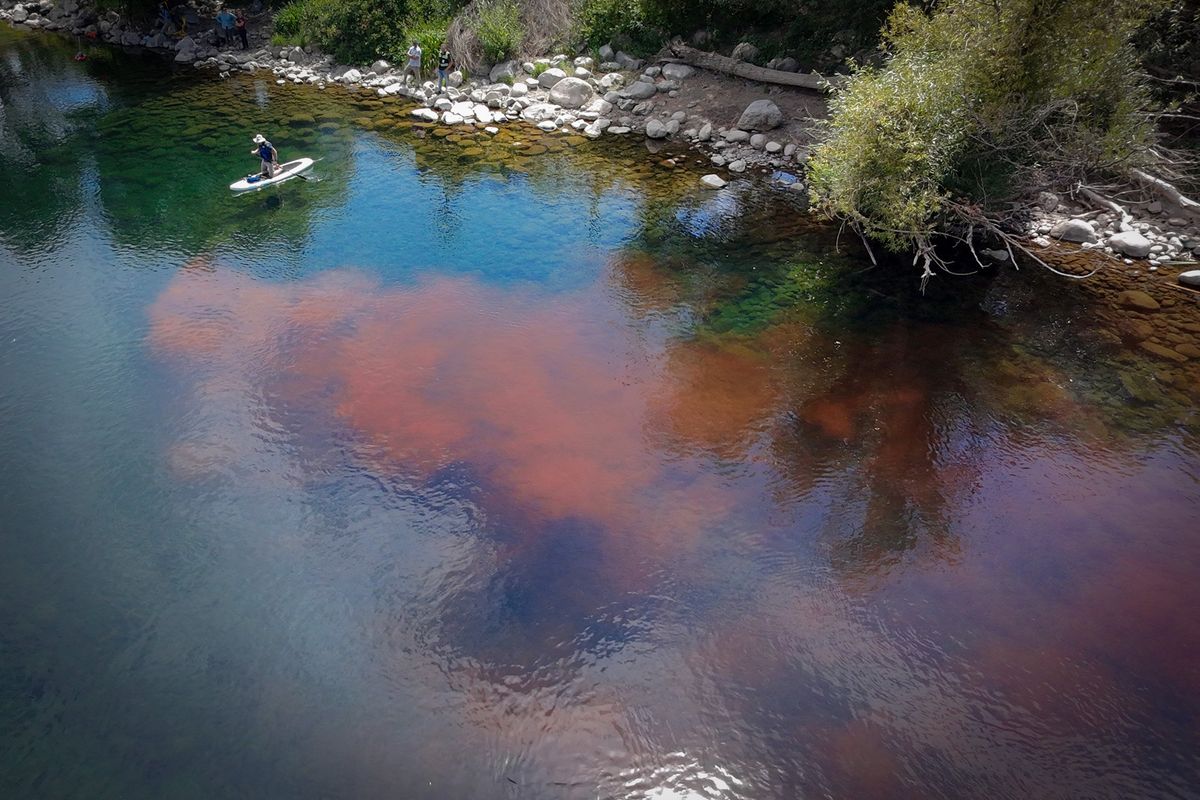
Plumes of red flowing through the Spokane River on Tuesday weren’t remnants of an incident at a hot sauce manufacturing plant or an unfortunate plunge into the water by the Kool-Aid man, but rather a tool for research.
From 11 a.m. to 3 p.m., water specialists from HDR Inc., an engineering firm hired by the county, conducted a dye tracer test in the Spokane River to analyze how clean water from the Spokane County Regional Water Reclamation Facility mixes with the river.
A nontoxic fluorescent dye known as Rhodamine WT was first added to treated wastewater at the sewage plant. It traveled about three-quarters of a mile down a gravity sewer into the Spokane River just east of Spokane Community College, emerging from the depths like underwater smoke.
The large stones beneath the clear water were slowly submerged by the dark dye at the mixing zone. As it trickled down the river, the dye slowly dissipated. Spokane County Water Reclamation Engineer Hannah Thomascall said after a few hours it would be diluted enough to be unnoticeable.
Researchers used a boat to access different locations and depths along the river, collecting samples and measuring other river qualities to better understand how the dye enters and spreads within the river.
This data will allow county officials to determine whether their treated wastewater discharge meets water quality standards in mixing zones, which are in place to protect aquatic life and minimize pollutants.
“This is a benefit to the community,” Thomascall said. “We’re trying to make sure that we’re not causing any harm and make sure that if there are any problems, we’re addressing them.”
This test is a required part of the state’s issued National Pollutant Discharge Elimination System Permit, which ensures that discharged water from facilities abides by the Clean Water Act.
While the test occurred, about a dozen people gathered at the opposite bank along East Upriver Drive to watch.
Most of the onlookers were public works employees eager to get a glimpse of what was a “quite rare” study, Thomascall said.
Greg Bem, librarian at the nearby Spokane Community College, decided to trek to the viewpoint to watch the dye test. He’d never seen anything like it in the river before.
“I spend a lot of time on this river and in this section of the river because I work right across street, so it’s interesting to think about my relationship to the river and also think about how the river can teach us so many different things,” Bem said. “It makes me wonder, what else are humans in the area doing to the river environmentally just to make the city run? What is the river doing for us?”