
What’s the buzz with native bees? Washington’s Bee Atlas fixes to find out
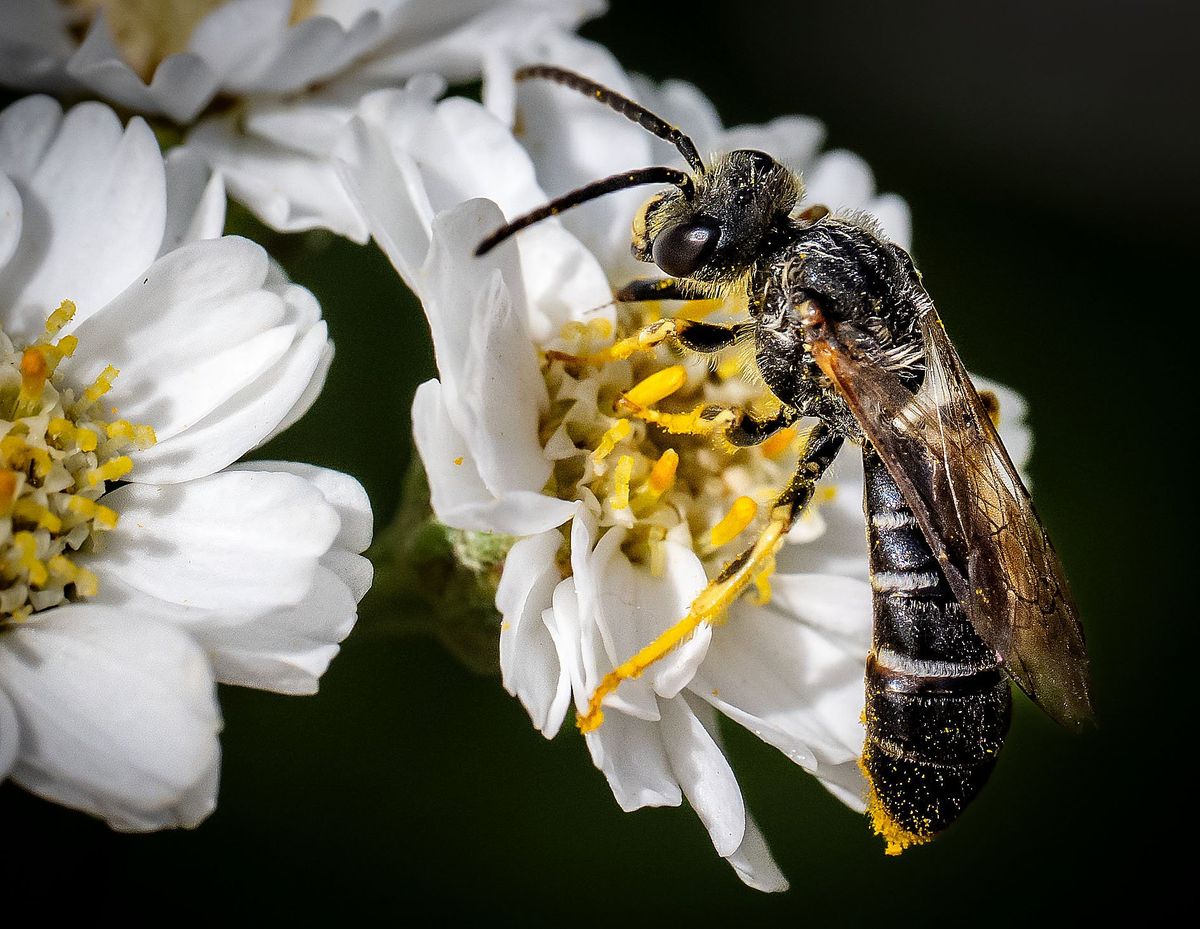
Last winter, more than 60% of commercial honeybee colonies in the United States died. It was the largest recorded loss in American history.
“It was kind of a failure of control all at once,” Katie Buckley, who works with pollinators for the Washington State Department of Agriculture, said.
The issues afflicting honeybees are the heart of an ongoing effort to better understand Washington’s native bees better.
It’s called the Washington Bee Atlas, which kicked off with legislative funding in 2023. It aims to create a public, online repository of native bees that have been collected in the state.
Director of the atlas, Karen Wright, said that U.S. farmers have long relied on the European honeybee for crop pollination because it is a domesticated and easily manipulated species. However, nearly 600 documented species of bee inhabit Washington state and little is known about many of them.
“What would happen if honeybees disappeared from the landscape?” Wright said.
The crash this year was due to a combination of disease and mite infestations within hives. The parasitic mites developed a resistance to a popular pesticide at the same time that colonies were grappling with novel diseases. Exacerbating the problem were the nationwide get-togethers of beekeepers for pollination events, inadvertently creating vibrant breeding grounds for cross-colony contamination.
“This was a single, fairly catastrophic event that we’ll be able to recover from without too many issues now that we know what the problem is,” Buckley said, adding that growers can usually rely on having honeybees each year. “But that’s not always the case, clearly.”
The last mass die-off event, which killed around 40% of commercial colonies, was in 2008. Losses of this scale spell disaster for agriculturalists, who rely on bees to pollinate their crops. Almonds, for example, “100% rely on being pollinated by bees,” Buckley said.
So creating a database, Wright said, will allow state naturalists to assess which native bees are in need of conservation.
“The knowledge in Washington state of the native bees that do a lot of our crop pollination, as well as all of our wildflowers – we have such little knowledge of where they live, what they pollinate, where they nest, what time of year are they out. So we just really don’t know the basics of the natural history of most of our native bees.”
The Department of Agriculture plans to develop seed mixes based on the collection information that will promote native bees, though Wright said that the data being public is the real draw.
But before the project can offer this comprehensive look into the world of native bees, the insects have to be collected.
Wright works with Oregon State University to train volunteers across the state in proper bee-catching and documenting technique. After going out and catching bees on their own, volunteers send samples back to Wright for species -level identification, and then Wright sends the bees to Washington State University for long-term storage.
Around 17,000 bees were collected for the project in 2024. Fifteen species had never been collected in the state before, and at least one bee was caught in Yakima that hasn’t been documented in the state since 1917. Wright makes up the entire identifications team, albeit with some help from other Washington bee experts.
With rare species, though, sometimes there isn’t information on how to fully determine what they are.
“It’s important to preserve all of these so that later on, maybe somebody will do the taxonomic work and then we can figure out what they are,” WSU’s Entomology Museum curator Joel Gardner said. “And then, we have a bunch of new records in Washington state once they figure out what they are.”
While Washington’s bee diversity can’t compare to the roughly thousand species in each of Utah and Colorado, it is greater than most of the Eastern U.S., Gardner said. Bees – which are largely solitary creatures – follow the somewhat unusual trend of being more diverse in desert environments.
“They’ll dig a burrow in the ground, like an anthill, and they’ll collect a bunch of pollen. They need to store all this pollen all underground and lay an egg on this pollen and then the larvae will feed on it,” Gardner said. “So they need to keep this pollen preserved underground, and if you’re in the tropics, it’s too wet.”
Other solitary bees will nest in hollow plant stems or wood. Honeybees, Gardner said, are a bit of an anomaly .
“Honeybees are the only bees in the U.S. that make honey. They’re the only bees that have perennial colonies,” he said. “And they’re the only ones that die when they sting.”
Wright said that bees’ aptitude for arid environments leads her to anticipate greater bee diversity in Eastern Washington. Currently, there are around 50 volunteers in the region.
“Spokane County is one of our counties that we would love to have more volunteers in,” Wright said. “Because anything east of the mountains is really sparsely covered by our volunteers with so much land to cover.”