
Jenkins set to retire after modernizing Pullman Police Department, rebuilding culture at WSU Police Department

Glenn Johnson knew immediately Gary Jenkins was the right man to lead the Pullman Police Department.
The longtime former Pullman mayor said Jenkins’ leadership skills, education background and thoughtful answers during his interview for the police chief job made the 33-year veteran of the Claremont Police Department in California stand out among other candidates.
“You could spot right away this is a person that you want to have, and he never let us down,” Johnson said.
Even Jenkins’ ex-wife spoke highly of him when Johnson called and spoke to her as part of Jenkins’ background check.
“She just bragged about him,” Johnson said. “I’m going, like, OK, well, if he can pass that, I think he’s good.”
Jenkins took the reins of Pullman police in 2010 and guided the department with professionalism and integrity for the next 12 years, modernizing the department with body cameras and a drone fleet, according to officials. He briefly retired in 2022 before Washington State University tapped him to lead its police department, which had lost three of its top police officials who failed to advise university officials of an officer’s sexual misconduct.
Jenkins, 69, is officially retiring from the WSU Police Department on Aug. 29 after 15 years of service to the Pullman and WSU communities and over 50 years in law enforcement. Dawn Daniels, who has been with the department for 27 years, was sworn in Friday as the new university police chief.
Jenkins started his law enforcement career in 1974 as a police cadet with the West Covina Police Department, about 18 miles east of Los Angeles. He served three years before moving 15 miles east on Interstate 10 to Claremont. He worked his way up to the rank of captain over three decades with that department.
With his children grown and out of the house, Jenkins said he and his wife wanted to move to the Pacific Northwest, so he looked for police chief positions in the region and found a new life in Pullman.
Pullman police
Some of Jenkins’ proudest accomplishments as Pullman’s chief are implementing body cameras for officers, starting a drone program and hiring more officers, including increasing female officers from one to five.
He said the agency also started a Ph.D. research fellowship program with WSU for which an incoming doctoral student in the school’s criminal justice program conducts three years of research for the police department.
Jenkins said Pullman police was one of the early adopters of body cameras in the region, putting them on officers’ uniforms in 2013. He said the cameras helped officers write more accurate reports and provided attorneys with clear evidence.
“I thought it would provide transparency with the public and also it would just be beneficial for officers and for the criminal justice system as a whole,” Jenkins said.
Jenkins said Pullman police was also one of the first agencies in the state to start using drones to look for suspects and missing people.
He said he hopes the new technology he implemented helped him leave the department in a better place than when he found it.
“I hope I’m remembered for ensuring that we maintained those best practices and provided high quality public safety services to the community,” Jenkins said.
Pullman police Chief Aaron Breshears, who’s worked for the agency for 26 years and was appointed chief in April, said Jenkins modernized the department and was a “driving force” behind implementing body cameras.
“One of the really great things that he did is he pushed our department forward from a technology aspect, specifically with body-worn cameras,” Breshears said.
Breshears described Jenkins as generous with a unique sense of humor.
“One of his defining characteristics is he has a fabulous poker face,” Breshears said. “You can walk in and talk to him and tell him something and not know what he’s thinking about at that moment and time.”
He said Jenkins provided feedback on the conversation later.
“Gary Jenkins was a person that we relied upon,” Breshears said. “He set a good moral compass for the department. We had some tribulations during his tenure and he made it pretty clear that we would be a transparent and accountable police department to our community.”
His consistency will be missed most.
“Very metered and moderated and consistent,” Breshears said. “There were not going to be excessive emotional highs or lows. It was just going to be very consistent and by the book.”
Johnson, who served 20 years as mayor before leaving office at the end of 2023, said Jenkins supported community policing, where working with residents to improve safety and build trust is prioritized over strict enforcement.
He said Jenkins led by example and didn’t make a decision without having all his facts together.
“He can look you in the eye and he can tell if you’re straight with him or not,” Johnson said.
Jenkins had great ethical standards, too, according to Johnson.
“It’s just great to see that kind of moral leadership in a police department,” he said.
WSU police
Jenkins retired from the Pullman Police Department in July 2022. Then, WSU approached him to see if he would be interested in becoming its police department’s chief after three police officials – Chief Bill Gardner, Assistant Chief Steve Hansen and Capt. Mike Larsen – resigned following a disciplinary investigation that revealed they had failed to advise university officials an officer had sex in the presidential suite of Martin Stadium while on duty.
Investigators determined Sgt. Matt Kuhrt engaged in predatory grooming behavior while in a supervisory role, made sexual comments to coworkers, engaged in sexual activity while on duty and subjected co-workers to nonconsensual physical contact, according to WSU. Kuhrt later resigned .
The investigation also found that police’s command staff fostered an environment that discouraged reporting incidents of sexual misconduct.
Jenkins accepted the chief position in August 2022 and was tasked with improving the department’s culture and rebuilding the agency’s trust in the community.
He said he was honored the university offered him the job and knew it would be a challenge, but facing challenges was one of the reasons he joined law enforcement, he said.
“I knew they were in a tight spot, and I was in a perfect position to help them out, at least as far as the timing goes,” Jenkins said. “I didn’t want to leave them hanging. It would have been somewhat of a tough road for them to come up with another plan in a short amount of time. It wasn’t necessarily that I felt an obligation, but I felt like I really wanted to help them.”
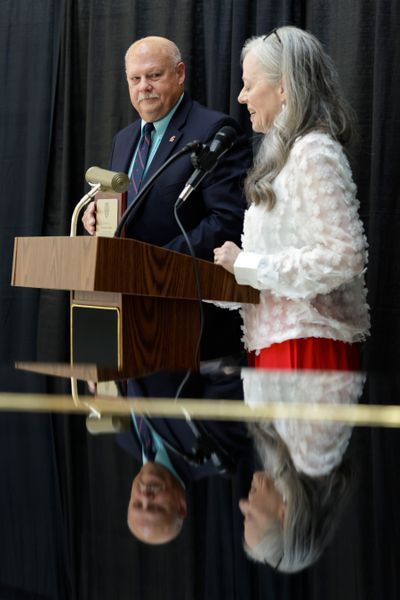
Leslie Brunelli, WSU executive vice president for finance and administration, recognized Jenkins with a plaque for his “exemplary service” to WSU during Friday’s swearing-in ceremony of Daniels. Jenkins received multiple loud rounds of applause from those in attendance.
Brunelli said Jenkins stepped into the WSU Police Department during a time of “critical need” and brought with him a “calm, steady and principled leadership.”
“After a long and distinguished career marked by professionalism, integrity and a steadfast commitment to public service, he retired in July 2022,” she said. “Obviously for us, that didn’t stick, and in an extraordinary act of dedication and service, he came out of retirement just weeks later to lead the WSU Police Department at a time of need.”
Jenkins said he had one-on-one conversations with each staff member when he took over the department and learned everyone wanted to see change and move forward in a positive direction.
Johnson said he would have hired Jenkins at WSU if he was president.
“You have this gold mine in town, you better use him,” Johnson said. “And if anyone can instill integrity and get things back to the way it should be, Gary’s the guy, and that certainly happened.”
Jenkins worked with WSU police, which has 19 sworn officers, during his time with the city police department and developed positive relationships with several university officials, he said. Daniels, the assistant chief at the time, helped him immensely when he took the job.
So, he was able to hit the ground running, working to improve transparency and communication within the department and university and with the public.
Jenkins said he and Daniels have been on the same page changing the culture of the department.
“I think where we are now is in an extremely good place,” he said. “I think we have a really good culture. We’re moving in a good direction. There’s more work to do, and I’m really confident that Dawn Daniels will continue to lead the department in the right direction and accomplish more things.”
Daniels thanked Jenkins for his leadership, guidance and the strong foundation he helped build at the department during her short speech Friday.
After the ceremony, Daniels held back tears talking about Jenkins with reporters.
“Gary’s awesome,” she said. “He came in when we were having a difficult time in our department, created that stability and that dependability that we needed within our agency.”
Jenkins said he and his department secured several grants, a skill Johnson credited to Jenkins, during his three-year tenure that focused on security enhancements and officer wellness.
A $3 million grant paid for more security cameras and door-access controls on campus, he said.
Another grant is funding automated license plate recognition cameras at entrances to the university. The cameras can be used in several circumstances, including identifying stolen cars as the cameras will interact with the agency’s stolen vehicle license plate system. If a person who is trespassed from campus drives onto university grounds, the cameras will pick up that person’s license plate number and alert police, Jenkins said.
Jenkins estimated the license plate cameras will be installed sometime this fall.
He said the department now has a workout room with cardio equipment, weights, stationary bicycles and treadmills thanks to grant funding. The department used grant funds to remodel an unused storage room at the police facility and then it put the workout equipment in there, Jenkins said. A couple cardio machines are also in the department’s vehicle bay area.
Another grant will fund work station treadmills, so staff can walk on a treadmill while they work at their desk.
Jenkins has been helping Daniels and Assistant Chief Harry Smith transition to their new roles since Aug. 8, when Daniels and Smith started their new positions.
“For the past three years, Chief Jenkins has provided steady leadership, strength and operational readiness and reinforced a culture of trust, accountability and engagement across our university community,” Brunelli said. “His decision to return to service during our time of significant challenge is a testament to his great character, unwavering sense of duty and deep commitment to public service.”
Kohberger
Jenkins interviewed Bryan Kohberger, the man sentenced last month to life in prison for fatally stabbing four University of Idaho students in November 2022, for an internship with Pullman police months before Kohberger murdered the four students.
Kohberger was a WSU criminal justice graduate student and applied for the Ph.D. research program established during Jenkins’ tenure with Pullman police.
Jenkins said he was looking to a hire a student who was interested in doing “actual research,” not just theoretical research, and someone who was able to establish trust and rapport with Jenkins’ staff. The hired student would be embedded in the police department, and those qualities would be important to be effective, he said.
Kohberger was one of four interviewees for the internship.
“He wasn’t very personable,” Jenkins said. “He didn’t really have a fluid way of talking. He just seemed a little awkward, and I didn’t feel like he would be able to establish that rapport and trust with my staff.”
Jenkins said he didn’t recognize any “red flags” with Kohberger during the roughly 30-minute Zoom interview.
A WSU police officer pulled over Kohberger in his white Hyundai Elantra, which was seen speeding away from the murder scene, about one month before the killings for an alleged traffic violation.
A couple weeks after the killings and about one week before the Moscow Police Department asked the public for help in locating a white 2011-13 Elantra, the department released the vehicle description to local law enforcement agencies, Jenkins said.
Within 12 hours of learning of the description, Jenkins said one of his WSU police officers found Kohberger’s Elantra outside a WSU apartment rented by Kohberger, who police did not seek as a suspect at that time.
Because the Elantra was a 2015 model, not the 2011-13 for which Moscow police were searching, the officer did not submit that information to the Moscow police tip line, Jenkins said.
About one week before Christmas 2022, Jenkins said he got a text message from James Fry, Moscow police chief at the time, asking him to meet him at the Moscow station.
Jenkins said Fry walked him into a room at the police station where the investigative team was. Investigators told him they identified Kohberger as the suspect through DNA at the crime scene.
Jenkins recognized that name and let investigators know he interviewed Kohberger earlier that year for the internship.
“The name rung a bell with me because it’s not a common name, and I knew I had heard it before, and it just took me a minute to remember why that name was familiar to me,” Jenkins said.
He said WSU students and their parents were extremely concerned before Kohberger was identified and arrested.
After he was taken into custody, people who had contact with him at campus were greatly affected. Jenkins said his department offered a mental health professional to the university’s Department of Criminal Justice and Criminology to help its staff cope.
Last month’s sentencing is a big step in helping the community heal, Jenkins said.
“That is probably the most horrific crime that I’ve been involved in in my entire career,” he said.
Jenkins said Moscow and Pullman, as well as both universities, showed they’re resiliency.
“That’s what I hope will be, besides honoring the victims and their families … that’s what I hope will be remembered, is how resilient our communities are,” Jenkins said.
When Jenkins leaves WSU police at the end of the month, he and his wife of 18 years, Malinda, will stay in the Northwest. Pullman is home for now, but they may migrate somewhere else in the region, he said.
Jenkins said he plans to visit his children and grandchildren more often. Most of them are in Southern California.
He will also spend more time woodworking, a hobby he picked up several years ago. He built a woodworking shop in his garage. Johnson called Jenkins a “craftsman” for his tremendous wood projects.
Jenkins said he will miss the challenges that come with the job and the officers and staff he worked alongside.
“I’ve found the vast majority of the people I work with are very dedicated people that really want to do a good job for the communities they work in, and that’s a really good environment to be part of,” Jenkins said, “so that’s what I’ll miss.”