
Lookout improvement: Forest Service making progress on popular Little Guard Lookout
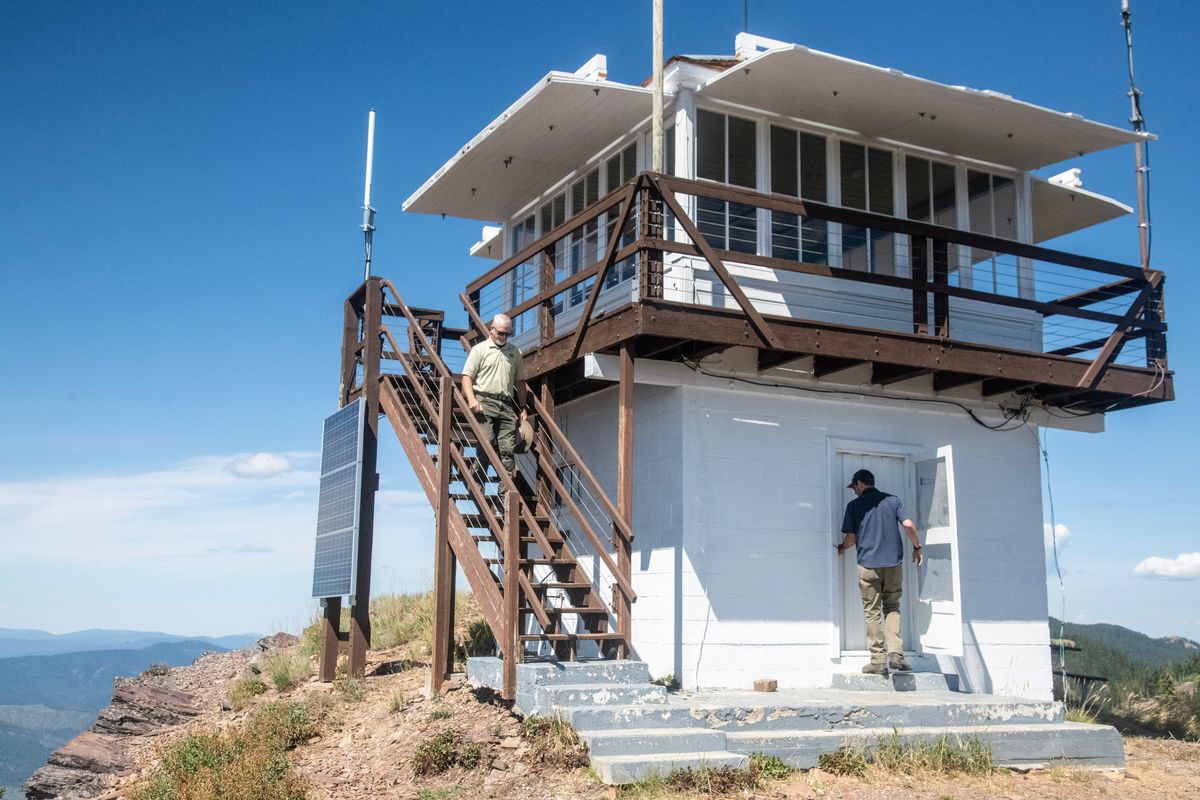
PRICHARD, Idaho – The roof on the Little Guard Lookout leaked. The windows wouldn’t open. The outriggers, which hold up the heavy wooden shutters all summer, were splintering.
Paint, siding, flooring – as you’d expect of an aging building on a 6,031 foot peak in North Idaho, the list could go on.
Rich Mastrisciano, a recreation facilities technician for the U.S. Forest Service, could enumerate every major and minor problem with the nearly 70-year-old tower, the major and the minor.
Instead, while sitting in the back seat on a drive to the tower earlier this month, Matrisciano chose brevity.
“There were things there that needed to be attended to,” he said.
The list shortened significantly in July, after Matrisciano and the Forest Service’s regional historic preservation team had a two-week work marathon.
Working through weather that yo-yoed between lovely and blustery, they rebuilt the outriggers, putting in fresh two-by-fours that are up to the job of keeping the shutters open. They removed all the windows and doors and put in a temporary set, which will stay in place until the spring.
Using custom-built scaffolding that fit perfectly on the tower’s deck, they tore off the leaky roof and put down a fresh layer of 16-inch cedar shingles.
A few weeks later, the shingles glowed in the sunlight when Jed Friedman, the Forest Service’s local recreation staff officer and Matrisciano’s boss, made the final right turn on their trip to the tower.
“Look at that shiny roof,” Friedman said.
The work, funded by the Idaho Panhandle National Forest’s Resource Advisory Council, brings the popular lookout closer to reopening to renters next summer after a two-year hiatus.
By hewing closely to the original plans for the tower, it also preserves a relic of the Forest Service’s past, giving visitors a chance to see what fire spotters saw when they spent summers there scanning for smoke.
“It’s part of our heritage and our history,” said Gary Weber, treasurer of the Forest Fire Lookouts Association. “Once you let it go, it’s gone and you never get it back.
Following the Big Burn of 1910, government officials started stationing lookouts on peaks all over the country, hoping to locate wildfires and stamp them out as quickly as possible. Idaho alone had more than 1,000 lookouts.
“Most named peaks here locally would have had a lookout on them,” said Friedman, who is based at the Coeur d’Alene River Ranger District.
Satellites and other technological improvements diminished the lookout’s role in firefighting over time, and the ranks dwindled. Hundreds are still in service today, but many more were left empty in the past several decades, with some burned down or torn down.
Dozens of lookouts that remain have found a new life as coveted rentals, like Little Guard.
The tower, which was staffed into the 1990s, stands at the southern end of Shoshone Ridge, one ridge west of the Idaho-Montana border. It was the first tower to be listed on the National Historic Lookout Register.
The first building there was a simple frame cabin, built in 1919. Ten years later, that cabin was replaced with a new one that had a cupola. That cabin lasted until the current tower was built in 1957.
It’s what’s known as an L-4 – a standardized design the federal government used starting in the 1930s. The main room is a 14-foot-by-14-foot square surrounded by a deck and capped by a four-sided, gabled roof. Big windows line each wall, with corresponding shutters outside that protect them in the winter.
At Little Guard, the cabin is on a square, 10-foot-tall cinder block foundation that doubles as the kitchen and extra sleeping space. Upstairs there’s a wood stove, a desk and a twin bed. A fire finder sits at the center of the room.
Restoration work has been done periodically. Friedman said the Forest Service identified the most recent needs in 2021. He arrived at the Idaho Panhandle National Forest in 2022 and started searching for money to fund the work. The forest’s Resource Advisory Committee approved $65,000 for the project in 2023.
Work began last year with some painting, which exposed more problems with the tower and wound up keeping it closed for longer than expected. Friedman said there were pencil drawn circles on the ceiling, showing where all the leaks were. A garbage bag was protecting the wood stove from the unwanted water.
Other projects required help from the agency’s regional historic preservation office, a two-person team based in Missoula that works on buildings that are either listed or are eligible for the National Register of Historic Places. Friedman got Little Guard onto their calendar for this summer, setting up the work frenzy that Matrisciano helped with just after the Fourth of July.
Matrisciano camped up there for a few days during those two weeks, and said the hardest part of the work was “sleeping on the ground.”
Matching historical standards made for a bit of a learning curve. Matrisciano said that was mostly about using the right materials. That’s why the roof is made of cedar, not metal, and why they had to return the first batch of shingles they’d purchased – they were 24 inches long instead of the 16-inchers the original design called for.
Temporary windows and doors are still in place. The originals are in the historic preservation shop in Missoula. This winter, Matrisciano plans to drive to over to rebuild them. In the spring, he’ll bring them back and get them put up.
His attention will then turn to the rest of the hit list. A fresh coat of paint is needed inside the cabin, and the hardwood floor needs attention.
There’s always more to do.