
Monument honors resilient Spokane family forced into WWII internment camp
He was only about 5, but Harold Kawaguchi remembers when U.S. soldiers came to their Seattle farm, tossed him and his family into the back of an army truck and temporarily relocated them to a horse stall at the Puyallup Fairgrounds.
His most vivid memory of the ordeal was when the soldiers drove through the family’s gardens where the vegetation had just started to sprout, Kawaguchi said, fighting back tears.
The Kawaguchis were among thousands of Japanese Americans forcibly removed from their homes and incarcerated in internment camps across the West following Japan’s Dec. 7, 1941, attack on Pearl Harbor, which thrust the U.S. into a world war.
The Kawaguchis, including Harold’s parents, Matsutaro and Hatsume, overcame adversity and eventually relocated to the Spokane area to farm at about the time the war ended. Part of Matsutaro Kawaguchi’s legacy is donating his meticulously cultivated bonsai to the Nishinomiya Tsutakawa Japanese Garden at Manito Park.
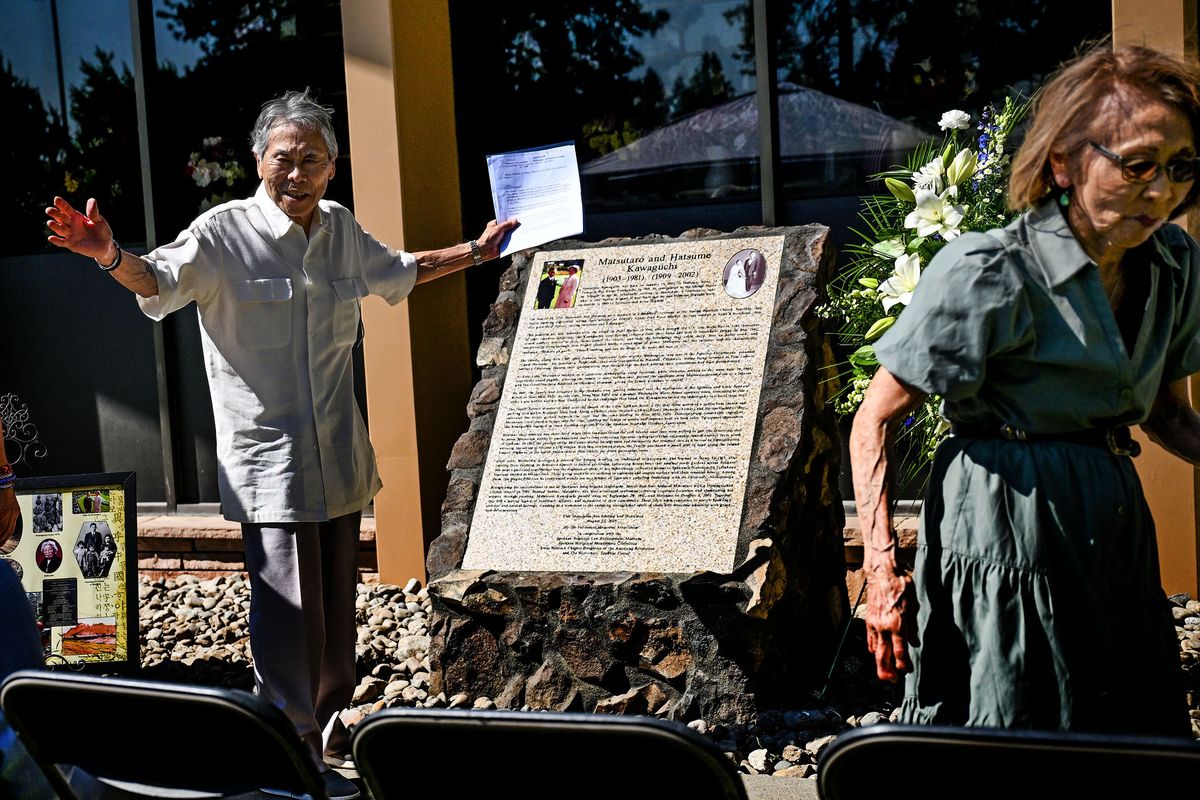
With dozens of Kawaguchi family members watching Friday, 86-year-old Harold Kawaguchi and his older sister, Ellen, pulled a blue blanket to reveal a basalt rock and granite monument honoring Matsutaro and Hatsume Kawaguchi at Fairmount Memorial Park in Spokane.
The monument tells the life story of the couple – who Fairmount Memorial Association Chief Operations Officer Sandra Walker described as courageous, resilient and gritty – on the monument’s granite tablet.
“Rather than being bitter and broken, their optimism and hope led them to light that served our community in so many ways,” Walker said.
Matsutaro Kawaguchi was born in Japan and immigrated by himself at 16 years old to the U.S., settling in Sunnydale in Western Washington, according to the monument. There, he met Hatsume Higashi, who was born in Seattle.
The couple wed in 1932 in the Emerald City, where they started farming vegetables and selling their produce at the popular Pike Place Market in Seattle. They had two sons, Harold and Arthur, and a daughter, Ellen.
Arthur Kawaguchi, the middle child, died last year, his brother said.
The family was uprooted in May 1942 and sent to Puyallup, which was renamed “Camp Harmony,” the monument reads.
Harold Kawaguchi, who now lives in Seattle, said they then were put on a train to Pinedale, California, for further processing before making their final stop at Tulelake, California, near the Oregon border.
While incarcerated, the family learned the barn where their possessions were stored was burned down, according to the monument.
At Tulelake, Harold Kawaguchi said barbed wire fencing surrounded the camp and guards stood watch at guard towers. Some guards occasionally fired rounds from their rifles into the ground to intimidate the prisoners.
The family’s barracks were built out of tar paper and plywood, he said.
Families at the camp each stayed in a room with cots. Harold Kawaguchi said they hung blankets in their room to provide privacy, especially for their parents. Bathrooms were in separate buildings.
Harold Kawaguchi said his father worked as a carpenter repairing buildings while his mother worked in the mess hall.
The camp was in a desert with some sagebrush providing the only greenery, he said. There was nothing to do there as children. Digging up the bullets fired from soldiers and trying to capture dragonflies were his hobbies.
In 1943, regulations loosened, and families who were able to move east beyond the “exclusion zone” could be released earlier, Harold Kawaguchi said. So, his father got a job with the Great Northern Railway in Glendive, Montana, where the family relocated.
By 1945, the family moved to Nine Mile Falls, where they leased farmland near the confluence of the Spokane and Little Spokane rivers, according to the monument. After the family’s landlord raised rent, the family decided to move again, leasing farmland south of Spokane.
Matsutaro Kawaguchi was unable to buy land because of laws restricting Japanese immigrants from citizenship, according to the monument. A 1952 federal act allowed Matsutaro Kawaguchi to become a U.S. citizen, and afterward, the family purchased land in Latah Valley, where they “finally put down permanent roots,” the monument reads.
Matsutaro Kawaguchi developed a passion for bonsai, and after retiring from farming in 1969, he cultivated bonsai trees. He donated many of the trees to the Japanese Garden in Manito Park.
“These living works of art continue to captivate and inspire visitors with their timeless beauty,” the monument reads.
Matsutaro Kawaguchi earned a “Distinguished Citizen Award” in 1981, the year he died, from Spokane Mayor Ron Bair for his bonsai contributions to one of Spokane’s most popular parks. Matsutaro Kawaguchi also created “exquisite furniture” and was a talented painter, according to the monument.
Harold Kawaguchi told the crowd, mostly comprised of his family and loved ones who came to Friday’s dedication from up and down the West Coast and Texas, that his father’s paintings were donated to the Smithsonian Museum as part of the internment camp collection.
He called his father’s bonsai artwork at Manito Park remarkable.
“He never strutted his stuff,” Harold Kawaguchi said. “He just did his work in a beautiful way and moved on to what was next in terms of contributing to the broader society.”
Rae Anna Victor, member of the Jonas Babcock Chapter of the Daughters of the American Revolution, told the crowd Matsutaro Kawaguchi’s love for bonsai was more than a hobby.
“It expressed the value of harmony, balance, patience and profound connection between humanity and the natural world,” she said. “His carefully tended trees stand as living metaphoric resilience and mindfulness. As we dedicate this monument, let us honor the spirit of Matsutaro and Hatsume Kawaguchi, remembering their strength, their grace and the lasting beauty they brought to this community.”
Hatsume Kawaguchi died in 2002.
“Together, they left a lasting legacy of resilience, artistry, and dedication to their community,” according to the monument. “Their life’s work continues to enrich Spokane’s cultural and natural heritage, standing as a testament to the enduring strength and spirit of those who overcome adversity with grace and determination.”
Harold Kawaguchi told the crowd his parents’ mission was “to live as good a life as possible” by raising a family, working hard and contributing to society.
Throughout each hardship the Kawaguchi couple faced, they refused to be victims, and they passed that lesson onto their children, Harold Kawaguchi said.
“Don’t let these negative events define who you are,” he said. “Live your life and do the best you can.”
The monument says Matsutaro Kawaguchi responded to the internment with the Japanese phrase, “Shikata ga nai,” which means, “There’s nothing you can do about it, so make the best of it.”
Harold Kawaguchi said his parents wanted their children to go to college and have a better life than they did.
“I feel good about the fact that I think we all accomplished that,” he said.
Harold Kawaguchi, a Lewis and Clark High School and University of Washington graduate, worked in the medical electronics field. His sister got her nursing degree from UW and practiced nursing in the Spokane area. Their brother graduated from Eastern Washington University and became a systems engineer.
Harold Kawaguchi said living a happy, successful life was the best way to repay his parents who experienced so much hardship.
Victor read a proclamation from Spokane Mayor Lisa Brown, who declared Friday “Matsutaro and Hatsume Kawaguchi Day.”
“The Kawaguchi family story stands as a powerful testament to the enduring strength of the Japanese American families and their immeasurable contributions to Spokane’s history,” the proclamation read.
The monument was a project of the Spokane Historical Monuments Committee, Spokane Regional Law Enforcement Museum, Daughters of the American Revolution and the Westerners – Spokane Corral.
Ty Brown, member of Spokane Historical Monuments Committee and a history teacher at West Valley High School, told The Spokesman-Review he wrote about the Kawaguchi family in his book, “Along the Little Spokane River.”
He thought the family had an interesting story and wanted to celebrate them in some way.
“It just never left my heart,” he told the crowd. “I had to do something about it.”
He said the family would be a good candidate to be recognized with a monument, so he researched and spoke with them .
“The meeting of the people and the family members as you go through the process and the research to me is the most rewarding,” Brown said.
He said the family is so humble.
“(Matsutaro Kawaguchi) just did his job and didn’t take a lot of praise for it, so we’re giving him praise now,” Brown said.