
The first Ladies of Gonzaga Prep: School celebrates 50 years since opening their doors to girls, upending “male bastion” all-boys tradition
In her first two years of high school, Madge Elmore felt liberated.
Attending the all-girls Catholic school Holy Names Academy in the 1970s, she spent her days surrounded by other girls and taught by nuns. There was no pressure to do her hair in the mornings or put on a face of makeup every day if she didn’t feel up to it; no one would look twice.
“It was just me being a part of the girls, and it was safe and it was wonderful,” she recalled in an interview Thursday. “It was free, and we could be as goofy as we wanted to. Nobody would think otherwise of it.”
Then, in her sophomore year, rumors started swirling that her beloved “girls club” was in a financial bind and considering closure.
By February, the Spokane school announced it would shutter at the end of the school year as costly facility repairs and dwindling enrollment forced the school’s hand after operating since 1891. It was a sudden reality check for Elmore and her 200-some peers, who were now unsure where they’d finish their high school years.
A month later, that answer came.
Gonzaga Preparatory School announced a seismic shift, going co-educational and breaking an 88-year tradition of enrolling only boys. Prep was the fourth all-boys school in the nation to open its doors to girls.
It was a rocky transition for many, the male students defensive of their brotherhood and girls trying to carve out space at the school for the first time.
“Prep wasn’t excited about opening the doors,” Elmore said.
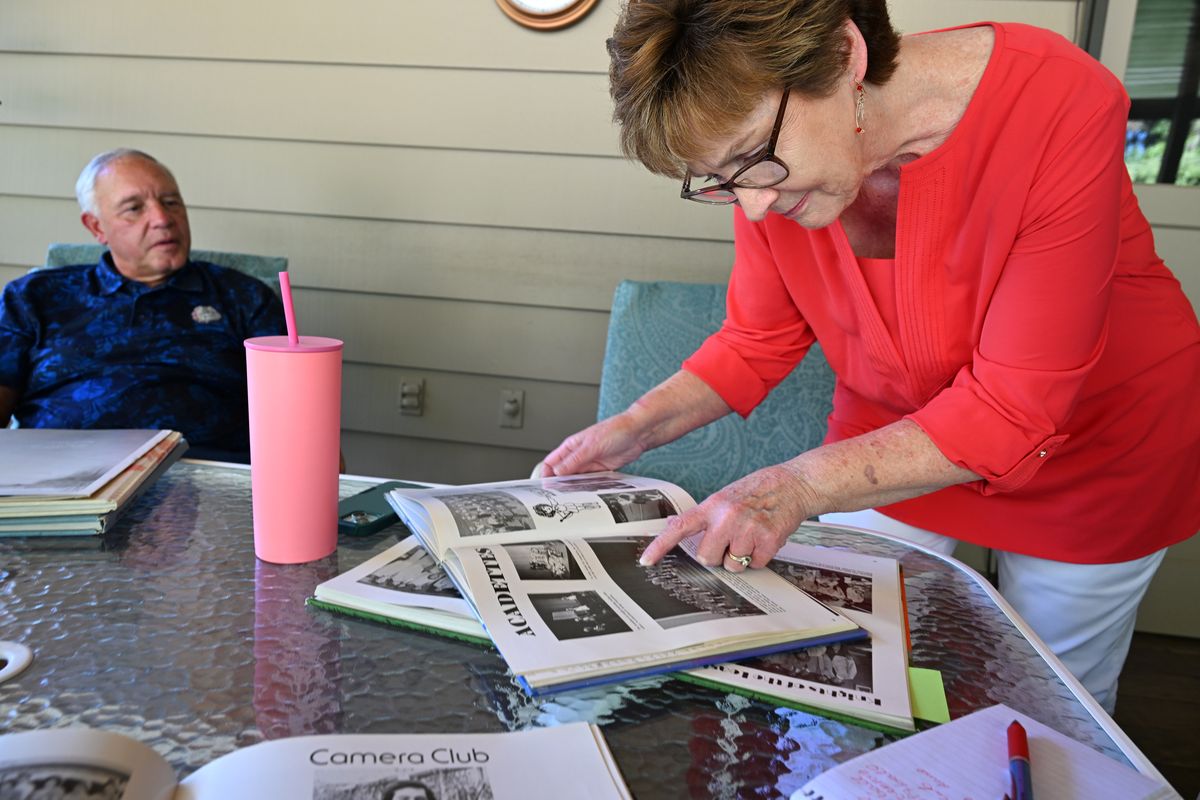
She was the first in line to register at Prep in 1975. And 50 years ago, she was the first girl enrolled and featured in The Spokesman-Review.
Attending Prep wasn’t much of a question; her four brothers cycled through the school and loved it. She knew she’d be in good company, joined by around 300 other girls and having some familiarity with their all-boys counterparts through church, mixers and sports games where Holy Names girls would cheer for Prep athletes.
Though outnumbered two to one by their male peers, Elmore said her fellow female classmates wasted no time laying claim to their new school.
“When we hit those floors, we were Prep,” she said.
The invaders
Described as an “invasion” by some leery about the change in tradition, the first day of school at Prep was jarring as an extra 300 students packed the halls, moving like a herd of cattle shoulder to shoulder.
“When that bell rang the very first day, it was chaos,” she said. “The halls seemed so small … you could not move. In those hallways, you were on top of each other.”
The school made some facility expansions for the impending enrollment boost, adding questionable girls locker rooms that weren’t updated until 2018 and converting some rooms to serve more female-associated curriculum like home economics and art, which weren’t previously offered at Prep.
Also installed were girls bathrooms, with stalls and toilets but missing one critical piece: a sink.
“Our main bathroom had a urinal as the place where we’d wash our hands,” Elmore laughed.
Also welcomed along with female students were 17 staff, including three nuns who taught. Learning from mostly “no-nonsense” nuns at Holy Names and among fellow girls, Elmore felt free of the ’70s-era gender dynamics that could have stifled classroom curiosity.
“I think many girls felt like they couldn’t be smart in front of guys,” she said. “So to be in a classroom with all girls, we excelled.”
That first year, two girls earned spots as valedictorians.
In co-educational classrooms, some boys felt the girls’ presence held them to a higher standard.
Michael McMahon, nicknamed “Bear,” was also a junior when Prep went co-ed. He recalled watching girls’ interesting presentations and asking questions of staff on topics he’d never considered.
“Once you saw their personalities in the classroom come out, I think that’s kind of when you realized, ‘Yeah, this is a person that I can be in a friendship with,’ and it just kind of clicks,” he said.
‘A brotherhood’
But it took some time before the boys began to warm up to the idea of girls in their space, where family legacy and tradition are held in high regard.
“I just kind of remember, I think the sense was that there’s going to be an invasion of these people of these species coming into our school and shouldn’t be allowed,” McMahon said. “I think a lot of people kind of had emotions or weren’t really too receptive because it’s new and uncharted waters.”
Newspaper archives from the time reflect mixed reactions from male students.
The boys enjoyed their fraternity, or “male bastion,” as one reporter put it at the time, “but apparently the boys are not sure they are against the pending female invasion.”
One student predicted the transition would be difficult for the female students, outnumbered and integrating themselves into the boys club. Another said, “The girls think they are not wanted, but all I have heard is people welcoming them.” One called the change “drastic,” hating to see the end to an 88-year tradition.
Another girl student from the time, Molly Schemmel, recalls it took at least half the year before students eased into their new normal.
“We had a lot in common; we just didn’t know at first,” she wrote.
McMahon said it was a few months before barriers began to fall and friendships stretched across genders, and the school began to change “for the better.”
One such tradition was a welcome breach for the students. A feared punishment for disobedient kids at Prep was getting “hacks” from a wooden paddle in the school hallway. Mark Elmore, Madge’s husband and fellow Prep alum who graduated in the last all-boys class, recalled a priest hitting him five times in the rear for playing a game with pennies that was considered gambling, he said.
“ ‘Hold your ankles, and if you jump, I gotta start over, so don’t jump,’ ” he remembers the priest telling him. “… I never did that again.”
It only took a couple of days in the first coed year before parents’ outcries against public hacking stopped the practice and punishment shifted to detention or picking up litter.
“To do something like that to a child or a teenager, I think the girls’ parents were just like, ‘Are you kidding me? Are you going to do that to my daughter?’ ” Madge said, adding she didn’t know of any girls who were hacked.
The “social stability” predicted by one teen manifested itself for the boys, McMahon said. He learned to compose himself around women, to be less brash, he said. He’s still close with many of his fellow Bullpups, men and women.
“That transition of meeting young women, tremendous young women in your life,” he said, “and how to relate to women, how to talk with them, develop great relations with them, too … So I look back on my years of Prep very, very fondly.”
A mission to serve
Madge Elmore holds a similar warmth for her two years at Prep. She wasn’t nervous to integrate into the boys’ space, raised in a large Catholic family with four older brothers and a sister.
Among her fondest memories there is the spiritual growth she fostered in theology classes, daily mass and frequent retreats at the school.
In classes, questions surrounding faith were encouraged, and she explored nuances she’d always wondered, like why not everyone goes to Heaven.
“The religion classes just offered a whole different perspective on the Catholic way of thinking about things,” she said. “I think my Catholic upbringing was very solid, but the Jesuits kind of opened up windows and allowed us to think outside of the box.”
Among the new clubs formed at Prep with the integration of the girls was Ancilla, a service-oriented club to mirror the boys’ Knights of the Leash.
The Jesuit mission dedicated to service resonated with students excited for Prep’s annual food drive and working together across gender lines.
That mission continues to drive Madge Elmore 50 years after she was the first girl enrolled at Prep.
She attended the University of Washington to study pediatric nursing, and has had a career working with children with cancer in hospitals and at summer camps. She’s recently taken a step back from work, undergoing cancer treatments of her own, and now lives in north Spokane across the street from her daughter and grandchildren and down the road from Evergreen Elementary, where she and Mark Elmore attended and he spent 44 years at as a teacher.
She, too, is still friends with many of her classmates from the time and looks with gratitude on her two years surrounded by female companionship and the two years paving her way at a freshly coed school.
“I think, had I not been there, Spokane would seem like a much bigger place,” she said. “It’s very small to me, because you can walk down the street and see somebody that you knew from high school.”