
Spokane River reaches potential water record lows after ‘perfect storm’ of conditions
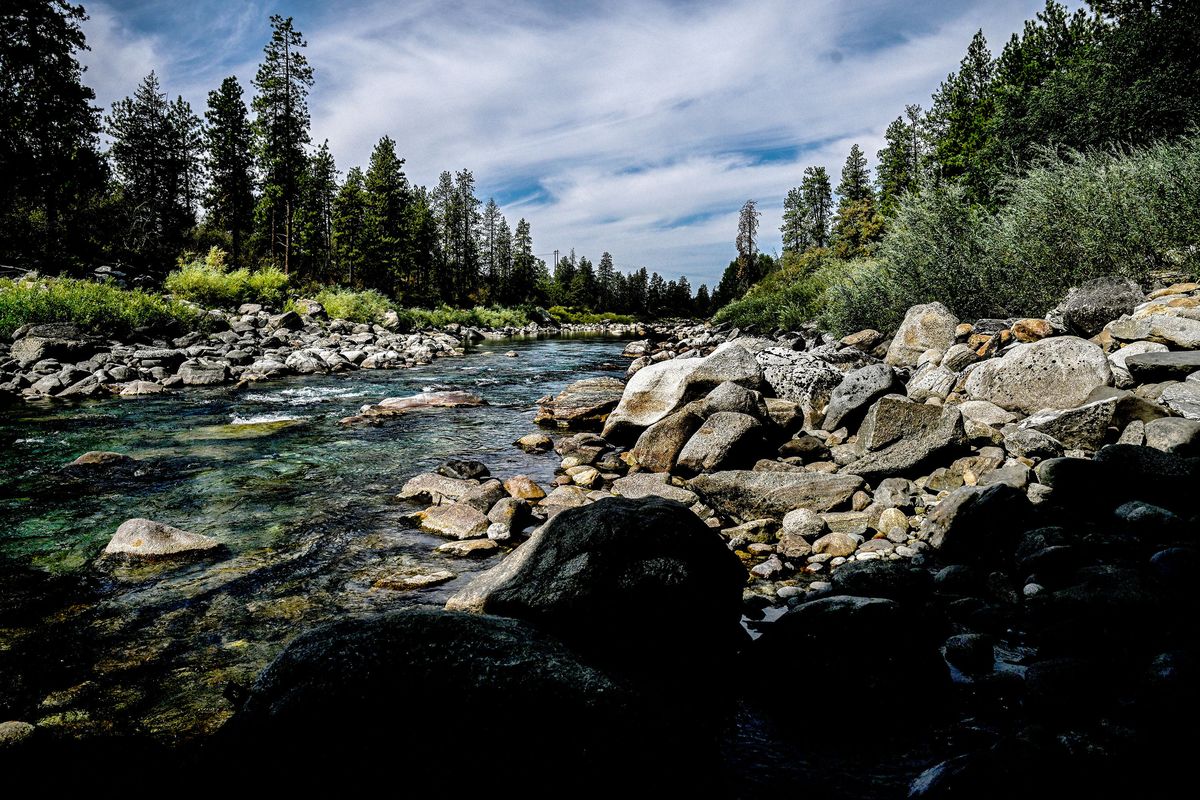
Katelyn Scott was walking along the Centennial Trail in Spokane Valley on Saturday morning when she noticed something odd. A blue heron, with a fish in its mouth, was stalking a shallow, rocky pond for more fish.
But the buffet-style puddle in which the heron was fishing is not a pond. It’s typically a vast, flowing river with a strong current that trout use to mask themselves from predators such as ospreys and herons.
Scott, the Water Protector for the Spokane Riverkeeper, said she floated down that same part of the river between Barker and Sullivan roads in a 10-foot raft back in June.
“There’s absolutely no way I could get my raft down that section right now,” Scott said. “I couldn’t even get a kayak or a paddle board, or a rubber duck in some sections.”
Because of a multitude of factors, the Spokane River is at one of the lowest, if not the lowest, water level it’s been. Scott said there are places along the river where you can walk from one side to the other without touching any water.
While Scott believes this is the river’s lowest depth in history, Patrick Maher, a senior hydro operations engineer for Avista, said it’s hard to tell what the record worst is. According to Maher, 2015 may have been drier.
Located about 9 miles downriver from Lake Coeur d’Alene is the Post Falls Dam, which plugs the river and regulates lake levels. During summer months, the normal minimum flow for the dam is 600 cubic feet per second. But once the lake drops 3 inches, because there’s more water going out than going in, Avista is required to change the minimum flow to 500 cubic feet per second to comply with its Federal Energy Regulatory Commission license, Maher said.
In an effort to balance Lake Coeur d’Alene water levels for recreation purposes and water flow levels in the Spokane River, the minimum flow rate of 500 cubic feet per second cannot be changed until after Labor Day Weekend, per the licensing agreement. Until then, Maher said, Avista’s hands are tied.
While this is partially to blame for the drastically low water levels in the Spokane River, it’s not the sole culprit.
“It’s this perfect storm,” Scott said. “Avista shut their dam gates, which has happened before and not caused this. … And as that water comes down from Post Falls, two more things are happening: It’s evaporating because it’s super hot, and that water is being lost into the aquifer, because the aquifer level has dropped so low that the river is recharging the aquifer in that stretch. Because so much water is going into the aquifer, it’s not making it downstream at surface flows.”
Scott doesn’t know for certain, but said it’s likely, because of extended droughts and higher temperatures reducing the amount of snowpack, that the aquifer wasn’t charged enough for this year.
Far and away, both Scott and Maher said human use is causing the Spokane River to be as dry as it is.
But not wanting to severely restrict a resident’s water use too much while simultaneously ensuring that the aquifer and river are protected is a careful balancing act, Maher said. Regardless, as time goes on and the population continues to rise in Spokane and surrounding areas, more people will be watering their lawn and using water sourced from the aquifer.
Scott said all the water downstream of Sullivan Road in Spokane Valley until Latah Creek is completely fed by the aquifer. Most years, there is an existing surface flow to bolster the water from the aquifer, but not this year. Mix in high temperatures leading to evaporation and little to no rainfall, and the pieces of the “perfect storm” Scott described begin to fall into place.
Water-use rates in Spokane and Kootenai counties, according to Scott, are high compared with nationwide rates.
While the Water Wise program Spokane implemented has reduced some of that use, Scott said the region as a whole still needs to reduce use.
“I should be clear when I say ‘people,’ ” Scott said. “I don’t just mean households. This applies to commercial businesses. It applies to the city. It applies to the county. Everybody that is misusing water needs to really check their use and make sure that we’re only using what we need when we need it.”
The instream flow rule is a water right for the Spokane River that says the river is permitted to legally exist at 850 cubic feet per second and cannot go under that allotted amount. However, this state law, enacted in 2015, does have some caveats. Any “senior” water rights that existed before 2015, which Scott said is basically all of them, supersede the instream flow law.
Water purveyors like the city of Spokane and all the water districts elsewhere in the county are not required by law to pump less water to maintain the river’s flow of 850 cubic feet per second. Scott said the instream flow rate for the Spokane River near downtown was at 717 cubic feet per second when she checked it Monday morning. That rate is both below the average natural flow and below the legal limit for the river.
There are numerous parties affected by the low level of the Spokane River, including the average person looking for a relaxing day along the riverbank. But it’s fish, Scott said, that will bear the brunt of this phenomenon.
With less water to swim through and tuck themselves away from potential predators, fish will lose access to large swaths of habitat, which in turn can affect numerous other wildlife that depend on them. And lower water levels means warmer water, which means there’s less dissolved oxygen available for fish.
“I’m not sure that we’re going to see much change this year, but by taking action to conserve water at home and really put in to practice some outdoor watering measures that consider the river and consider our water levels so that next year, we’re not necessarily facing the same issue, that’s one thing that we can do,” Scott said.
“Another big thing that we can do is talk to your elected officials. You can let the city council, let the county commissioners know that this is an issue that you’re concerned about, that you care about, and let them know that it’s something that they should address.”
Editor’s note: This story was changed on Aug. 26, 2025, to make it clear that water purveyors created before 2015 like water districts within Spokane County and the city of Spokane are not required by law to lower water usage in an attempt to increase the river’s flow to 850 cubic feet per second.